 Add to Chrome
 Add to Firefox
 Add to Edge
Exploring Plan Space through Conversation: An Agentic Framework for LLM-Mediated Explanations in Planning
Mar 02, 2026
When automating plan generation for a real-world sequential decision problem, the goal is often not to replace the human planner, but to facilitate an iterative reasoning and elicitation process, where the human's role is to guide the AI planner according to their preferences and expertise. In this context, explanations that respond to users' questions are crucial to improve their understanding of potential solutions and increase their trust in the system. To enable natural interaction with such a system, we present a multi-agent Large Language Model (LLM) architecture that is agnostic to the explanation framework and enables user- and context-dependent interactive explanations. We also describe an instantiation of this framework for goal-conflict explanations, which we use to conduct a user study comparing the LLM-powered interaction with a baseline template-based explanation interface.

Iterative Planning with Plan-Space Explanations: A Tool and User Study
Nov 19, 2020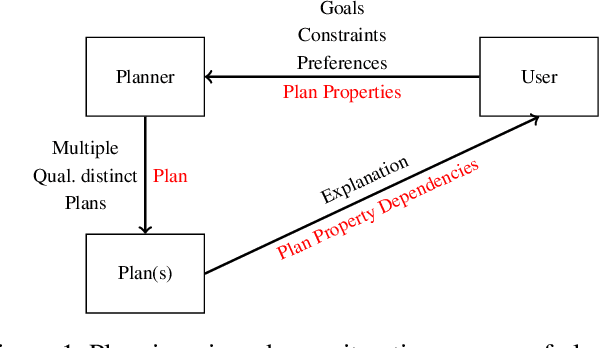
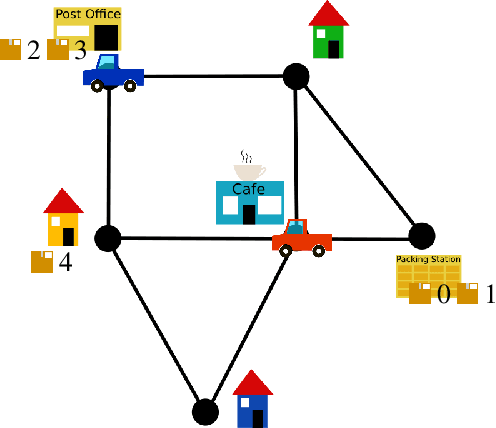
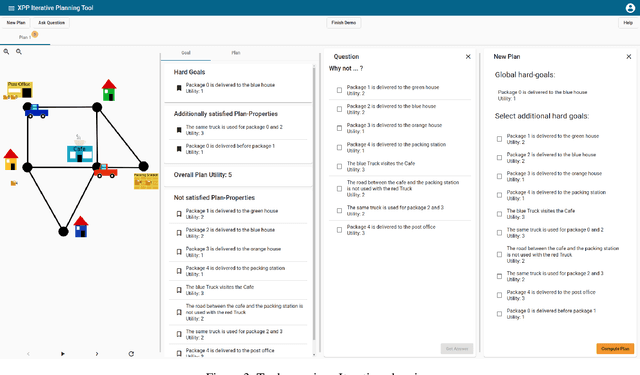
In a variety of application settings, the user preference for a planning task - the precise optimization objective - is difficult to elicit. One possible remedy is planning as an iterative process, allowing the user to iteratively refine and modify example plans. A key step to support such a process are explanations, answering user questions about the current plan. In particular, a relevant kind of question is "Why does the plan you suggest not satisfy $p$?", where p is a plan property desirable to the user. Note that such a question pertains to plan space, i.e., the set of possible alternative plans. Adopting the recent approach to answer such questions in terms of plan-property dependencies, here we implement a tool and user interface for human-guided iterative planning including plan-space explanations. The tool runs in standard Web browsers, and provides simple user interfaces for both developers and users. We conduct a first user study, whose outcome indicates the usefulness of plan-property dependency explanations in iterative planning.