 Add to Chrome
 Add to Firefox
 Add to Edge
OmniMech: All-in-one Multimodal Mechanical Benchmark for 3D Reconstruction
Aug 06, 2026
Recent vision-language models (VLMs) can generate executable CAD programs from images, but existing methods mainly target coarse, general-purpose 3D objects and rarely address the fine-grained geometry and millimeter-level tolerances required in industrial mechanical design. We introduce OmniMech, the first million-scale benchmark for evaluating VLMs on executable CAD generation from industrial manufacturing data. OmniMech contains more than 251,000 fully dimensioned and toleranced 2D orthographic drawings, paired with native CAD models, multi-view renderings, mesh, STEP and B-rep representations, and rich semantic annotations. The benchmark includes four tasks: (1) parametric CAD program synthesis from engineering drawings; (2) diagram-to-3D reasoning for geometrically and structurally consistent reconstruction; (3) annotation-grounded reasoning over dimensions, symbols, feature callouts, and manufacturing constraints; and (4) tool-augmented agentic reasoning using visualization, measurement, CAD execution, and verification tools. Experiments show that current VLMs and CAD-specialized models still struggle with executable program synthesis, fine-grained 3D reconstruction, and reliable enforcement of dimensions and tolerances. We will release the benchmark data, evaluation code, and tool interfaces to support future research.

OmniRouting: A Semantic-Coupled Multimodal Benchmark for Constraint-Aware Spatial Reasoning in PCB Routing
Aug 05, 2026Recent large language models (LLMs) have demonstrated remarkable progress in constraint-aware navigation, maze reasoning, and graph reasoning. However, their ability to reason about complex routing problems under strict geometric, topological, and electrical constraints remains largely unexplored, despite routing being one of the most challenging and critical stages of electronic design automation (EDA). To bridge this gap, we introduce OmniRouting, the first large-scale benchmark designed to evaluate LLMs on printed-circuit-board (PCB) routing reasoning under real-world industrial design-rule, manufacturability, and connectivity constraints. OmniRouting contains 1,681 industrial-grade schematic-coupled PCB designs, including board geometries, routable component placements by human engineers, footprints, pad locations, netlists, stackup information, and routing constraints. The benchmark comprises four tasks: (1) geometric routing reasoning, generating physically valid copper traces, vias, and layer assignments to connect circuit nets within constrained board regions; (2) design-rule-aware routing reasoning, producing routable layouts that satisfy clearance, trace-width, via, obstacle-avoidance, and board-boundary constraints; (3) electrical functionality reasoning, preserving schematic-specified connectivity while reasoning over net names and functional roles to produce electrically correct routing; and (4) tool-augmented agentic routing, leveraging external tools for tasks (1)-(3). Our results reveal substantial limitations of current LMMs in PCB routing, including weak path-planning capabilities, poor adherence to design-rule constraints, and inconsistent preservation of electrical functionality. We will open-source all benchmark data, evaluation code, and tool interfaces to facilitate future research.
OmniLayout: A Schematic-Coupled Multimodal Benchmark for Constraint-Aware Geometric Reasoning in PCB Layout
Jul 03, 2026Recent large language models (LLMs) have demonstrated remarkable progress in 3D spatial reasoning, spatial grounding, and fine-grained geometric understanding. However, their ability to reason about densely packed object placement under strict spatial and functional constraints remains largely unexplored, despite being a fundamental challenge in practical electronic design automation (EDA) workflows. To bridge this gap, we introduce OmniLayout, the first benchmark designed to evaluate LLMs on printed-circuit-board (PCB) layout placement reasoning under real-world geometric, routing, and connectivity constraints. OmniLayout contains 1,681 industrial-grade schematic-coupled PCB layouts and includes four tasks: (1) geometric reasoning for IC physical placement, with 77.24K placement instances constrained within PCB board boundaries; (2) routability-aware placement reasoning, generating physically valid component placements; (3) electrical functionality, preserving schematic-specified connectivity and electronic functional correctness; and (4) tool-augmented agentic reasoning for invoking external tools to accomplish tasks (1)-(3). Our results reveal substantial limitations of current LLMs in PCB layout placement, including weak geometric reasoning, poor routability optimization, and inconsistent preservation of electrical functionality.
Beyond Benchmarks of IUGC: Rethinking Requirements of Deep Learning Methods for Intrapartum Ultrasound Biometry from Fetal Ultrasound Videos
Feb 13, 2026A substantial proportion (45\%) of maternal deaths, neonatal deaths, and stillbirths occur during the intrapartum phase, with a particularly high burden in low- and middle-income countries. Intrapartum biometry plays a critical role in monitoring labor progression; however, the routine use of ultrasound in resource-limited settings is hindered by a shortage of trained sonographers. To address this challenge, the Intrapartum Ultrasound Grand Challenge (IUGC), co-hosted with MICCAI 2024, was launched. The IUGC introduces a clinically oriented multi-task automatic measurement framework that integrates standard plane classification, fetal head-pubic symphysis segmentation, and biometry, enabling algorithms to exploit complementary task information for more accurate estimation. Furthermore, the challenge releases the largest multi-center intrapartum ultrasound video dataset to date, comprising 774 videos (68,106 frames) collected from three hospitals, providing a robust foundation for model training and evaluation. In this study, we present a comprehensive overview of the challenge design, review the submissions from eight participating teams, and analyze their methods from five perspectives: preprocessing, data augmentation, learning strategy, model architecture, and post-processing. In addition, we perform a systematic analysis of the benchmark results to identify key bottlenecks, explore potential solutions, and highlight open challenges for future research. Although encouraging performance has been achieved, our findings indicate that the field remains at an early stage, and further in-depth investigation is required before large-scale clinical deployment. All benchmark solutions and the complete dataset have been publicly released to facilitate reproducible research and promote continued advances in automatic intrapartum ultrasound biometry.
De-Noising of Photoacoustic Microscopy Images by Deep Learning
Jan 12, 2022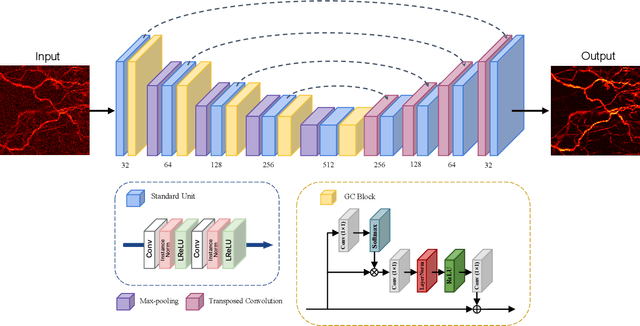
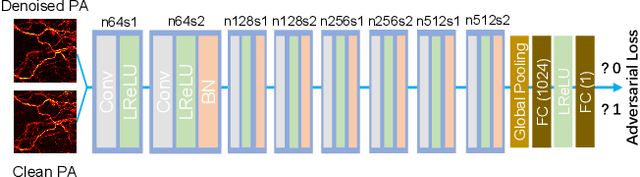
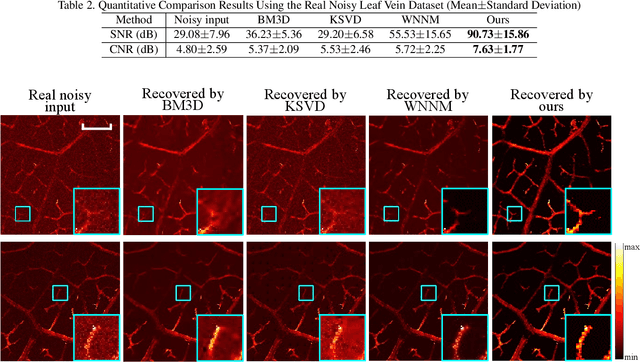
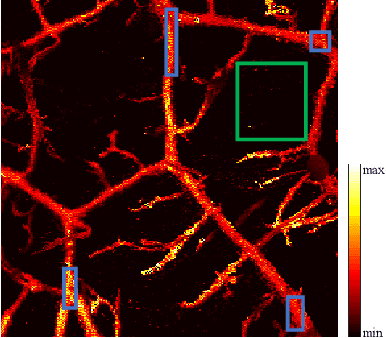
As a hybrid imaging technology, photoacoustic microscopy (PAM) imaging suffers from noise due to the maximum permissible exposure of laser intensity, attenuation of ultrasound in the tissue, and the inherent noise of the transducer. De-noising is a post-processing method to reduce noise, and PAM image quality can be recovered. However, previous de-noising techniques usually heavily rely on mathematical priors as well as manually selected parameters, resulting in unsatisfactory and slow de-noising performance for different noisy images, which greatly hinders practical and clinical applications. In this work, we propose a deep learning-based method to remove complex noise from PAM images without mathematical priors and manual selection of settings for different input images. An attention enhanced generative adversarial network is used to extract image features and remove various noises. The proposed method is demonstrated on both synthetic and real datasets, including phantom (leaf veins) and in vivo (mouse ear blood vessels and zebrafish pigment) experiments. The results show that compared with previous PAM de-noising methods, our method exhibits good performance in recovering images qualitatively and quantitatively. In addition, the de-noising speed of 0.016 s is achieved for an image with $256\times256$ pixels. Our approach is effective and practical for the de-noising of PAM images.
Image enhancement in acoustic-resolution photoacoustic microscopy enabled by a novel directional algorithm
Nov 19, 2021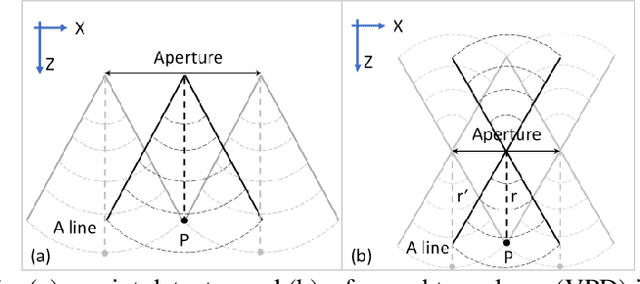
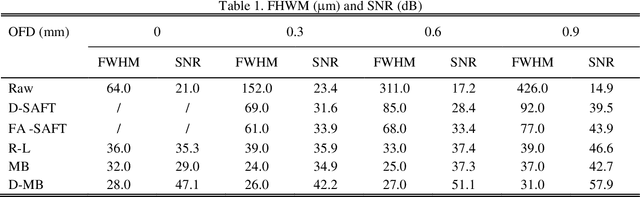
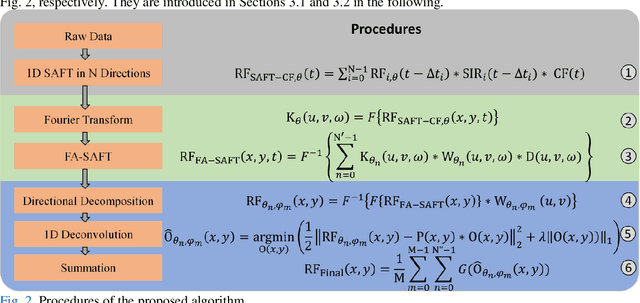
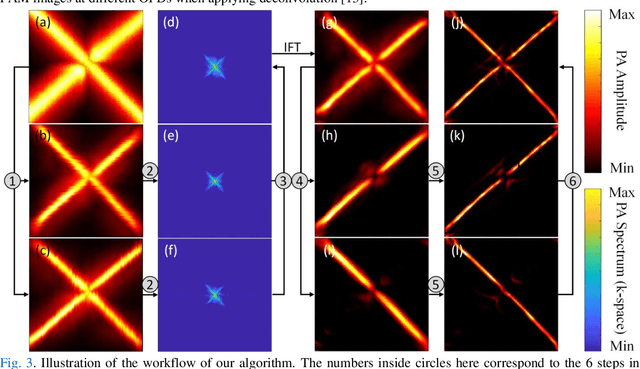
Acoustic-resolution photoacoustic microscopy (AR-PAM) is a promising tool for microvascular imaging. In the focal region, resolution of AR-PAM is determined by the ultrasound transducer and ultimately limited by acoustic diffraction. In the out-of-focus region, resolution deteriorates with increasing distance from the focal plane, which restricts depth of focus (DOF). Besides, a trade-off exists between resolution and DOF. Previously, synthetic aperture focusing technique (SAFT) and/or deconvolution methods have been demonstrated to enhance AR-PAM images. However, they suffer from issues in low resolution, low signal-to-noise ratio (SNR), and/or poor image fidelity. Here, we propose a novel algorithm for AR-PAM to enhance image resolution, SNR, and fidelity. The algorithm consists of a Fourier accumulation SAFT (FA-SAFT) and a directional model-based (D-MB) deconvolution method. Inspired from Fourier denoising technique and directional SAFT, FA-SAFT mainly compensates for the defocusing effect. Besides, D-MB deconvolution enhances the resolution as well as preserves the image fidelity, especially for the objects with line patterns such as microvasculature. Full width at half maximum of 26-31 um over DOF of 1.8 mm and minimum resolvable distance of 46-49 um are experimentally achieved by imaging tungsten wire phantom. Moreover, imaging of leaf skeleton phantom and in vivo imaging of mouse blood vessels also prove that our algorithm is capable of providing high-resolution, high-SNR, and good-fidelity results for complex structures and for in vivo applications.
Adaptive Weighting Depth-variant Deconvolution of Fluorescence Microscopy Images with Convolutional Neural Network
Jul 07, 2019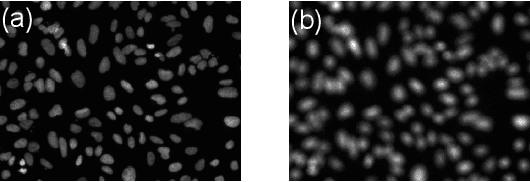
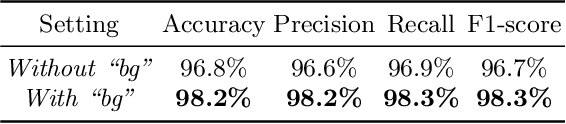
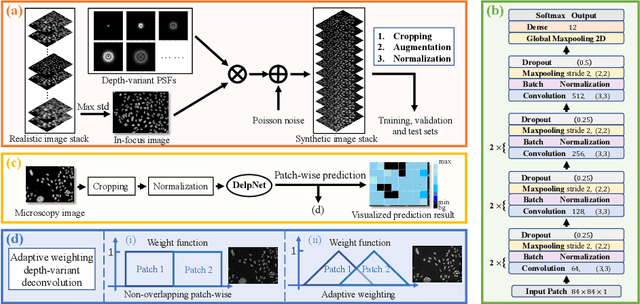
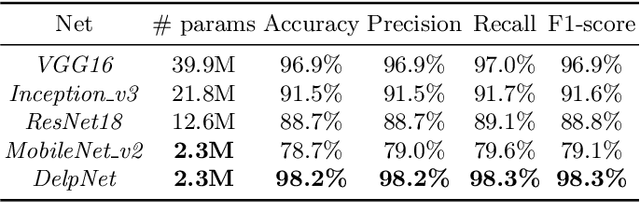
Fluorescence microscopy plays an important role in biomedical research. The depth-variant point spread function (PSF) of a fluorescence microscope produces low-quality images especially in the out-of-focus regions of thick specimens. Traditional deconvolution to restore the out-of-focus images is usually insufficient since a depth-invariant PSF is assumed. This article aims at handling fluorescence microscopy images by learning-based depth-variant PSF and reducing artifacts. We propose adaptive weighting depth-variant deconvolution (AWDVD) with defocus level prediction convolutional neural network (DelpNet) to restore the out-of-focus images. Depth-variant PSFs of image patches can be obtained by DelpNet and applied in the afterward deconvolution. AWDVD is adopted for a whole image which is patch-wise deconvolved and appropriately cropped before deconvolution. DelpNet achieves the accuracy of 98.2%, which outperforms the best-ever one using the same microscopy dataset. Image patches of 11 defocus levels after deconvolution are validated with maximum improvement in the peak signal-to-noise ratio and structural similarity index of 6.6 dB and 11%, respectively. The adaptive weighting of the patch-wise deconvolved image can eliminate patch boundary artifacts and improve deconvolved image quality. The proposed method can accurately estimate depth-variant PSF and effectively recover out-of-focus microscopy images. To our acknowledge, this is the first study of handling out-of-focus microscopy images using learning-based depth-variant PSF. Facing one of the most common blurs in fluorescence microscopy, the novel method provides a practical technology to improve the image quality.