 Add to Chrome
 Add to Firefox
 Add to Edge
CrevasseSeg: A Label-Efficient UAV Crevasse Segmentation Framework
Aug 18, 2026
Crevasse mapping from uncrewed aerial vehicle (UAV) imagery matters for glaciological research and for field safety in glaciated terrain. Yet, pixel-level annotation of glacier surfaces is costly and requires domain experts. We introduce CrevasseSeg, a framework for binary segmentation over the terminus of Borebreen, Svalbard, comprising 1,938 unlabelled UAV orthomosaic tiles for self-supervised/unsupervised fine-tuning, 24 labelled tiles for validation and 176 labelled tiles for testing. Using CrevasseSeg, we benchmark five self-supervised objectives -- BYOL, a Jensen-Shannon Divergence (JSD) objective, Barlow-Twins, VICReg, and a combined BYOL-JSD objective -- across three architectures: O-Net, O-Net++, and a DINOv3-initialised O-Net. Each configuration is evaluated under two frozen-feature readouts that differ only in the form of their decision boundary: a linear probe and a non-linear XGBoost classifier fit only on the 24 labelled validation images. Our central finding is a consistent inversion between the two readouts: DINOv3 features are the weakest under linear probing but the strongest under a non-linear readout. A UMAP analysis of the learned feature space shows that DINOv3 fragments pixels into many small clusters in which the classes are locally interleaved, whereas the convolutional architectures (O-Net and O-Net++) embed them onto a single class-sorted manifold. Satellite-pretrained DINOv3 improves over natural-image initialisation across objectives, and our label-efficient DINOv3-ViT-L-Sat-O-Net-BYOL-JSD pipeline reaches 75.33 mDSC / 61.28 mIoU, outperforming standard machine learning baselines fit on the same 24 labelled images with the RGB pixel values used as features. We release CrevasseSeg to support label-efficient segmentation research in remote sensing.

Proof-of-TBI -- Fine-Tuned Vision Language Model Consortium and OpenAI-o3 Reasoning LLM-Based Medical Diagnosis Support System for Mild Traumatic Brain Injury (TBI) Prediction
Apr 25, 2025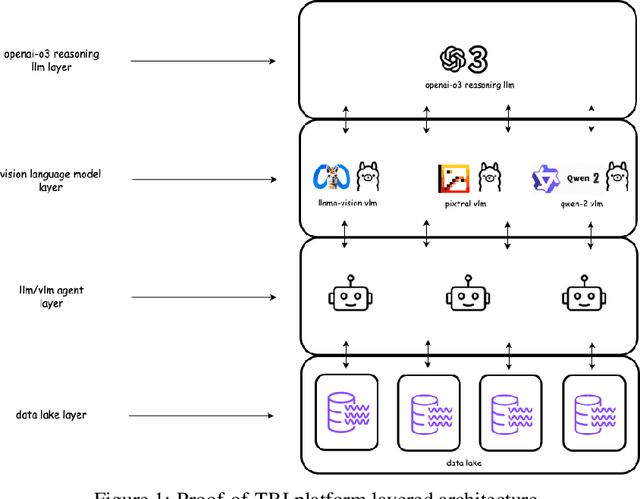
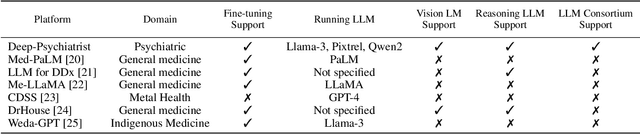
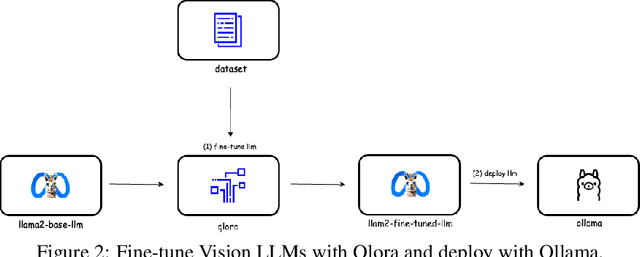
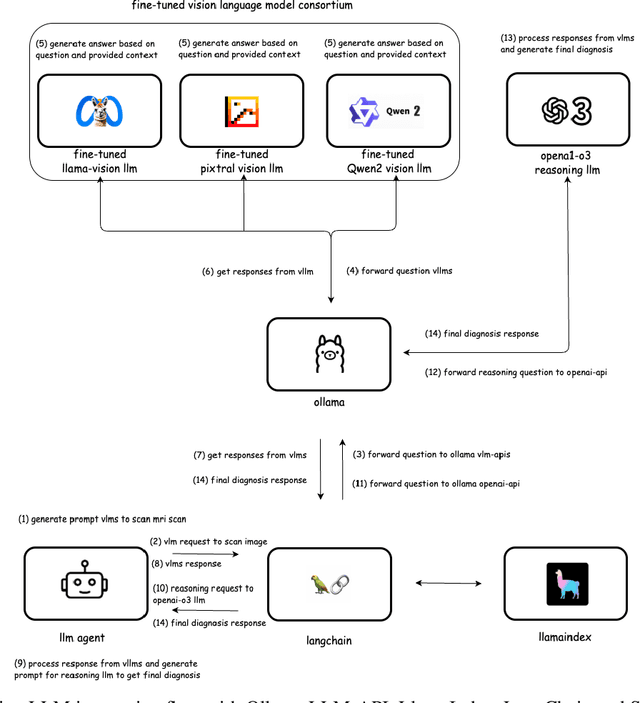
Mild Traumatic Brain Injury (TBI) detection presents significant challenges due to the subtle and often ambiguous presentation of symptoms in medical imaging, making accurate diagnosis a complex task. To address these challenges, we propose Proof-of-TBI, a medical diagnosis support system that integrates multiple fine-tuned vision-language models with the OpenAI-o3 reasoning large language model (LLM). Our approach fine-tunes multiple vision-language models using a labeled dataset of TBI MRI scans, training them to diagnose TBI symptoms effectively. The predictions from these models are aggregated through a consensus-based decision-making process. The system evaluates the predictions from all fine-tuned vision language models using the OpenAI-o3 reasoning LLM, a model that has demonstrated remarkable reasoning performance, to produce the most accurate final diagnosis. The LLM Agents orchestrates interactions between the vision-language models and the reasoning LLM, managing the final decision-making process with transparency, reliability, and automation. This end-to-end decision-making workflow combines the vision-language model consortium with the OpenAI-o3 reasoning LLM, enabled by custom prompt engineering by the LLM agents. The prototype for the proposed platform was developed in collaboration with the U.S. Army Medical Research team in Newport News, Virginia, incorporating five fine-tuned vision-language models. The results demonstrate the transformative potential of combining fine-tuned vision-language model inputs with the OpenAI-o3 reasoning LLM to create a robust, secure, and highly accurate diagnostic system for mild TBI prediction. To the best of our knowledge, this research represents the first application of fine-tuned vision-language models integrated with a reasoning LLM for TBI prediction tasks.