 Add to Chrome
 Add to Firefox
 Add to Edge
SEDTalker: Emotion-Aware 3D Facial Animation Using Frame-Level Speech Emotion Diarization
Apr 14, 2026
We introduce SEDTalker, an emotion-aware framework for speech-driven 3D facial animation that leverages frame-level speech emotion diarization to achieve fine-grained expressive control. Unlike prior approaches that rely on utterance-level or manually specified emotion labels, our method predicts temporally dense emotion categories and intensities directly from speech, enabling continuous modulation of facial expressions over time. The diarized emotion signals are encoded as learned embeddings and used to condition a speech-driven 3D animation model based on a hybrid Transformer-Mamba architecture. This design allows effective disentanglement of linguistic content and emotional style while preserving identity and temporal coherence. We evaluate our approach on a large-scale multi-corpus dataset for speech emotion diarization and on the EmoVOCA dataset for emotional 3D facial animation. Quantitative results demonstrate strong frame-level emotion recognition performance and low geometric and temporal reconstruction errors, while qualitative results show smooth emotion transitions and consistent expression control. These findings highlight the effectiveness of frame-level emotion diarization for expressive and controllable 3D talking head generation.

FreeTalk: Emotional Topology-Free 3D Talking Heads
Mar 16, 2026Speech-driven 3D facial animation has advanced rapidly, yet most approaches remain tied to registered template meshes, preventing effective deployment on raw 3D scans with arbitrary topology. At the same time, modeling controllable emotional dynamics beyond lip articulation remains challenging, and is often tied to template-based parameterizations. We address these challenges by proposing FreeTalk, a two-stage framework for emotion-conditioned 3D talking-head animation that generalizes to unregistered face meshes with arbitrary vertex count and connectivity. First, Audio-To-Sparse (ATS) predicts a temporally coherent sequence of 3D landmark displacements from speech audio, conditioned on an emotion category and intensity. This sparse representation captures both articulatory and affective motion while remaining independent of mesh topology. Second, Sparse-To-Mesh (STM) transfers the predicted landmark motion to a target mesh by combining intrinsic surface features with landmark-to-vertex conditioning, producing dense per-vertex deformations without template fitting or correspondence supervision at test time. Extensive experiments show that FreeTalk matches specialized baselines when trained in-domain, while providing substantially improved robustness to unseen identities and mesh topologies. Code and pre-trained models will be made publicly available.
Revisiting Emotions Representation for Recognition in the Wild
Feb 06, 2026Facial emotion recognition has been typically cast as a single-label classification problem of one out of six prototypical emotions. However, that is an oversimplification that is unsuitable for representing the multifaceted spectrum of spontaneous emotional states, which are most often the result of a combination of multiple emotions contributing at different intensities. Building on this, a promising direction that was explored recently is to cast emotion recognition as a distribution learning problem. Still, such approaches are limited in that research datasets are typically annotated with a single emotion class. In this paper, we contribute a novel approach to describe complex emotional states as probability distributions over a set of emotion classes. To do so, we propose a solution to automatically re-label existing datasets by exploiting the result of a study in which a large set of both basic and compound emotions is mapped to probability distributions in the Valence-Arousal-Dominance (VAD) space. In this way, given a face image annotated with VAD values, we can estimate the likelihood of it belonging to each of the distributions, so that emotional states can be described as a mixture of emotions, enriching their description, while also accounting for the ambiguous nature of their perception. In a preliminary set of experiments, we illustrate the advantages of this solution and a new possible direction of investigation. Data annotations are available at https://github.com/jbcnrlz/affectnet-b-annotation.
No MoCap Needed: Post-Training Motion Diffusion Models with Reinforcement Learning using Only Textual Prompts
Oct 08, 2025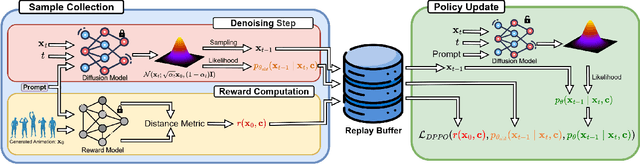
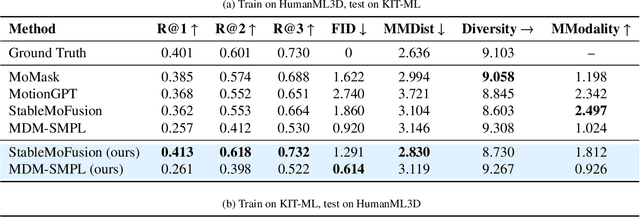
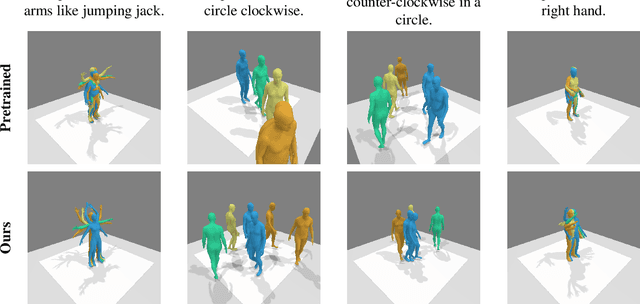
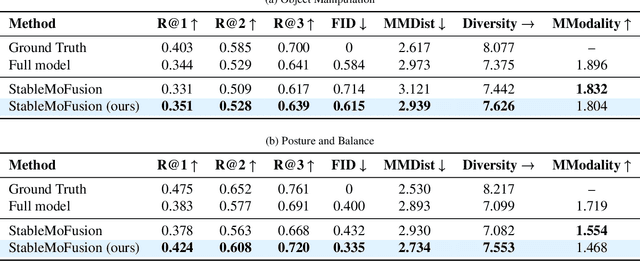
Diffusion models have recently advanced human motion generation, producing realistic and diverse animations from textual prompts. However, adapting these models to unseen actions or styles typically requires additional motion capture data and full retraining, which is costly and difficult to scale. We propose a post-training framework based on Reinforcement Learning that fine-tunes pretrained motion diffusion models using only textual prompts, without requiring any motion ground truth. Our approach employs a pretrained text-motion retrieval network as a reward signal and optimizes the diffusion policy with Denoising Diffusion Policy Optimization, effectively shifting the model's generative distribution toward the target domain without relying on paired motion data. We evaluate our method on cross-dataset adaptation and leave-one-out motion experiments using the HumanML3D and KIT-ML datasets across both latent- and joint-space diffusion architectures. Results from quantitative metrics and user studies show that our approach consistently improves the quality and diversity of generated motions, while preserving performance on the original distribution. Our approach is a flexible, data-efficient, and privacy-preserving solution for motion adaptation.
Deep Learning for Skeleton Based Human Motion Rehabilitation Assessment: A Benchmark
Jul 28, 2025Automated assessment of human motion plays a vital role in rehabilitation, enabling objective evaluation of patient performance and progress. Unlike general human activity recognition, rehabilitation motion assessment focuses on analyzing the quality of movement within the same action class, requiring the detection of subtle deviations from ideal motion. Recent advances in deep learning and video-based skeleton extraction have opened new possibilities for accessible, scalable motion assessment using affordable devices such as smartphones or webcams. However, the field lacks standardized benchmarks, consistent evaluation protocols, and reproducible methodologies, limiting progress and comparability across studies. In this work, we address these gaps by (i) aggregating existing rehabilitation datasets into a unified archive called Rehab-Pile, (ii) proposing a general benchmarking framework for evaluating deep learning methods in this domain, and (iii) conducting extensive benchmarking of multiple architectures across classification and regression tasks. All datasets and implementations are released to the community to support transparency and reproducibility. This paper aims to establish a solid foundation for future research in automated rehabilitation assessment and foster the development of reliable, accessible, and personalized rehabilitation solutions. The datasets, source-code and results of this article are all publicly available.
3D Face Reconstruction Error Decomposed: A Modular Benchmark for Fair and Fast Method Evaluation
May 23, 2025Computing the standard benchmark metric for 3D face reconstruction, namely geometric error, requires a number of steps, such as mesh cropping, rigid alignment, or point correspondence. Current benchmark tools are monolithic (they implement a specific combination of these steps), even though there is no consensus on the best way to measure error. We present a toolkit for a Modularized 3D Face reconstruction Benchmark (M3DFB), where the fundamental components of error computation are segregated and interchangeable, allowing one to quantify the effect of each. Furthermore, we propose a new component, namely correction, and present a computationally efficient approach that penalizes for mesh topology inconsistency. Using this toolkit, we test 16 error estimators with 10 reconstruction methods on two real and two synthetic datasets. Critically, the widely used ICP-based estimator provides the worst benchmarking performance, as it significantly alters the true ranking of the top-5 reconstruction methods. Notably, the correlation of ICP with the true error can be as low as 0.41. Moreover, non-rigid alignment leads to significant improvement (correlation larger than 0.90), highlighting the importance of annotating 3D landmarks on datasets. Finally, the proposed correction scheme, together with non-rigid warping, leads to an accuracy on a par with the best non-rigid ICP-based estimators, but runs an order of magnitude faster. Our open-source codebase is designed for researchers to easily compare alternatives for each component, thus helping accelerating progress in benchmarking for 3D face reconstruction and, furthermore, supporting the improvement of learned reconstruction methods, which depend on accurate error estimation for effective training.
Beyond Fixed Topologies: Unregistered Training and Comprehensive Evaluation Metrics for 3D Talking Heads
Oct 14, 2024


Generating speech-driven 3D talking heads presents numerous challenges; among those is dealing with varying mesh topologies. Existing methods require a registered setting, where all meshes share a common topology: a point-wise correspondence across all meshes the model can animate. While simplifying the problem, it limits applicability as unseen meshes must adhere to the training topology. This work presents a framework capable of animating 3D faces in arbitrary topologies, including real scanned data. Our approach relies on a model leveraging heat diffusion over meshes to overcome the fixed topology constraint. We explore two training settings: a supervised one, in which training sequences share a fixed topology within a sequence but any mesh can be animated at test time, and an unsupervised one, which allows effective training with varying mesh structures. Additionally, we highlight the limitations of current evaluation metrics and propose new metrics for better lip-syncing evaluation between speech and facial movements. Our extensive evaluation shows our approach performs favorably compared to fixed topology techniques, setting a new benchmark by offering a versatile and high-fidelity solution for 3D talking head generation.
Generation of Complex 3D Human Motion by Temporal and Spatial Composition of Diffusion Models
Sep 18, 2024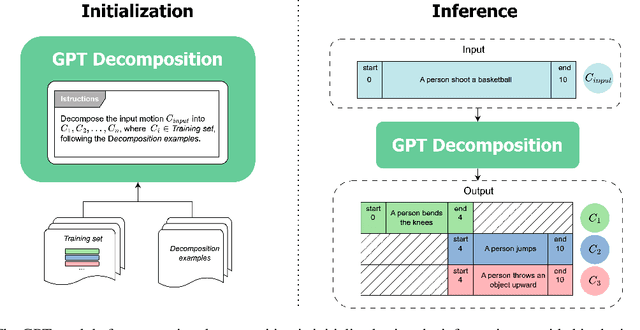
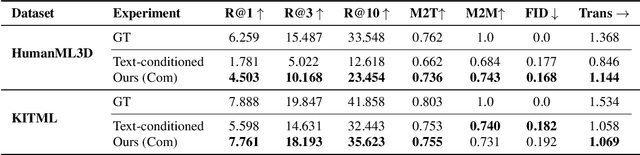
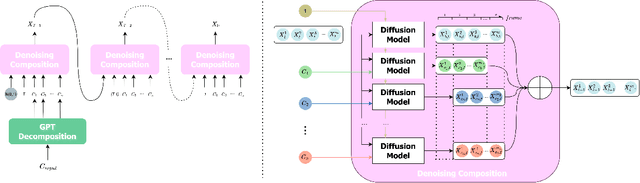
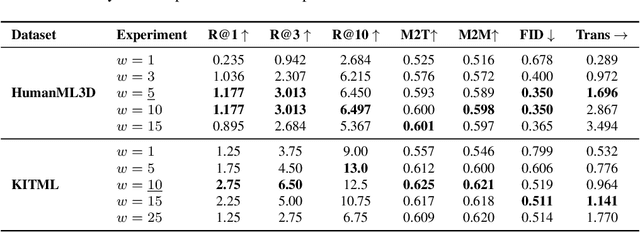
In this paper, we address the challenge of generating realistic 3D human motions for action classes that were never seen during the training phase. Our approach involves decomposing complex actions into simpler movements, specifically those observed during training, by leveraging the knowledge of human motion contained in GPTs models. These simpler movements are then combined into a single, realistic animation using the properties of diffusion models. Our claim is that this decomposition and subsequent recombination of simple movements can synthesize an animation that accurately represents the complex input action. This method operates during the inference phase and can be integrated with any pre-trained diffusion model, enabling the synthesis of motion classes not present in the training data. We evaluate our method by dividing two benchmark human motion datasets into basic and complex actions, and then compare its performance against the state-of-the-art.
Look Into the LITE in Deep Learning for Time Series Classification
Sep 04, 2024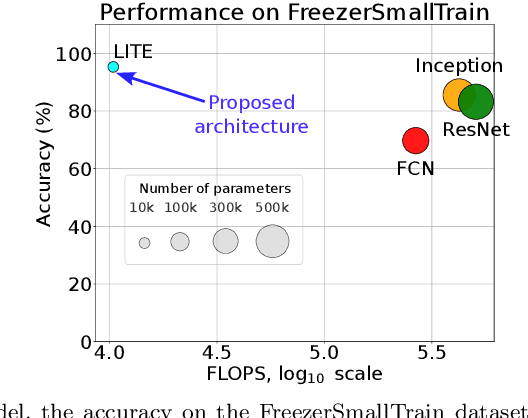

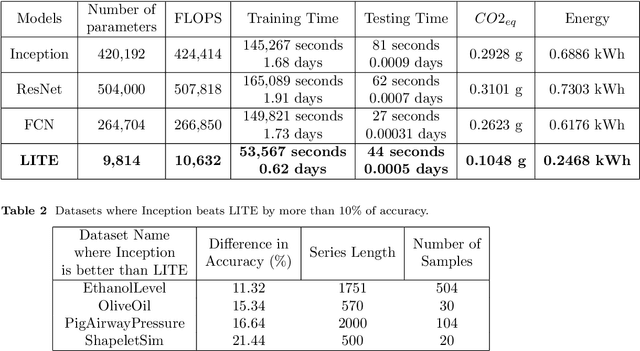
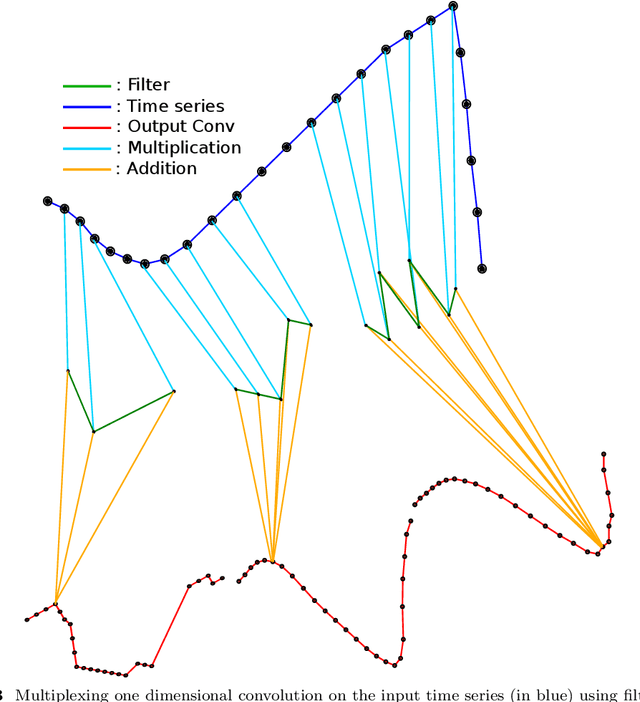
Deep learning models have been shown to be a powerful solution for Time Series Classification (TSC). State-of-the-art architectures, while producing promising results on the UCR and the UEA archives , present a high number of trainable parameters. This can lead to long training with high CO2 emission, power consumption and possible increase in the number of FLoating-point Operation Per Second (FLOPS). In this paper, we present a new architecture for TSC, the Light Inception with boosTing tEchnique (LITE) with only 2.34% of the number of parameters of the state-of-the-art InceptionTime model, while preserving performance. This architecture, with only 9, 814 trainable parameters due to the usage of DepthWise Separable Convolutions (DWSC), is boosted by three techniques: multiplexing, custom filters, and dilated convolution. The LITE architecture, trained on the UCR, is 2.78 times faster than InceptionTime and consumes 2.79 times less CO2 and power. To evaluate the performance of the proposed architecture on multivariate time series data, we adapt LITE to handle multivariate time series, we call this version LITEMV. To bring theory into application, we also conducted experiments using LITEMV on multivariate time series representing human rehabilitation movements, showing that LITEMV not only is the most efficient model but also the best performing for this application on the Kimore dataset, a skeleton based human rehabilitation exercises dataset. Moreover, to address the interpretability of LITEMV, we present a study using Class Activation Maps to understand the classification decision taken by the model during evaluation.
JambaTalk: Speech-Driven 3D Talking Head Generation Based on Hybrid Transformer-Mamba Language Model
Aug 03, 2024In recent years, talking head generation has become a focal point for researchers. Considerable effort is being made to refine lip-sync motion, capture expressive facial expressions, generate natural head poses, and achieve high video quality. However, no single model has yet achieved equivalence across all these metrics. This paper aims to animate a 3D face using Jamba, a hybrid Transformers-Mamba model. Mamba, a pioneering Structured State Space Model (SSM) architecture, was designed to address the constraints of the conventional Transformer architecture. Nevertheless, it has several drawbacks. Jamba merges the advantages of both Transformer and Mamba approaches, providing a holistic solution. Based on the foundational Jamba block, we present JambaTalk to enhance motion variety and speed through multimodal integration. Extensive experiments reveal that our method achieves performance comparable or superior to state-of-the-art models.