 Add to Chrome
 Add to Firefox
 Add to Edge
The 2nd International StepUP Competition for Biometric Footstep Recognition: From Steps to Strides
Jul 15, 2026
The International StepUP Competition Series was launched to advance research in pressure-based footstep biometrics through a standardized and challenging evaluation framework. Using the large-scale StepUP-P150 dataset (with more than 200,000 high-resolution dynamic footsteps from 150 individuals) and a previously unreleased test set, the 2nd edition of the competition addressed three key challenges: (1) generalization to unseen users with limited enrollment data, (2) robustness to domain shift caused by variations in footwear and walking speed and (3) effective fusion of paired left-right footsteps. While the first two challenges built on the inaugural competition, this edition introduced more extreme cross-domain conditions and moved beyond isolated footsteps to stride-level verification, enabling new opportunities for representation learning and inter-step information fusion. The competition attracted 26 registrants from academia and industry, with a best equal error rate of 8.00% achieved by the ArogyaPandit Research Team using a spatiotemporal CNN combined with an ensemble-based scoring strategy. The top solutions showcase the value of harnessing temporal patterns and of incorporating inference-time normalization and calibration strategies to improve scoring. However, the results also reveal that recognizing users in unseen personal footwear remains a challenge, especially in the presence of distractors with similar characteristics.

Enhancing deep learning models for time series classification via knowledge distillation
Jul 07, 2026Deep learning has achieved remarkable success in various domains including time series analysis, computer vision and natural language processing. However, high computational and memory demands of state-of-the-art architectures pose challenges for deployment in resource-limited environments. Knowledge Distillation (KD) addresses this by transferring knowledge from a large teacher model to a smaller, more efficient student model while maintaining competitive performance. In this work, we investigate the effectiveness of KD for Time Series Classification (TSC) across three architectures: the classical Fully Convolutional Network (FCN), the convolutional Inception model and the transformer-based ConvTran model. We evaluate our approach on UCR Archive, the largest benchmark repository of time series datasets, by modifying architectural components such as convolutional filters, Inception modules and attention heads across the three architectures. Our results consistently show that KD most effectively benefits student models of intermediate complexity across all three architectures, with the distilled FCN student reducing parameters by a factor of 38, the distilled Inception student achieving nearly the same performance as the teacher with 42% fewer parameters and the distilled ConvTran student with 2 attention heads showing the most significant improvement through distillation. To encourage further research and reproducibility, we provide our implementation at https://github.com/MSD-IRIMAS/KD-4-TSC.
* Published version. Open access under CC BY 4.0. 24 pages, 11 figures
The Multiverse of Time Series Machine Learning: an Archive for Multivariate Time Series Classification
Mar 20, 2026Time series machine learning (TSML) is a growing research field that spans a wide range of tasks. The popularity of established tasks such as classification, clustering, and extrinsic regression has, in part, been driven by the availability of benchmark datasets. An archive of 30 multivariate time series classification datasets, introduced in 2018 and commonly known as the UEA archive, has since become an essential resource cited in hundreds of publications. We present a substantial expansion of this archive that more than quadruples its size, from 30 to 133 classification problems. We also release preprocessed versions of datasets containing missing values or unequal length series, bringing the total number of datasets to 147. Reflecting the growth of the archive and the broader community, we rebrand it as the Multiverse archive to capture its diversity of domains. The Multiverse archive includes datasets from multiple sources, consolidating other collections and standalone datasets into a single, unified repository. Recognising that running experiments across the full archive is computationally demanding, we recommend a subset of the full archive called Multiverse-core (MV-core) for initial exploration. To support researchers in using the new archive, we provide detailed guidance and a baseline evaluation of established and recent classification algorithms, establishing performance benchmarks for future research. We have created a dedicated repository for the Multiverse archive that provides a common aeon and scikit-learn compatible framework for reproducibility, an extensive record of published results, and an interactive interface to explore the results.
Adaptive Structured Pruning of Convolutional Neural Networks for Time Series Classification
Feb 13, 2026Deep learning models for Time Series Classification (TSC) have achieved strong predictive performance but their high computational and memory requirements often limit deployment on resource-constrained devices. While structured pruning can address these issues by removing redundant filters, existing methods typically rely on manually tuned hyperparameters such as pruning ratios which limit scalability and generalization across datasets. In this work, we propose Dynamic Structured Pruning (DSP), a fully automatic, structured pruning framework for convolution-based TSC models. DSP introduces an instance-wise sparsity loss during training to induce channel-level sparsity, followed by a global activation analysis to identify and prune redundant filters without needing any predefined pruning ratio. This work tackles computational bottlenecks of deep TSC models for deployment on resource-constrained devices. We validate DSP on 128 UCR datasets using two different deep state-of-the-art architectures: LITETime and InceptionTime. Our approach achieves an average compression of 58% for LITETime and 75% for InceptionTime architectures while maintaining classification accuracy. Redundancy analyses confirm that DSP produces compact and informative representations, offering a practical path for scalable and efficient deep TSC deployment.
Enhancing Time Series Classification with Diversity-Driven Neural Network Ensembles
Feb 07, 2026Ensemble methods have played a crucial role in achieving state-of-the-art (SOTA) performance across various machine learning tasks by leveraging the diversity of features learned by individual models. In Time Series Classification (TSC), ensembles have proven highly effective whether based on neural networks (NNs) or traditional methods like HIVE-COTE. However most existing NN-based ensemble methods for TSC train multiple models with identical architectures and configurations. These ensembles aggregate predictions without explicitly promoting diversity which often leads to redundant feature representations and limits the benefits of ensembling. In this work, we introduce a diversity-driven ensemble learning framework that explicitly encourages feature diversity among neural network ensemble members. Our approach employs a decorrelated learning strategy using a feature orthogonality loss applied directly to the learned feature representations. This ensures that each model in the ensemble captures complementary rather than redundant information. We evaluate our framework on 128 datasets from the UCR archive and show that it achieves SOTA performance with fewer models. This makes our method both efficient and scalable compared to conventional NN-based ensemble approaches.
* Published in IEEE IJCNN 2025 proceedings. 10 pages, 8 figures
Deep Learning for Skeleton Based Human Motion Rehabilitation Assessment: A Benchmark
Jul 28, 2025Automated assessment of human motion plays a vital role in rehabilitation, enabling objective evaluation of patient performance and progress. Unlike general human activity recognition, rehabilitation motion assessment focuses on analyzing the quality of movement within the same action class, requiring the detection of subtle deviations from ideal motion. Recent advances in deep learning and video-based skeleton extraction have opened new possibilities for accessible, scalable motion assessment using affordable devices such as smartphones or webcams. However, the field lacks standardized benchmarks, consistent evaluation protocols, and reproducible methodologies, limiting progress and comparability across studies. In this work, we address these gaps by (i) aggregating existing rehabilitation datasets into a unified archive called Rehab-Pile, (ii) proposing a general benchmarking framework for evaluating deep learning methods in this domain, and (iii) conducting extensive benchmarking of multiple architectures across classification and regression tasks. All datasets and implementations are released to the community to support transparency and reproducibility. This paper aims to establish a solid foundation for future research in automated rehabilitation assessment and foster the development of reliable, accessible, and personalized rehabilitation solutions. The datasets, source-code and results of this article are all publicly available.
Look Into the LITE in Deep Learning for Time Series Classification
Sep 04, 2024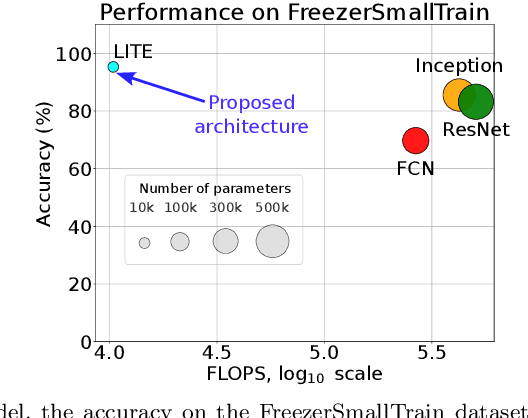

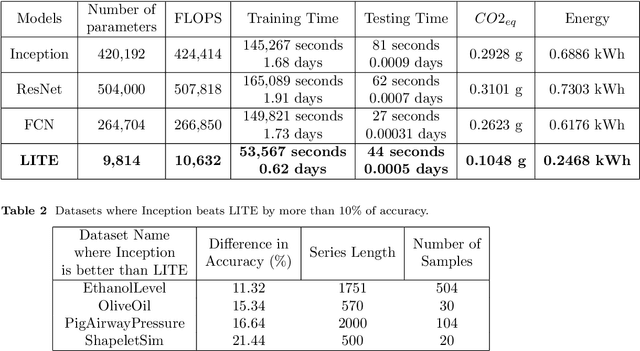
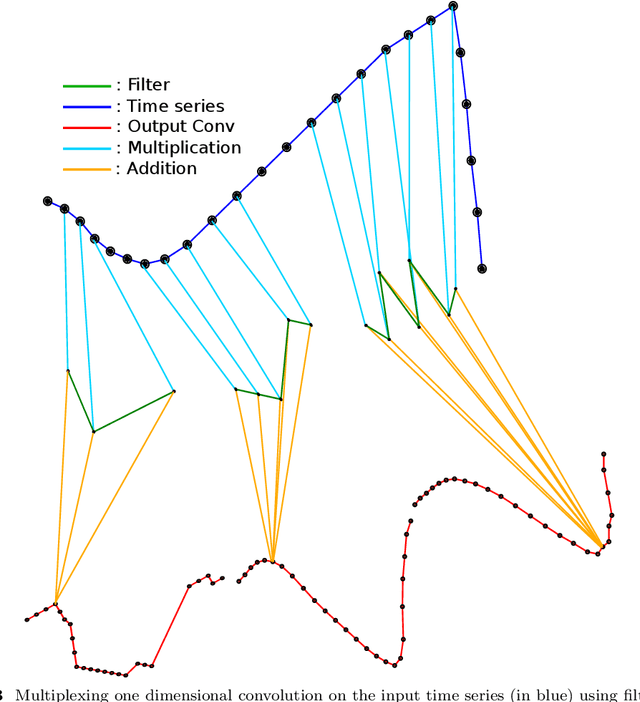
Deep learning models have been shown to be a powerful solution for Time Series Classification (TSC). State-of-the-art architectures, while producing promising results on the UCR and the UEA archives , present a high number of trainable parameters. This can lead to long training with high CO2 emission, power consumption and possible increase in the number of FLoating-point Operation Per Second (FLOPS). In this paper, we present a new architecture for TSC, the Light Inception with boosTing tEchnique (LITE) with only 2.34% of the number of parameters of the state-of-the-art InceptionTime model, while preserving performance. This architecture, with only 9, 814 trainable parameters due to the usage of DepthWise Separable Convolutions (DWSC), is boosted by three techniques: multiplexing, custom filters, and dilated convolution. The LITE architecture, trained on the UCR, is 2.78 times faster than InceptionTime and consumes 2.79 times less CO2 and power. To evaluate the performance of the proposed architecture on multivariate time series data, we adapt LITE to handle multivariate time series, we call this version LITEMV. To bring theory into application, we also conducted experiments using LITEMV on multivariate time series representing human rehabilitation movements, showing that LITEMV not only is the most efficient model but also the best performing for this application on the Kimore dataset, a skeleton based human rehabilitation exercises dataset. Moreover, to address the interpretability of LITEMV, we present a study using Class Activation Maps to understand the classification decision taken by the model during evaluation.
A Medical Low-Back Pain Physical Rehabilitation Dataset for Human Body Movement Analysis
Jun 29, 2024
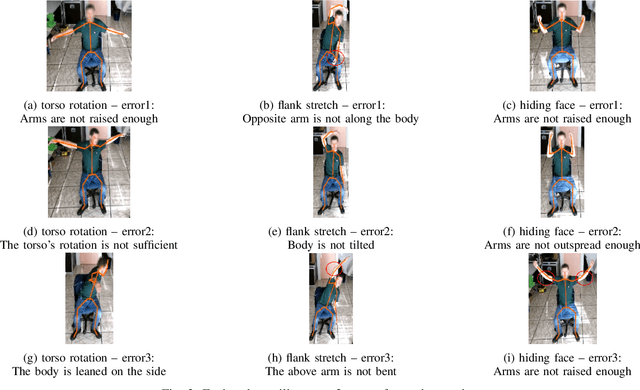
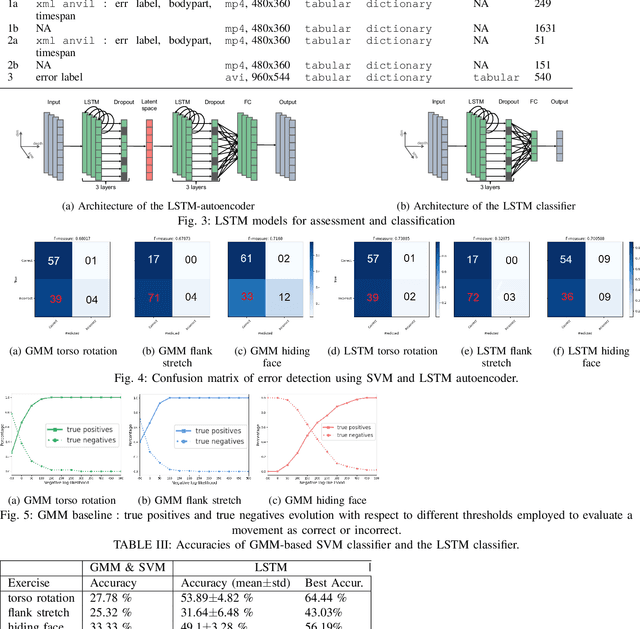
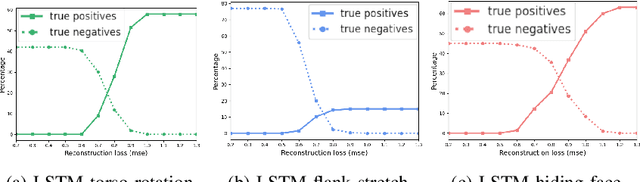
While automatic monitoring and coaching of exercises are showing encouraging results in non-medical applications, they still have limitations such as errors and limited use contexts. To allow the development and assessment of physical rehabilitation by an intelligent tutoring system, we identify in this article four challenges to address and propose a medical dataset of clinical patients carrying out low back-pain rehabilitation exercises. The dataset includes 3D Kinect skeleton positions and orientations, RGB videos, 2D skeleton data, and medical annotations to assess the correctness, and error classification and localisation of body part and timespan. Along this dataset, we perform a complete research path, from data collection to processing, and finally a small benchmark. We evaluated on the dataset two baseline movement recognition algorithms, pertaining to two different approaches: the probabilistic approach with a Gaussian Mixture Model (GMM), and the deep learning approach with a Long-Short Term Memory (LSTM). This dataset is valuable because it includes rehabilitation relevant motions in a clinical setting with patients in their rehabilitation program, using a cost-effective, portable, and convenient sensor, and because it shows the potential for improvement on these challenges.
Establishing a Unified Evaluation Framework for Human Motion Generation: A Comparative Analysis of Metrics
May 13, 2024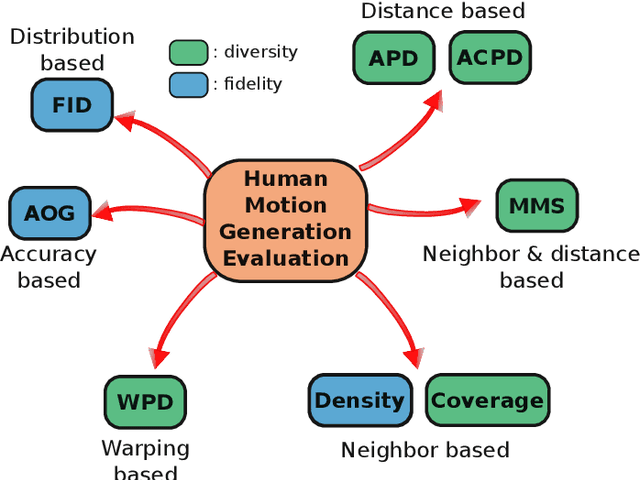
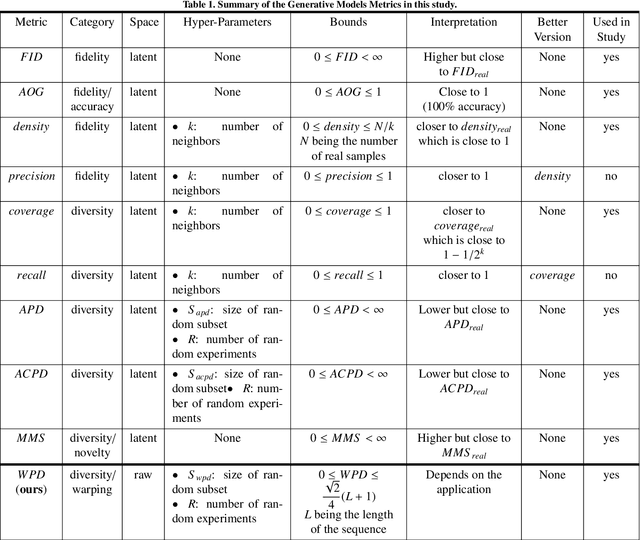
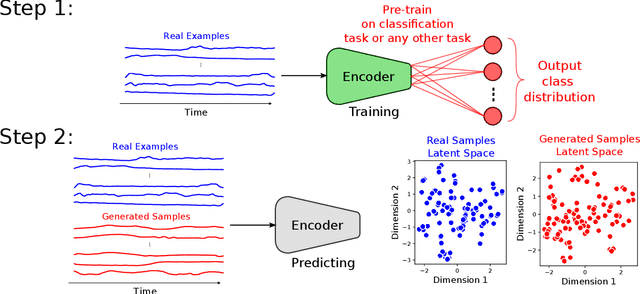
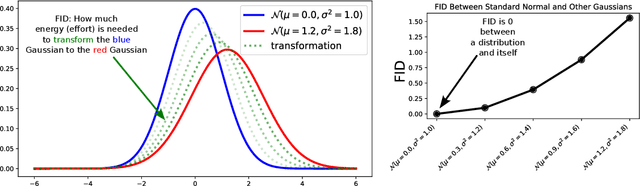
The development of generative artificial intelligence for human motion generation has expanded rapidly, necessitating a unified evaluation framework. This paper presents a detailed review of eight evaluation metrics for human motion generation, highlighting their unique features and shortcomings. We propose standardized practices through a unified evaluation setup to facilitate consistent model comparisons. Additionally, we introduce a novel metric that assesses diversity in temporal distortion by analyzing warping diversity, thereby enhancing the evaluation of temporal data. We also conduct experimental analyses of three generative models using a publicly available dataset, offering insights into the interpretation of each metric in specific case scenarios. Our goal is to offer a clear, user-friendly evaluation framework for newcomers, complemented by publicly accessible code.
Finding Foundation Models for Time Series Classification with a PreText Task
Nov 24, 2023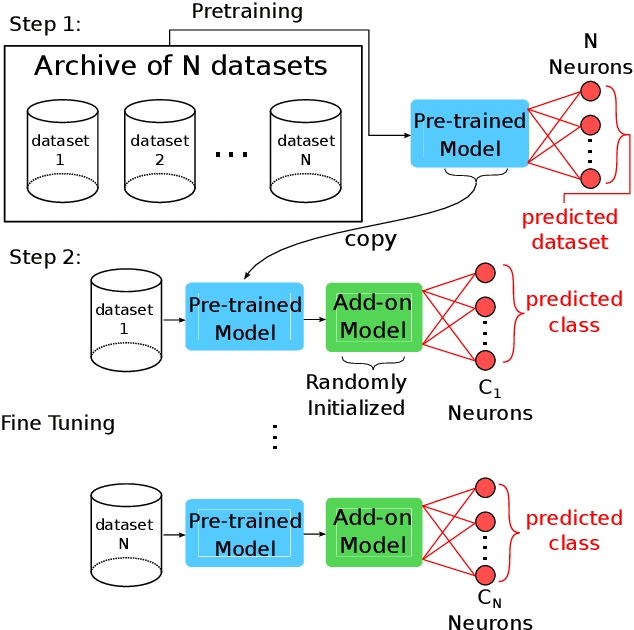
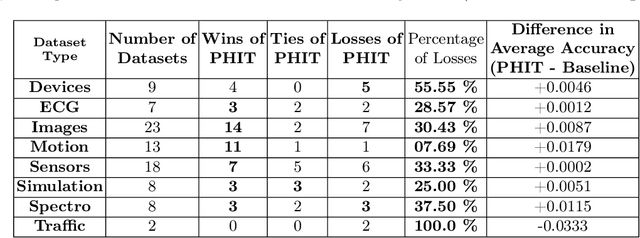
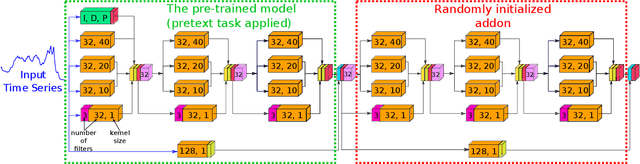
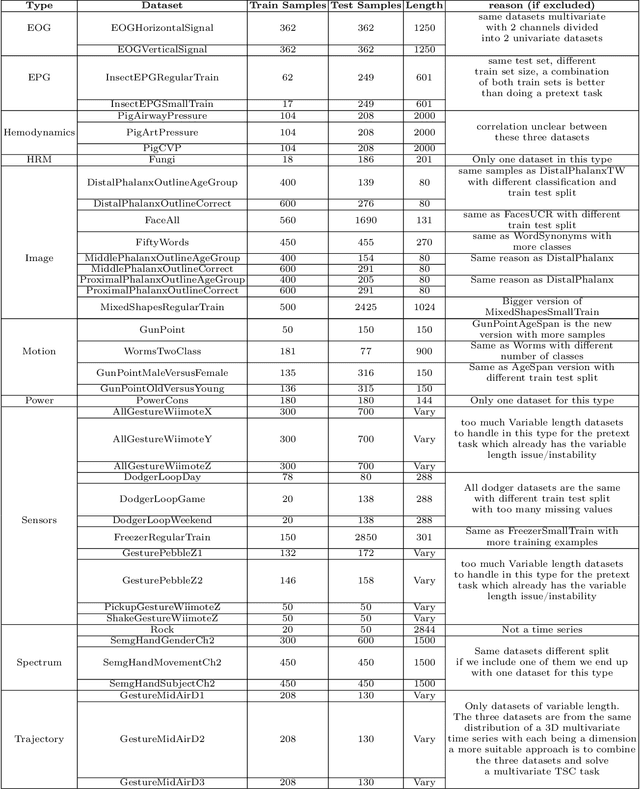
Over the past decade, Time Series Classification (TSC) has gained an increasing attention. While various methods were explored, deep learning - particularly through Convolutional Neural Networks (CNNs)-stands out as an effective approach. However, due to the limited availability of training data, defining a foundation model for TSC that overcomes the overfitting problem is still a challenging task. The UCR archive, encompassing a wide spectrum of datasets ranging from motion recognition to ECG-based heart disease detection, serves as a prime example for exploring this issue in diverse TSC scenarios. In this paper, we address the overfitting challenge by introducing pre-trained domain foundation models. A key aspect of our methodology is a novel pretext task that spans multiple datasets. This task is designed to identify the originating dataset of each time series sample, with the goal of creating flexible convolution filters that can be applied across different datasets. The research process consists of two phases: a pre-training phase where the model acquires general features through the pretext task, and a subsequent fine-tuning phase for specific dataset classifications. Our extensive experiments on the UCR archive demonstrate that this pre-training strategy significantly outperforms the conventional training approach without pre-training. This strategy effectively reduces overfitting in small datasets and provides an efficient route for adapting these models to new datasets, thus advancing the capabilities of deep learning in TSC.