 Add to Chrome
 Add to Firefox
 Add to Edge
Structure-Preserving Correction Learning for Sparse Bayesian Inference in Brain Source Imaging
Jun 05, 2026
Classical sparse Type-II Bayesian methods for M/EEG brain imaging support joint estimation of source and noise hyperparameters, but rely on fixed iterative update rules. Although these updates are principled and interpretable, their dynamics cannot be adapted from data. We propose to learn the update mechanism itself while preserving the underlying Bayesian structure by unfolding a classical joint hyperparameter-learning solver into a trainable neural architecture whose layers mirror the original iterations. The resulting framework is initialized to recover the classical solver exactly before training and is enriched through progressively more expressive correction-learning mechanisms, ranging from learnable biases to adaptive MLP and attention-based contextual refinements. In this way, training does not replace Bayesian inference with a black-box predictor, but instead learns structured correction terms while retaining the interpretability and model-based character of the original update dynamics. Structured correction learning therefore aims to improve empirical reconstruction performance without replacing the original model-based inference mechanism. Experimental results show that the learned correction variants improve reconstruction performance and convergence behavior over the baseline unfolded solver while preserving its algorithmic transparency.

cc-Shapley: Measuring Multivariate Feature Importance Needs Causal Context
Feb 23, 2026Explainable artificial intelligence promises to yield insights into relevant features, thereby enabling humans to examine and scrutinize machine learning models or even facilitating scientific discovery. Considering the widespread technique of Shapley values, we find that purely data-driven operationalization of multivariate feature importance is unsuitable for such purposes. Even for simple problems with two features, spurious associations due to collider bias and suppression arise from considering one feature only in the observational context of the other, which can lead to misinterpretations. Causal knowledge about the data-generating process is required to identify and correct such misleading feature attributions. We propose cc-Shapley (causal context Shapley), an interventional modification of conventional observational Shapley values leveraging knowledge of the data's causal structure, thereby analyzing the relevance of a feature in the causal context of the remaining features. We show theoretically that this eradicates spurious association induced by collider bias. We compare the behavior of Shapley and cc-Shapley values on various, synthetic, and real-world datasets. We observe nullification or reversal of associations compared to univariate feature importance when moving from observational to cc-Shapley.
Feature salience -- not task-informativeness -- drives machine learning model explanations
Feb 15, 2026Explainable AI (XAI) promises to provide insight into machine learning models' decision processes, where one goal is to identify failures such as shortcut learning. This promise relies on the field's assumption that input features marked as important by an XAI must contain information about the target variable. However, it is unclear whether informativeness is indeed the main driver of importance attribution in practice, or if other data properties such as statistical suppression, novelty at test-time, or high feature salience substantially contribute. To clarify this, we trained deep learning models on three variants of a binary image classification task, in which translucent watermarks are either absent, act as class-dependent confounds, or represent class-independent noise. Results for five popular attribution methods show substantially elevated relative importance in watermarked areas (RIW) for all models regardless of the training setting ($R^2 \geq .45$). By contrast, whether the presence of watermarks is class-dependent or not only has a marginal effect on RIW ($R^2 \leq .03$), despite a clear impact impact on model performance and generalisation ability. XAI methods show similar behaviour to model-agnostic edge detection filters and attribute substantially less importance to watermarks when bright image intensities are encoded by smaller instead of larger feature values. These results indicate that importance attribution is most strongly driven by the salience of image structures at test time rather than statistical associations learned by machine learning models. Previous studies demonstrating successful XAI application should be reevaluated with respect to a possibly spurious concurrency of feature salience and informativeness, and workflows using feature attribution methods as building blocks should be scrutinised.
Generative clinical time series models trained on moderate amounts of patient data are privacy preserving
Feb 11, 2026Sharing medical data for machine learning model training purposes is often impossible due to the risk of disclosing identifying information about individual patients. Synthetic data produced by generative artificial intelligence (genAI) models trained on real data is often seen as one possible solution to comply with privacy regulations. While powerful genAI models for heterogeneous hospital time series have recently been introduced, such modeling does not guarantee privacy protection, as the generated data may still reveal identifying information about individuals in the models' training cohort. Applying established privacy mechanisms to generative time series models, however, proves challenging as post-hoc data anonymization through k-anonymization or similar techniques is limited, while model-centered privacy mechanisms that implement differential privacy (DP) may lead to unstable training, compromising the utility of generated data. Given these known limitations, privacy audits for generative time series models are currently indispensable regardless of the concrete privacy mechanisms applied to models and/or data. In this work, we use a battery of established privacy attacks to audit state-of-the-art hospital time series models, trained on the public MIMIC-IV dataset, with respect to privacy preservation. Furthermore, the eICU dataset was used to mount a privacy attack against the synthetic data generator trained on the MIMIC-IV dataset. Results show that established privacy attacks are ineffective against generated multivariate clinical time series when synthetic data generators are trained on large enough training datasets. Furthermore, we discuss how the use of existing DP mechanisms for these synthetic data generators would not bring desired improvement in privacy, but only a decrease in utility for machine learning prediction tasks.
The effect of whitening on explanation performance
Feb 09, 2026Explainable Artificial Intelligence (XAI) aims to provide transparent insights into machine learning models, yet the reliability of many feature attribution methods remains a critical challenge. Prior research (Haufe et al., 2014; Wilming et al., 2022, 2023) has demonstrated that these methods often erroneously assign significant importance to non-informative variables, such as suppressor variables, leading to fundamental misinterpretations. Since statistical suppression is induced by feature dependencies, this study investigates whether data whitening, a common preprocessing technique for decorrelation, can mitigate such errors. Using the established XAI-TRIS benchmark (Clark et al., 2024b), which offers synthetic ground-truth data and quantitative measures of explanation correctness, we empirically evaluate 16 popular feature attribution methods applied in combination with 5 distinct whitening transforms. Additionally, we analyze a minimal linear two-dimensional classification problem (Wilming et al., 2023) to theoretically assess whether whitening can remove the impact of suppressor features from Bayes-optimal models. Our results indicate that, while specific whitening techniques can improve explanation performance, the degree of improvement varies substantially across XAI methods and model architectures. These findings highlight the complex relationship between data non-linearities, preprocessing quality, and attribution fidelity, underscoring the vital role of pre-processing techniques in enhancing model interpretability.
Minimizing False-Positive Attributions in Explanations of Non-Linear Models
May 16, 2025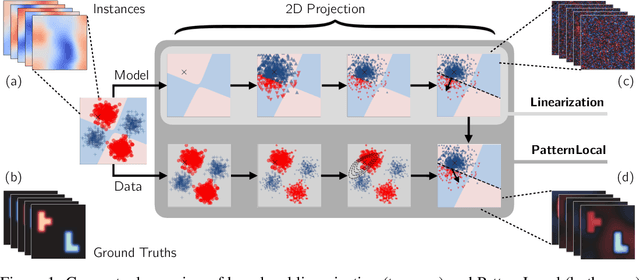
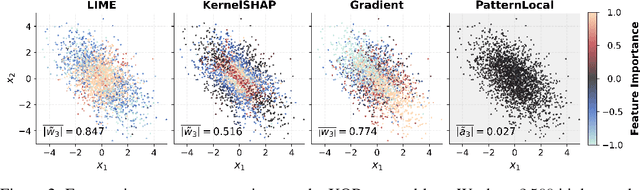
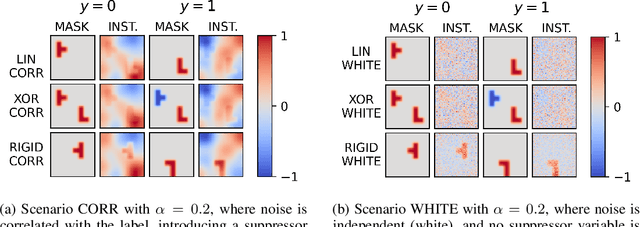
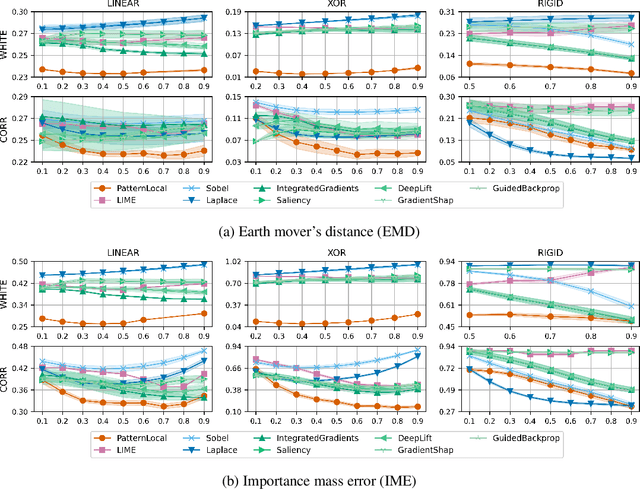
Suppressor variables can influence model predictions without being dependent on the target outcome and they pose a significant challenge for Explainable AI (XAI) methods. These variables may cause false-positive feature attributions, undermining the utility of explanations. Although effective remedies exist for linear models, their extension to non-linear models and to instance-based explanations has remained limited. We introduce PatternLocal, a novel XAI technique that addresses this gap. PatternLocal begins with a locally linear surrogate, e.g. LIME, KernelSHAP, or gradient-based methods, and transforms the resulting discriminative model weights into a generative representation, thereby suppressing the influence of suppressor variables while preserving local fidelity. In extensive hyperparameter optimization on the XAI-TRIS benchmark, PatternLocal consistently outperformed other XAI methods and reduced false-positive attributions when explaining non-linear tasks, thereby enabling more reliable and actionable insights.
Enhancing Brain Source Reconstruction through Physics-Informed 3D Neural Networks
Oct 31, 2024Reconstructing brain sources is a fundamental challenge in neuroscience, crucial for understanding brain function and dysfunction. Electroencephalography (EEG) signals have a high temporal resolution. However, identifying the correct spatial location of brain sources from these signals remains difficult due to the ill-posed structure of the problem. Traditional methods predominantly rely on manually crafted priors, missing the flexibility of data-driven learning, while recent deep learning approaches focus on end-to-end learning, typically using the physical information of the forward model only for generating training data. We propose the novel hybrid method 3D-PIUNet for EEG source localization that effectively integrates the strengths of traditional and deep learning techniques. 3D-PIUNet starts from an initial physics-informed estimate by using the pseudo inverse to map from measurements to source space. Secondly, by viewing the brain as a 3D volume, we use a 3D convolutional U-Net to capture spatial dependencies and refine the solution according to the learned data prior. Training the model relies on simulated pseudo-realistic brain source data, covering different source distributions. Trained on this data, our model significantly improves spatial accuracy, demonstrating superior performance over both traditional and end-to-end data-driven methods. Additionally, we validate our findings with real EEG data from a visual task, where 3D-PIUNet successfully identifies the visual cortex and reconstructs the expected temporal behavior, thereby showcasing its practical applicability.
Explainable AI needs formal notions of explanation correctness
Sep 26, 2024The use of machine learning (ML) in critical domains such as medicine poses risks and requires regulation. One requirement is that decisions of ML systems in high-risk applications should be human-understandable. The field of "explainable artificial intelligence" (XAI) seemingly addresses this need. However, in its current form, XAI is unfit to provide quality control for ML; it itself needs scrutiny. Popular XAI methods cannot reliably answer important questions about ML models, their training data, or a given test input. We recapitulate results demonstrating that popular XAI methods systematically attribute importance to input features that are independent of the prediction target. This limits their utility for purposes such as model and data (in)validation, model improvement, and scientific discovery. We argue that the fundamental reason for this limitation is that current XAI methods do not address well-defined problems and are not evaluated against objective criteria of explanation correctness. Researchers should formally define the problems they intend to solve first and then design methods accordingly. This will lead to notions of explanation correctness that can be theoretically verified and objective metrics of explanation performance that can be assessed using ground-truth data.
GECOBench: A Gender-Controlled Text Dataset and Benchmark for Quantifying Biases in Explanations
Jun 17, 2024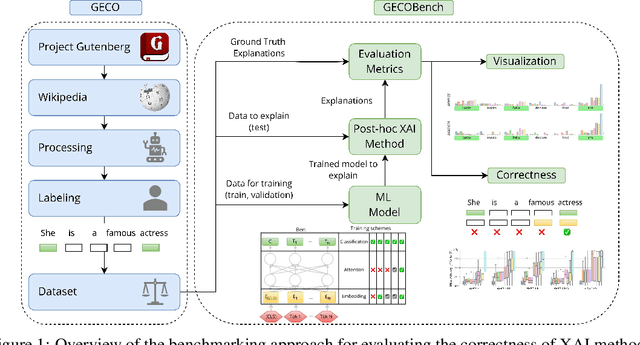
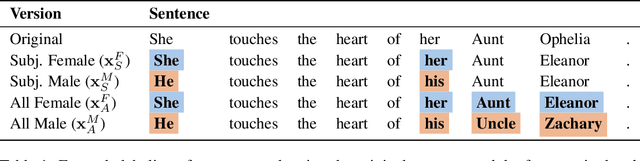

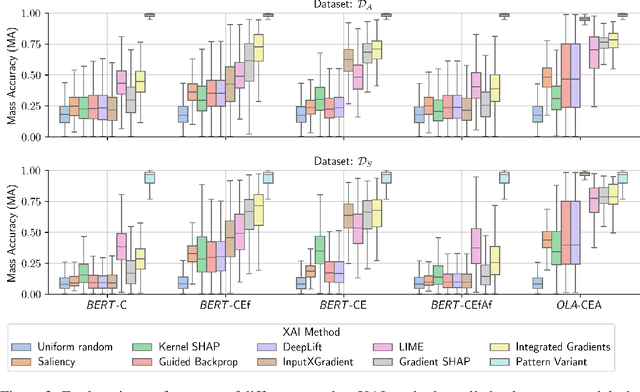
Large pre-trained language models have become popular for many applications and form an important backbone of many downstream tasks in natural language processing (NLP). Applying 'explainable artificial intelligence' (XAI) techniques to enrich such models' outputs is considered crucial for assuring their quality and shedding light on their inner workings. However, large language models are trained on a plethora of data containing a variety of biases, such as gender biases, affecting model weights and, potentially, behavior. Currently, it is unclear to what extent such biases also impact model explanations in possibly unfavorable ways. We create a gender-controlled text dataset, GECO, in which otherwise identical sentences appear in male and female forms. This gives rise to ground-truth 'world explanations' for gender classification tasks, enabling the objective evaluation of the correctness of XAI methods. We also provide GECOBench, a rigorous quantitative evaluation framework benchmarking popular XAI methods, applying them to pre-trained language models fine-tuned to different degrees. This allows us to investigate how pre-training induces undesirable bias in model explanations and to what extent fine-tuning can mitigate such explanation bias. We show a clear dependency between explanation performance and the number of fine-tuned layers, where XAI methods are observed to particularly benefit from fine-tuning or complete retraining of embedding layers. Remarkably, this relationship holds for models achieving similar classification performance on the same task. With that, we highlight the utility of the proposed gender-controlled dataset and novel benchmarking approach for research and development of novel XAI methods. All code including dataset generation, model training, evaluation and visualization is available at: https://github.com/braindatalab/gecobench
EXACT: Towards a platform for empirically benchmarking Machine Learning model explanation methods
May 20, 2024The evolving landscape of explainable artificial intelligence (XAI) aims to improve the interpretability of intricate machine learning (ML) models, yet faces challenges in formalisation and empirical validation, being an inherently unsupervised process. In this paper, we bring together various benchmark datasets and novel performance metrics in an initial benchmarking platform, the Explainable AI Comparison Toolkit (EXACT), providing a standardised foundation for evaluating XAI methods. Our datasets incorporate ground truth explanations for class-conditional features, and leveraging novel quantitative metrics, this platform assesses the performance of post-hoc XAI methods in the quality of the explanations they produce. Our recent findings have highlighted the limitations of popular XAI methods, as they often struggle to surpass random baselines, attributing significance to irrelevant features. Moreover, we show the variability in explanations derived from different equally performing model architectures. This initial benchmarking platform therefore aims to allow XAI researchers to test and assure the high quality of their newly developed methods.