 Add to Chrome
 Add to Firefox
 Add to Edge
Efficient Knowledge Distillation for LLMs: Offline Top-K Logits and a Fused Chunked KL Loss
Aug 04, 2026
Small language models are often the only option for deployment under tight latency, cost, and on-premises constraints, but they are rarely trained from scratch: a compressed model is usually recovered through knowledge distillation (KD). This recovery step largely decides the final quality, yet it is expensive. We present a practitioner's study of how to make distillation training efficient, organised around two systems contributions. First, we show that offline KD (caching the teacher's top-$K$ logits once and training the student against the cache) matches online distillation at near-identical training loss while removing the teacher from memory, running about 29\% faster per iteration, and reaching up to 41\% higher throughput on a single H200 GPU. Second, we introduce a \emph{fused, chunked KL loss} that never materialises the full vocabulary-sized logit tensor, making peak memory linear in the sequence length. This removes the memory spike that otherwise caps context length and lets us train at four times the context (32{,}768 tokens) on a single GPU. A separate output-head-only toy benchmark isolates the loss kernel and confirms its memory and iteration-rate scaling from 4K to 256K tokens. Together these make large-scale healing and hundreds of ablations affordable. We also report supporting ablations on loss design and sequence packing. We release our chunked-loss implementation: https://github.com/CompactifAI/Full-Chunked-KL-Loss.

Distilling Lightweight Domain Experts from Large ML Models by Identifying Relevant Subspaces
Jan 09, 2026Knowledge distillation involves transferring the predictive capabilities of large, high-performing AI models (teachers) to smaller models (students) that can operate in environments with limited computing power. In this paper, we address the scenario in which only a few classes and their associated intermediate concepts are relevant to distill. This scenario is common in practice, yet few existing distillation methods explicitly focus on the relevant subtask. To address this gap, we introduce 'SubDistill', a new distillation algorithm with improved numerical properties that only distills the relevant components of the teacher model at each layer. Experiments on CIFAR-100 and ImageNet with Convolutional and Transformer models demonstrate that SubDistill outperforms existing layer-wise distillation techniques on a representative set of subtasks. Our benchmark evaluations are complemented by Explainable AI analyses showing that our distilled student models more closely match the decision structure of the original teacher model.
Enhancing Brain Source Reconstruction through Physics-Informed 3D Neural Networks
Oct 31, 2024Reconstructing brain sources is a fundamental challenge in neuroscience, crucial for understanding brain function and dysfunction. Electroencephalography (EEG) signals have a high temporal resolution. However, identifying the correct spatial location of brain sources from these signals remains difficult due to the ill-posed structure of the problem. Traditional methods predominantly rely on manually crafted priors, missing the flexibility of data-driven learning, while recent deep learning approaches focus on end-to-end learning, typically using the physical information of the forward model only for generating training data. We propose the novel hybrid method 3D-PIUNet for EEG source localization that effectively integrates the strengths of traditional and deep learning techniques. 3D-PIUNet starts from an initial physics-informed estimate by using the pseudo inverse to map from measurements to source space. Secondly, by viewing the brain as a 3D volume, we use a 3D convolutional U-Net to capture spatial dependencies and refine the solution according to the learned data prior. Training the model relies on simulated pseudo-realistic brain source data, covering different source distributions. Trained on this data, our model significantly improves spatial accuracy, demonstrating superior performance over both traditional and end-to-end data-driven methods. Additionally, we validate our findings with real EEG data from a visual task, where 3D-PIUNet successfully identifies the visual cortex and reconstructs the expected temporal behavior, thereby showcasing its practical applicability.
Efficient Hierarchical Bayesian Inference for Spatio-temporal Regression Models in Neuroimaging
Nov 23, 2021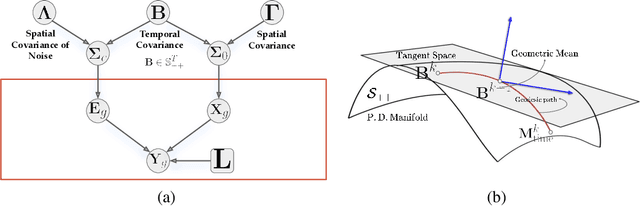
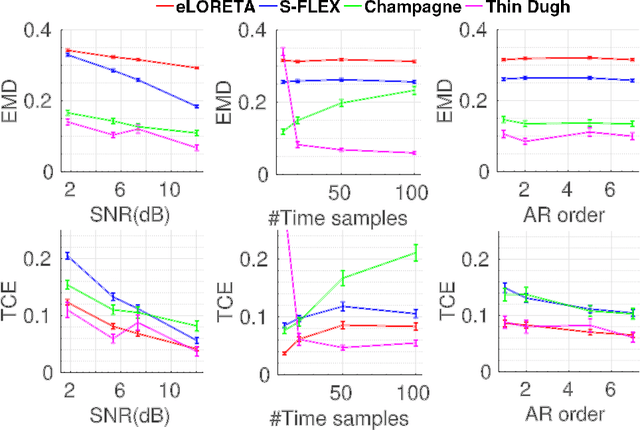
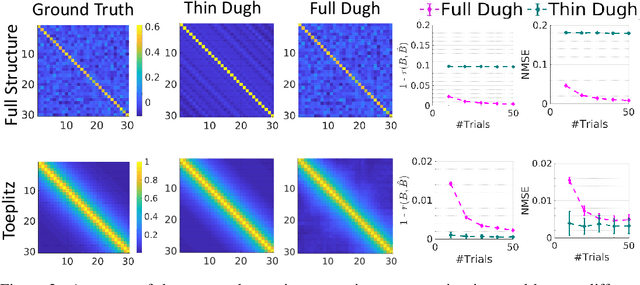
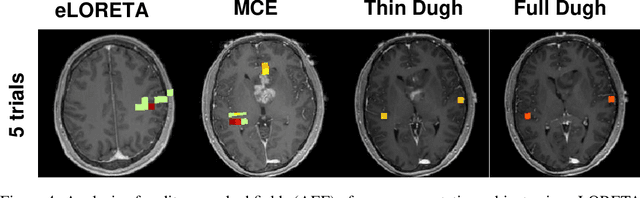
Several problems in neuroimaging and beyond require inference on the parameters of multi-task sparse hierarchical regression models. Examples include M/EEG inverse problems, neural encoding models for task-based fMRI analyses, and climate science. In these domains, both the model parameters to be inferred and the measurement noise may exhibit a complex spatio-temporal structure. Existing work either neglects the temporal structure or leads to computationally demanding inference schemes. Overcoming these limitations, we devise a novel flexible hierarchical Bayesian framework within which the spatio-temporal dynamics of model parameters and noise are modeled to have Kronecker product covariance structure. Inference in our framework is based on majorization-minimization optimization and has guaranteed convergence properties. Our highly efficient algorithms exploit the intrinsic Riemannian geometry of temporal autocovariance matrices. For stationary dynamics described by Toeplitz matrices, the theory of circulant embeddings is employed. We prove convex bounding properties and derive update rules of the resulting algorithms. On both synthetic and real neural data from M/EEG, we demonstrate that our methods lead to improved performance.