 Add to Chrome
 Add to Firefox
 Add to Edge
Parameters as Experts: Adapting Vision Models with Dynamic Parameter Routing
Feb 06, 2026
Adapting pre-trained vision models using parameter-efficient fine-tuning (PEFT) remains challenging, as it aims to achieve performance comparable to full fine-tuning using a minimal number of trainable parameters. When applied to complex dense prediction tasks, existing methods exhibit limitations, including input-agnostic modeling and redundant cross-layer representations. To this end, we propose AdaRoute, a new adapter-style method featuring a simple mixture-of-experts (MoE) architecture. Specifically, we introduce shared expert centers, where each expert is a trainable parameter matrix. During a feedforward pass, each AdaRoute module in the network dynamically generates weight matrices tailored for the current module via a simple dynamic parameter routing mechanism, which selectively aggregates parameter matrices in the corresponding expert center. Dynamic weight matrices in AdaRoute modules facilitate low-rank adaptation in an input-dependent manner, thus generating more customized and powerful feature representations. Moreover, since AdaRoute modules across multiple network layers share the same expert center, they improve feature diversity by promoting implicit cross-layer feature interaction. Extensive experiments demonstrate the superiority of AdaRoute on diverse vision tasks, including semantic segmentation, object detection and instance segmentation, and panoptic segmentation. Code will be available at: https://bit.ly/3NZcr0H.

From Directions to Cones: Exploring Multidimensional Representations of Propositional Facts in LLMs
May 27, 2025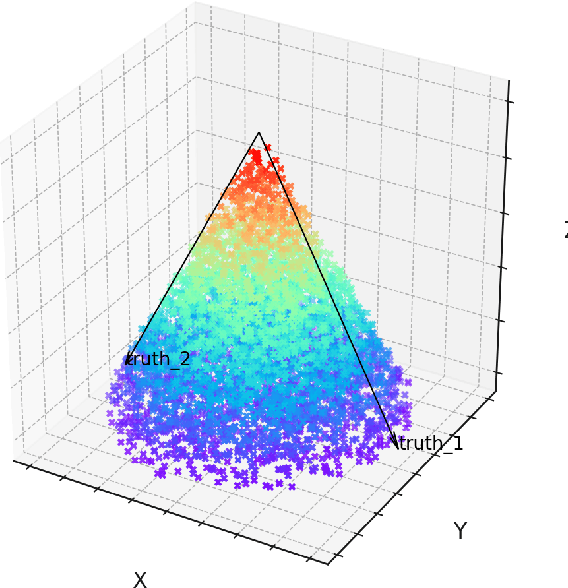
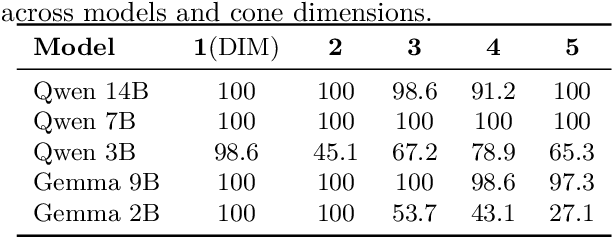
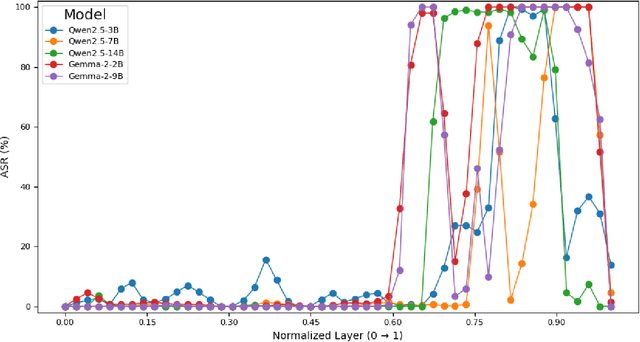
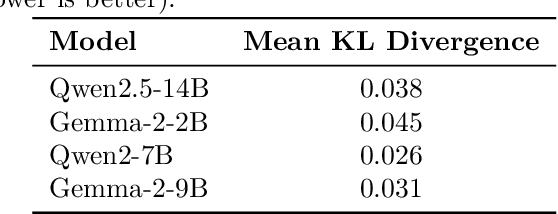
Large Language Models (LLMs) exhibit strong conversational abilities but often generate falsehoods. Prior work suggests that the truthfulness of simple propositions can be represented as a single linear direction in a model's internal activations, but this may not fully capture its underlying geometry. In this work, we extend the concept cone framework, recently introduced for modeling refusal, to the domain of truth. We identify multi-dimensional cones that causally mediate truth-related behavior across multiple LLM families. Our results are supported by three lines of evidence: (i) causal interventions reliably flip model responses to factual statements, (ii) learned cones generalize across model architectures, and (iii) cone-based interventions preserve unrelated model behavior. These findings reveal the richer, multidirectional structure governing simple true/false propositions in LLMs and highlight concept cones as a promising tool for probing abstract behaviors.
Executing Instructions in Situated Collaborative Interactions
Oct 17, 2019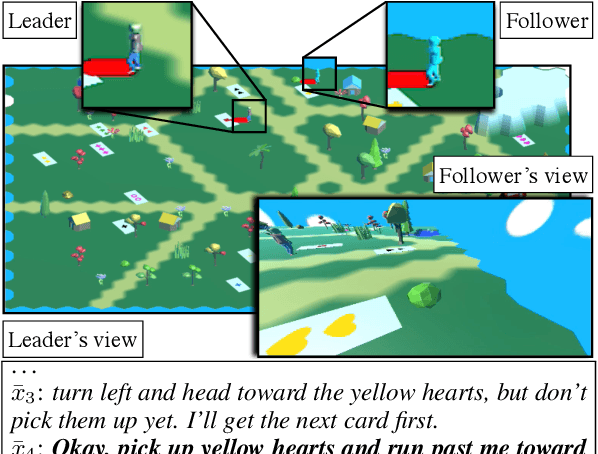
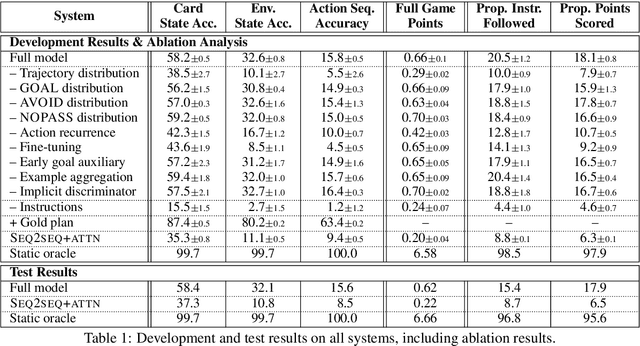
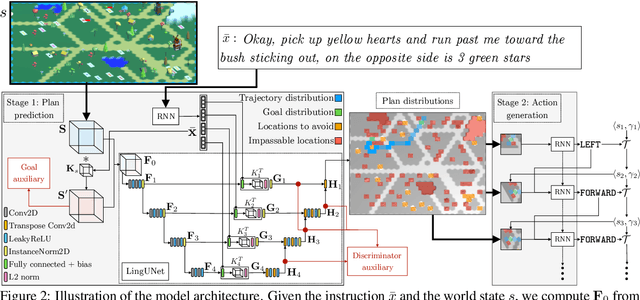
We study a collaborative scenario where a user not only instructs a system to complete tasks, but also acts alongside it. This allows the user to adapt to the system abilities by changing their language or deciding to simply accomplish some tasks themselves, and requires the system to effectively recover from errors as the user strategically assigns it new goals. We build a game environment to study this scenario, and learn to map user instructions to system actions. We introduce a learning approach focused on recovery from cascading errors between instructions, and modeling methods to explicitly reason about instructions with multiple goals. We evaluate with a new evaluation protocol using recorded interactions and online games with human users, and observe how users adapt to the system abilities.