 Add to Chrome
 Add to Firefox
 Add to Edge
MPSelectTune: Prompt-type Selection for Fine-tuning improves Concept Unlearning in LLMs
Jul 04, 2026
LLMs can be conveniently adapted to a diverse set of tasks, e.g, prediction, question-answering tasks, etc, using appropriate prompts with few-shot examples. Biased or harmful concepts, e.g. gender or bio-weapons, present in pre-trained LLMs can lead to unsafe or unethical responses for many such prompts. Removing such undesirable concepts robustly across different prompt types remains a challenging problem, since existing unlearning methods typically ignore the impact of prompt variation. In this paper, we explore a novel adversarial approach to use a joint prompt for the main task and concept task prediction. We show that fine-tuning using the ``worst prompt type'' for concept prediction (with the highest concept accuracy) improves the average unlearning performance over a fine-tuning method that uses a combination of all prompt types. Our proposed method, MPSelectTune, is a two-stage approach that minimizes the concept accuracy of the highest accuracy-prompt type, after fine-tuning using a novel multi-task loss using multiple prompt types. Experimental results on four benchmarks show $2 - 15\%$ main task accuracy improvements over recent baselines and while reducing the worst-case concept accuracy by up to $17\%$ compared to recent baselines.

VTruST: Controllable value function based subset selection for Data-Centric Trustworthy AI
Mar 08, 2024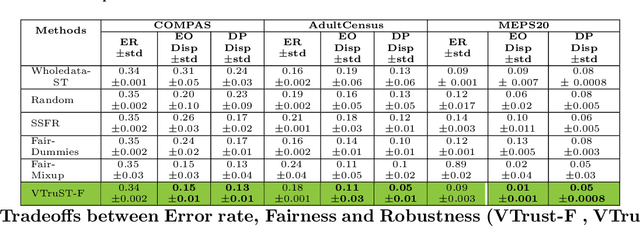
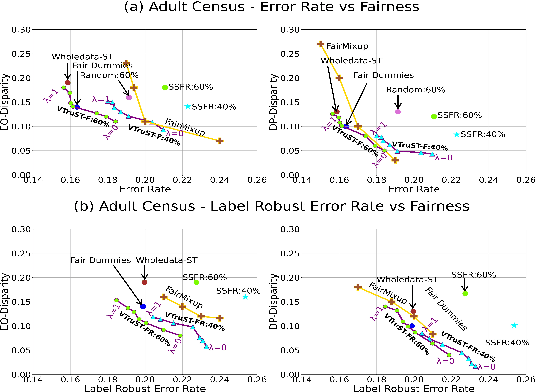
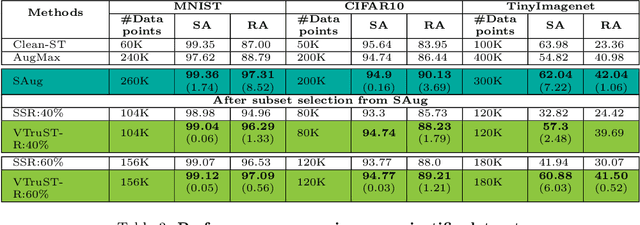
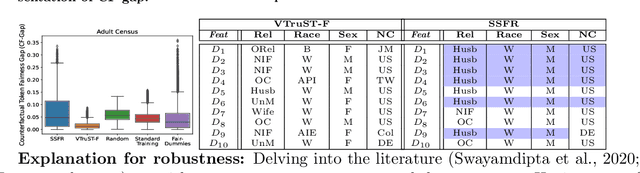
Trustworthy AI is crucial to the widespread adoption of AI in high-stakes applications with fairness, robustness, and accuracy being some of the key trustworthiness metrics. In this work, we propose a controllable framework for data-centric trustworthy AI (DCTAI)- VTruST, that allows users to control the trade-offs between the different trustworthiness metrics of the constructed training datasets. A key challenge in implementing an efficient DCTAI framework is to design an online value-function-based training data subset selection algorithm. We pose the training data valuation and subset selection problem as an online sparse approximation formulation. We propose a novel online version of the Orthogonal Matching Pursuit (OMP) algorithm for solving this problem. Experimental results show that VTruST outperforms the state-of-the-art baselines on social, image, and scientific datasets. We also show that the data values generated by VTruST can provide effective data-centric explanations for different trustworthiness metrics.