 Add to Chrome
 Add to Firefox
 Add to Edge
Warmer for Less: A Cost-Efficient Strategy for Cold-Start Recommendations at Pinterest
Dec 19, 2025
Pinterest is a leading visual discovery platform where recommender systems (RecSys) are key to delivering relevant, engaging, and fresh content to our users. In this paper, we study the problem of improving RecSys model predictions for cold-start (CS) items, which appear infrequently in the training data. Although this problem is well-studied in academia, few studies have addressed its root causes effectively at the scale of a platform like Pinterest. By investigating live traffic data, we identified several challenges of the CS problem and developed a corresponding solution for each: First, industrial-scale RecSys models must operate under tight computational constraints. Since CS items are a minority, any related improvements must be highly cost-efficient. To address this, our solutions were designed to be lightweight, collectively increasing the total parameters by only 5%. Second, CS items are represented only by non-historical (e.g., content or attribute) features, which models often treat as less important. To elevate their significance, we introduce a residual connection for the non-historical features. Third, CS items tend to receive lower prediction scores compared to non-CS items, reducing their likelihood of being surfaced. We mitigate this by incorporating a score regularization term into the model. Fourth, the labels associated with CS items are sparse, making it difficult for the model to learn from them. We apply the manifold mixup technique to address this data sparsity. Implemented together, our methods increased fresh content engagement at Pinterest by 10% without negatively impacting overall engagement and cost, and have been deployed to serve over 570 million users on Pinterest.

GIF: Generative Inspiration for Face Recognition at Scale
May 05, 2025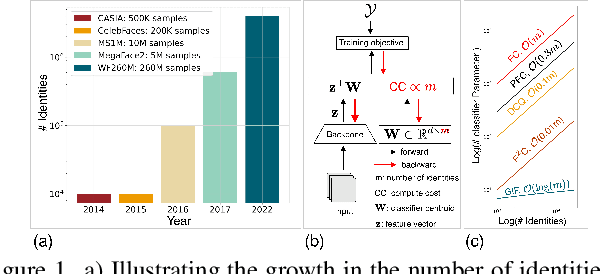
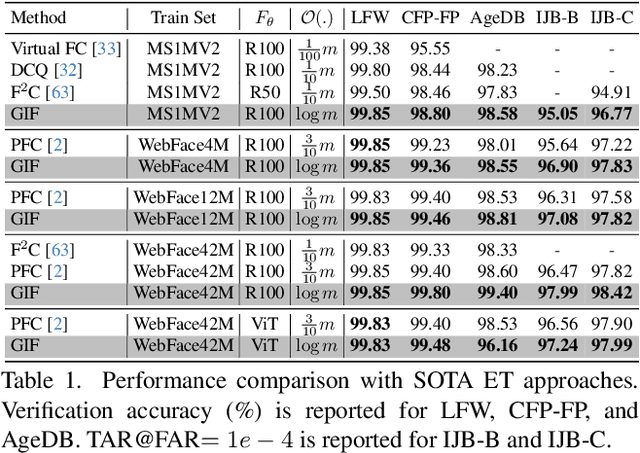
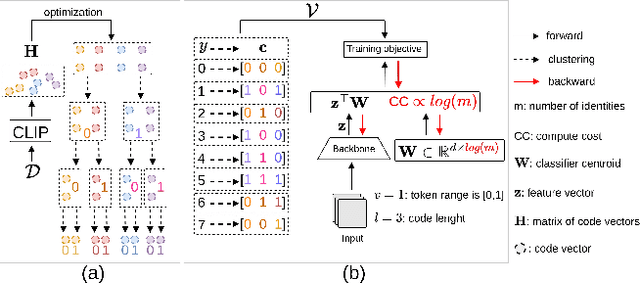
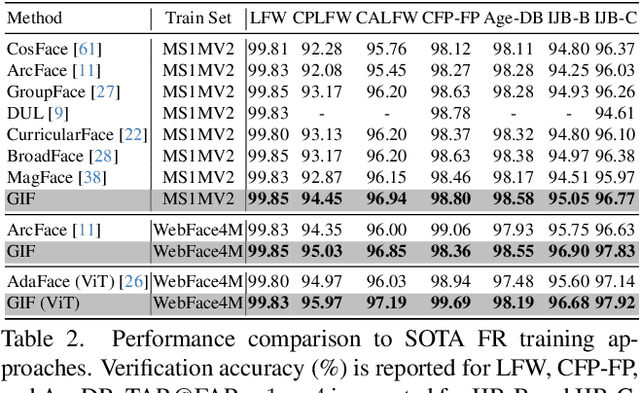
Aiming to reduce the computational cost of Softmax in massive label space of Face Recognition (FR) benchmarks, recent studies estimate the output using a subset of identities. Although promising, the association between the computation cost and the number of identities in the dataset remains linear only with a reduced ratio. A shared characteristic among available FR methods is the employment of atomic scalar labels during training. Consequently, the input to label matching is through a dot product between the feature vector of the input and the Softmax centroids. Inspired by generative modeling, we present a simple yet effective method that substitutes scalar labels with structured identity code, i.e., a sequence of integers. Specifically, we propose a tokenization scheme that transforms atomic scalar labels into structured identity codes. Then, we train an FR backbone to predict the code for each input instead of its scalar label. As a result, the associated computational cost becomes logarithmic w.r.t. number of identities. We demonstrate the benefits of the proposed method by conducting experiments. In particular, our method outperforms its competitors by 1.52%, and 0.6% at TAR@FAR$=1e-4$ on IJB-B and IJB-C, respectively, while transforming the association between computational cost and the number of identities from linear to logarithmic. See code at https://github.com/msed-Ebrahimi/GIF