 Add to Chrome
 Add to Firefox
 Add to Edge
SiamCTC: Learning Speech Representations through Monotonic Temporal Alignment
Jun 01, 2026
Self-supervised speech representation learning has made significant progress through Siamese networks, which leverage different views of the same input. However, existing methods often require frame-wise alignment between these views, overlooking the broader linguistic context invariance across different speaking styles. We introduce SiamCTC, a framework that integrates Siamese networks with Connectionist Temporal Classification (CTC) to learn speech representations without strict frame-level correspondence. By employing CTC loss to establish flexible, monotonic alignments between differing temporal realizations of the same content, SiamCTC accommodates speed perturbations and other temporal augmentations. This design relaxes frame-wise constraints while preserving temporal coherence and enhancing robustness to speaking-rate variations in downstream tasks. Our experiments demonstrate that SiamCTC leads to more adaptable speech representations, particularly at diverse speaking rates.

Decomposed On-Policy Distillation for Vision-Language Reasoning: Steering Gradients for Visual Grounding
May 30, 2026While on-policy distillation offers dense supervision for training small reasoning models, its optimization dynamics in the multimodal domain remain under-explored. In this work, we challenge the standard monolithic view of Vision-Language Model (VLM) distillation by mathematically decomposing the loss into two distinct components: the language prior and visual grounding. Our analysis uncovers that gradient vectors for these components are nearly orthogonal, indicating that the objective of aligning with the teacher's language distribution is geometrically independent from the objective of matching its visual perception. Consequently, standard optimization passively follows a suboptimal compromise trajectory that implicitly balances the two objectives. Hypothesizing that visual grounding constitutes the primary bottleneck for vision-language reasoning, we introduce Visual Gradient Steering (VGS), a method that dynamically reorients the update vector to prioritize the visual subspace. Experimental results on multiple distillation settings and complex multimodal benchmarks demonstrate that VGS significantly outperforms the standard monolithic formulation of on-policy distillation, achieving superior grounding with minimal training overhead.
PDCR: Perception-Decomposed Confidence Reward for Vision-Language Reasoning
May 13, 2026Reinforcement Learning with Verifiable Rewards (RLVR) traditionally relies on a sparse, outcome-based signal. Recent work shows that providing a fine-grained, model-intrinsic signal (rewarding the confidence growth in the ground-truth answer) effectively improves language reasoning training by providing step-level guidance without costly external models. While effective for unimodal text, we find that naively applying this global reward to vision-language (V-L) reasoning is a suboptimal strategy, as the task is a heterogeneous mix of sparse visual perception and dense textual reasoning. This global normalization creates mixture-induced signal degradation, where the training signal for visual steps is statistically distorted by the predominant textual steps. We propose Perception-Decomposed Confidence Reward (PDCR), a framework that solves this by aligning the reward structure with the task's heterogeneous nature. PDCR first performs an unsupervised skill decomposition, introducing a model-internal Visual Dependence Score to quantify visual reliance and applying a clustering algorithm to separate perception and reasoning steps. Based on this, PDCR computes a decomposed advantage by normalizing confidence gains within each skill cluster. This intra-cluster normalization provides a stable, correctly-scaled signal for both perception and reasoning. We demonstrate that PDCR outperforms the naive, global-reward formulation and sparse-reward baselines on key V-L reasoning benchmarks.
High-Fidelity Text-to-Image Generation from Pre-Trained Vision-Language Models via Distribution-Conditioned Diffusion Decoding
Mar 11, 2026Recent large-scale vision-language models (VLMs) have shown remarkable text-to-image generation capabilities, yet their visual fidelity remains constrained by the discrete image tokenization, which poses a major challenge. Although several studies have explored continuous representation modeling to enhance visual quality, adapting pre-trained VLM models to such representations requires large-scale data and training costs comparable to the original pre-training. To circumvent this limitation, we propose a diffusion-based decoding framework that enhances image fidelity by training only a diffusion decoder on the output image-token logits of pre-trained VLMs, thereby preserving the original model intact. At its core, Logit-to-Code Distributional Mapping converts the VLM's image-token logits into continuous, distribution-weighted code vectors with uncertainty features, providing an effective conditioning signal for diffusion decoding. A lightweight Logit Calibration aligns training-time proxy logits from the VQ-VAE encoder with VLM-generated logits, mitigating the train-inference gap. Conditioned on these representations, the Distribution-Conditioned Diffusion Decoder generates high-fidelity images. Achieved solely through short training on ImageNet-1K, our method consistently improves visual fidelity for both VQ-VAE reconstructions and text-to-image generations from VLM-predicted tokens.
Zero-Shot Dual-Path Integration Framework for Open-Vocabulary 3D Instance Segmentation
Aug 16, 2024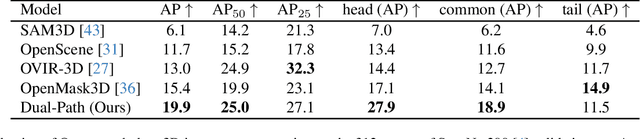
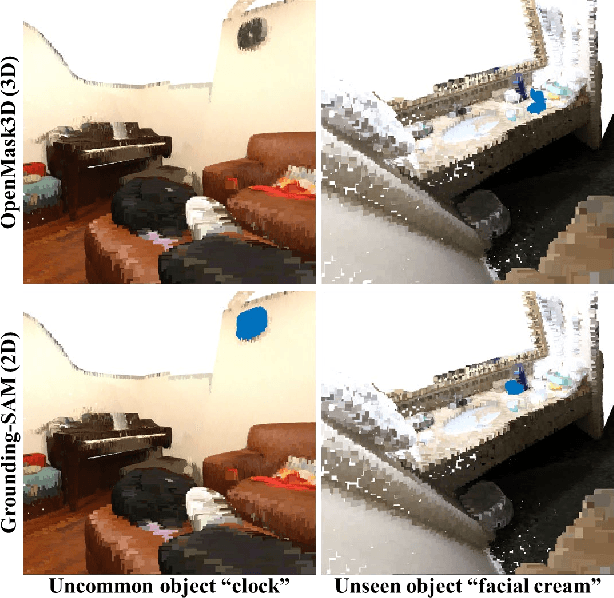

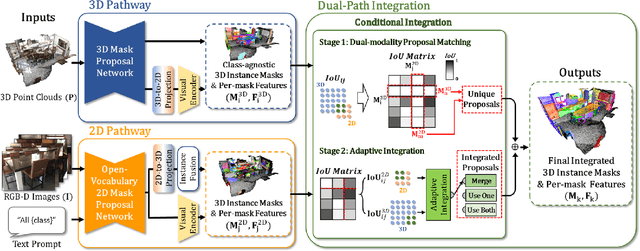
Open-vocabulary 3D instance segmentation transcends traditional closed-vocabulary methods by enabling the identification of both previously seen and unseen objects in real-world scenarios. It leverages a dual-modality approach, utilizing both 3D point clouds and 2D multi-view images to generate class-agnostic object mask proposals. Previous efforts predominantly focused on enhancing 3D mask proposal models; consequently, the information that could come from 2D association to 3D was not fully exploited. This bias towards 3D data, while effective for familiar indoor objects, limits the system's adaptability to new and varied object types, where 2D models offer greater utility. Addressing this gap, we introduce Zero-Shot Dual-Path Integration Framework that equally values the contributions of both 3D and 2D modalities. Our framework comprises three components: 3D pathway, 2D pathway, and Dual-Path Integration. 3D pathway generates spatially accurate class-agnostic mask proposals of common indoor objects from 3D point cloud data using a pre-trained 3D model, while 2D pathway utilizes pre-trained open-vocabulary instance segmentation model to identify a diverse array of object proposals from multi-view RGB-D images. In Dual-Path Integration, our Conditional Integration process, which operates in two stages, filters and merges the proposals from both pathways adaptively. This process harmonizes output proposals to enhance segmentation capabilities. Our framework, utilizing pre-trained models in a zero-shot manner, is model-agnostic and demonstrates superior performance on both seen and unseen data, as evidenced by comprehensive evaluations on the ScanNet200 and qualitative results on ARKitScenes datasets.
TLCR: Token-Level Continuous Reward for Fine-grained Reinforcement Learning from Human Feedback
Jul 23, 2024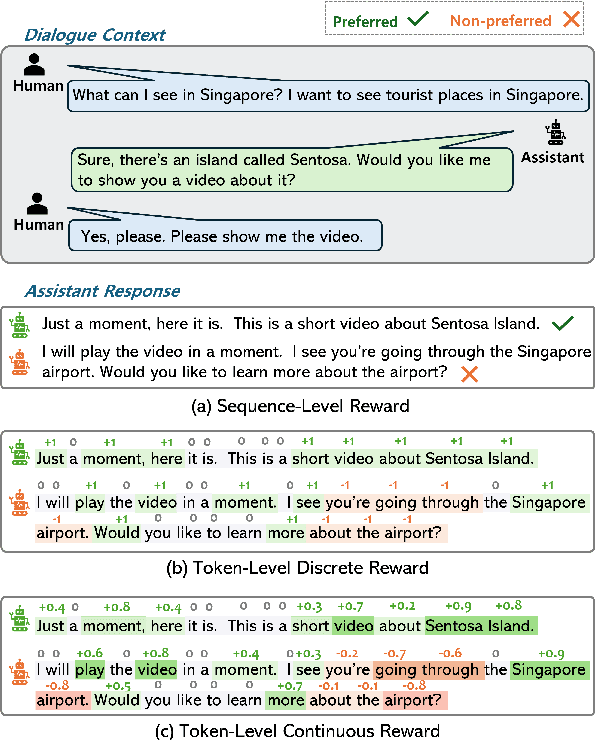
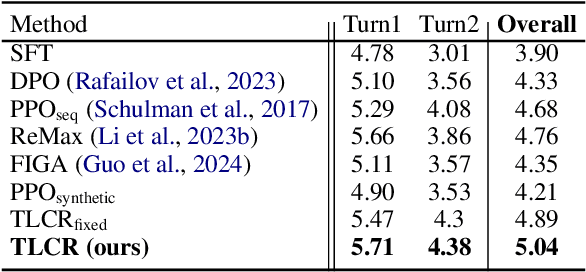
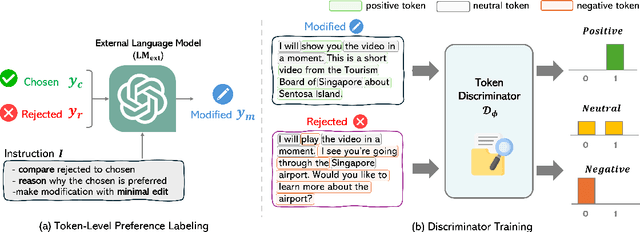
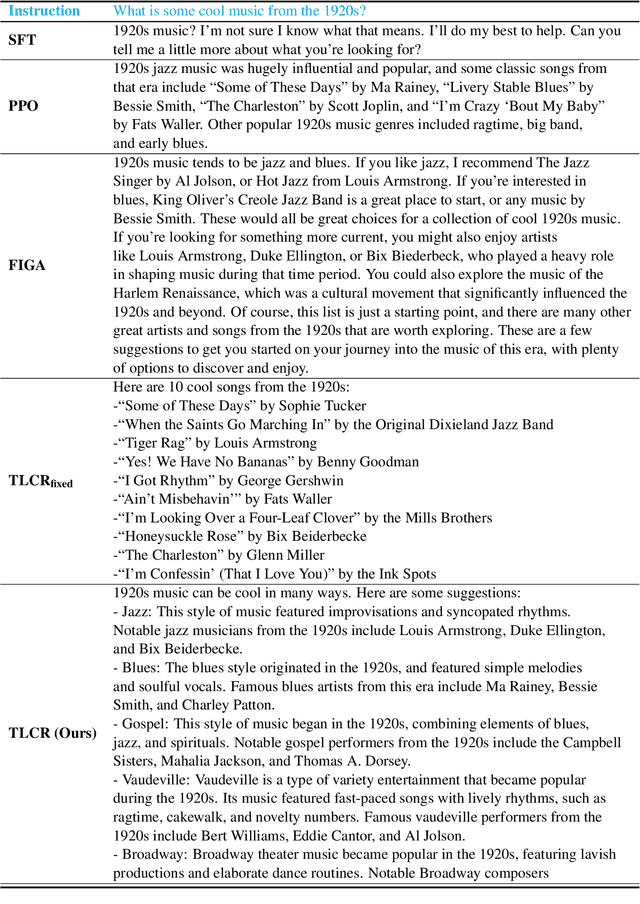
Reinforcement Learning from Human Feedback (RLHF) leverages human preference data to train language models to align more closely with human essence. These human preference data, however, are labeled at the sequence level, creating a mismatch between sequence-level preference labels and tokens, which are autoregressively generated from the language model. Although several recent approaches have tried to provide token-level (i.e., dense) rewards for each individual token, these typically rely on predefined discrete reward values (e.g., positive: +1, negative: -1, neutral: 0), failing to account for varying degrees of preference inherent to each token. To address this limitation, we introduce TLCR (Token-Level Continuous Reward) for RLHF, which incorporates a discriminator trained to distinguish positive and negative tokens, and the confidence of the discriminator is used to assign continuous rewards to each token considering the context. Extensive experiments show that our proposed TLCR leads to consistent performance improvements over previous sequence-level or token-level discrete rewards on open-ended generation benchmarks.
AdaMER-CTC: Connectionist Temporal Classification with Adaptive Maximum Entropy Regularization for Automatic Speech Recognition
Mar 18, 2024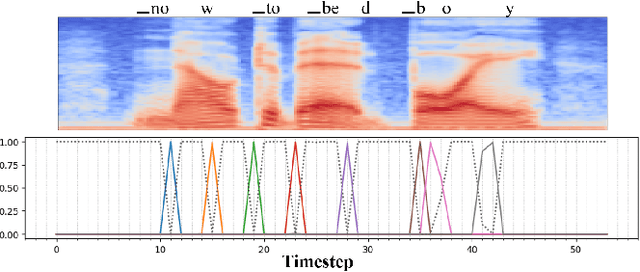
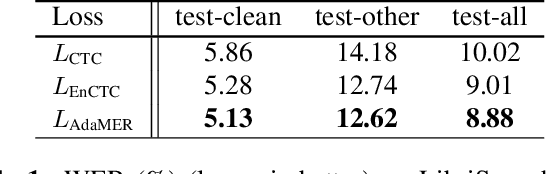
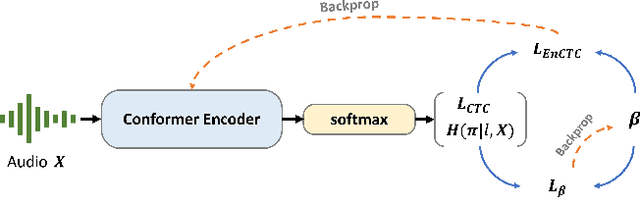
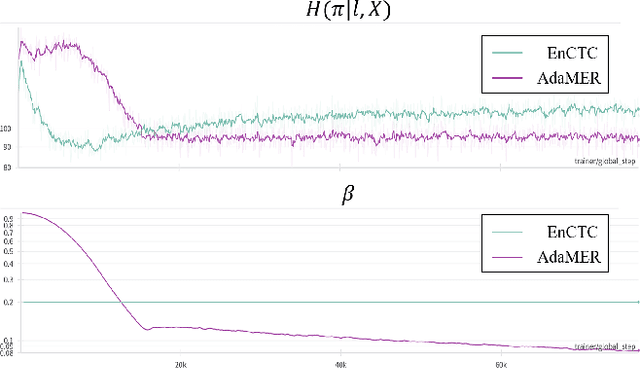
In Automatic Speech Recognition (ASR) systems, a recurring obstacle is the generation of narrowly focused output distributions. This phenomenon emerges as a side effect of Connectionist Temporal Classification (CTC), a robust sequence learning tool that utilizes dynamic programming for sequence mapping. While earlier efforts have tried to combine the CTC loss with an entropy maximization regularization term to mitigate this issue, they employed a constant weighting term on the regularization during the training, which we find may not be optimal. In this work, we introduce Adaptive Maximum Entropy Regularization (AdaMER), a technique that can modulate the impact of entropy regularization throughout the training process. This approach not only refines ASR model training but ensures that as training proceeds, predictions display the desired model confidence.
Mitigating the Exposure Bias in Sentence-Level Grapheme-to-Phoneme (G2P) Transduction
Aug 16, 2023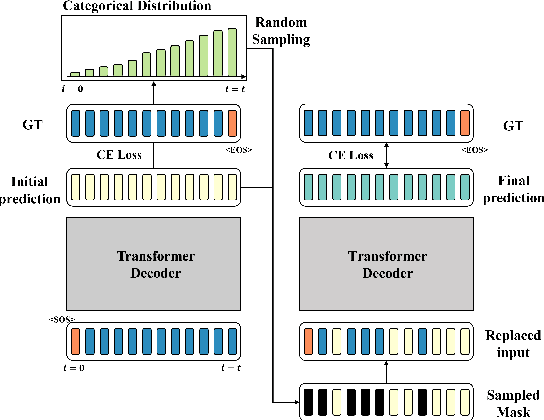
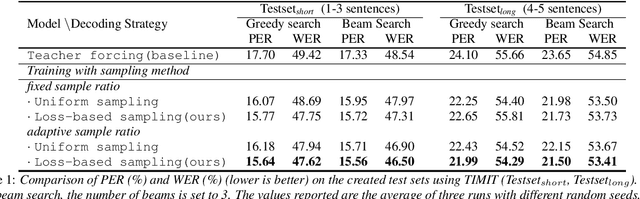
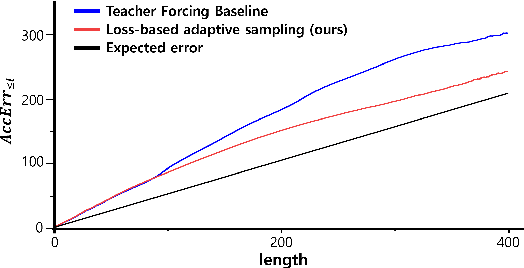
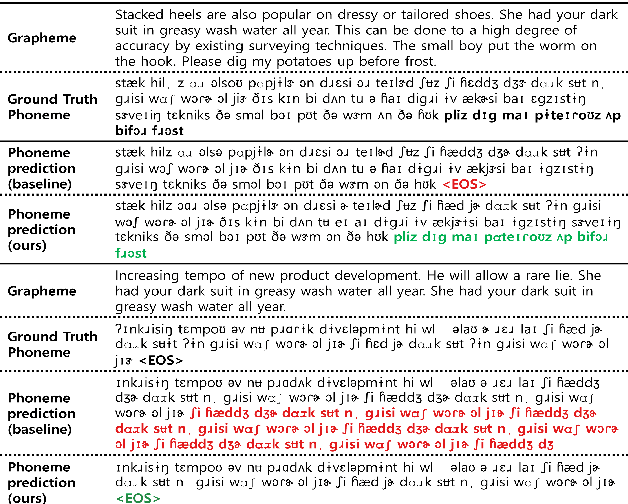
Text-to-Text Transfer Transformer (T5) has recently been considered for the Grapheme-to-Phoneme (G2P) transduction. As a follow-up, a tokenizer-free byte-level model based on T5 referred to as ByT5, recently gave promising results on word-level G2P conversion by representing each input character with its corresponding UTF-8 encoding. Although it is generally understood that sentence-level or paragraph-level G2P can improve usability in real-world applications as it is better suited to perform on heteronyms and linking sounds between words, we find that using ByT5 for these scenarios is nontrivial. Since ByT5 operates on the character level, it requires longer decoding steps, which deteriorates the performance due to the exposure bias commonly observed in auto-regressive generation models. This paper shows that the performance of sentence-level and paragraph-level G2P can be improved by mitigating such exposure bias using our proposed loss-based sampling method.