 Add to Chrome
 Add to Firefox
 Add to Edge
InSpace: Structure-Aware 3D Indoor Scene Generation from a Single 360° Image
Jul 04, 2026
Recent advances in single image-to-3D generation have enabled high-quality asset synthesis, yet extending these capabilities to indoor scene generation remains challenging. Existing methods focus on asset-level generation while neglecting the structural layout, which is essential for downstream applications and serves as the spatial anchor for grounding assets. However, a single image with a limited field of view lacks the spatial coverage to recover a coherent global layout. To this end, we use a 360° image represented in equirectangular projection (ERP) and propose InSpace, a structure-aware framework for 3D indoor scene generation. InSpace comprises three stages: (1) estimating partial scene geometry as spatial priors, (2) generating coarse scene structure with view-selective cross-attention, and (3) producing detailed layout and asset geometry with textures through a global-local hybrid attention, using flow matching. We also propose ERP-FRONT, a paired ERP-Image-to-3D indoor scene dataset based on 3D-FRONT. Experiments show that InSpace generates complete 3D indoor scenes with structural layout, along with separate textured assets from a single ERP image, achieving strong performance across 3D and 2D metrics. Project Page: https://kookie12.github.io/InSpace-Project-Page/

GADA: Geometry-Aware Deformable Aggregation for Image-Based Gaussian Splatting
Jul 01, 2026Gaussian Splatting has achieved significant improvements by incorporating warping-based techniques. However, such methods suffer from pixel-level inaccuracies due to uncertain geometry. This uncertainty leads to spatial misalignments in the warped images, which disrupt residual learning used in warping-based methods and fundamentally limit the gains of correction, particularly on thin structures and high-frequency details. Driven by our insight that useful visual cues are not lost but locally preserved under slight displacement, we propose Geometry-Aware Deformable Aggregation (GADA). This method introduces an iterative refinement module with deformable offsets to actively correct spatial misalignments and recover these displaced cues. Furthermore, to address the limitations of standard pipelines where visibility checks (i.e., thresholding) often discard valid pixels and multi-view warped image fusion relies on naive mean aggregation, our module is coupled with an implicit confidence weighting mechanism that selectively suppresses unreliable evidence. Consequently, our approach outperforms prior warping-based Gaussian Splatting, preserving high-frequency quality while achieving 2.13 times faster FPS.
Query-based Cross-Modal Projector Bolstering Mamba Multimodal LLM
Jun 03, 2026The Transformer's quadratic complexity with input length imposes an unsustainable computational load on large language models (LLMs). In contrast, the Selective Scan Structured State-Space Model, or Mamba, addresses this computational challenge effectively. This paper explores a query-based cross-modal projector designed to bolster Mamba's efficiency for vision-language modeling by compressing visual tokens based on input through the cross-attention mechanism. This innovative projector also removes the need for manually designing the 2D scan order of original image features when converting them into an input sequence for Mamba LLM. Experimental results across various vision-language understanding benchmarks show that the proposed cross-modal projector enhances Mamba-based multimodal LLMs, boosting both performance and throughput.
PDCR: Perception-Decomposed Confidence Reward for Vision-Language Reasoning
May 13, 2026Reinforcement Learning with Verifiable Rewards (RLVR) traditionally relies on a sparse, outcome-based signal. Recent work shows that providing a fine-grained, model-intrinsic signal (rewarding the confidence growth in the ground-truth answer) effectively improves language reasoning training by providing step-level guidance without costly external models. While effective for unimodal text, we find that naively applying this global reward to vision-language (V-L) reasoning is a suboptimal strategy, as the task is a heterogeneous mix of sparse visual perception and dense textual reasoning. This global normalization creates mixture-induced signal degradation, where the training signal for visual steps is statistically distorted by the predominant textual steps. We propose Perception-Decomposed Confidence Reward (PDCR), a framework that solves this by aligning the reward structure with the task's heterogeneous nature. PDCR first performs an unsupervised skill decomposition, introducing a model-internal Visual Dependence Score to quantify visual reliance and applying a clustering algorithm to separate perception and reasoning steps. Based on this, PDCR computes a decomposed advantage by normalizing confidence gains within each skill cluster. This intra-cluster normalization provides a stable, correctly-scaled signal for both perception and reasoning. We demonstrate that PDCR outperforms the naive, global-reward formulation and sparse-reward baselines on key V-L reasoning benchmarks.
High-Fidelity Text-to-Image Generation from Pre-Trained Vision-Language Models via Distribution-Conditioned Diffusion Decoding
Mar 11, 2026Recent large-scale vision-language models (VLMs) have shown remarkable text-to-image generation capabilities, yet their visual fidelity remains constrained by the discrete image tokenization, which poses a major challenge. Although several studies have explored continuous representation modeling to enhance visual quality, adapting pre-trained VLM models to such representations requires large-scale data and training costs comparable to the original pre-training. To circumvent this limitation, we propose a diffusion-based decoding framework that enhances image fidelity by training only a diffusion decoder on the output image-token logits of pre-trained VLMs, thereby preserving the original model intact. At its core, Logit-to-Code Distributional Mapping converts the VLM's image-token logits into continuous, distribution-weighted code vectors with uncertainty features, providing an effective conditioning signal for diffusion decoding. A lightweight Logit Calibration aligns training-time proxy logits from the VQ-VAE encoder with VLM-generated logits, mitigating the train-inference gap. Conditioned on these representations, the Distribution-Conditioned Diffusion Decoder generates high-fidelity images. Achieved solely through short training on ImageNet-1K, our method consistently improves visual fidelity for both VQ-VAE reconstructions and text-to-image generations from VLM-predicted tokens.
ITA-MDT: Image-Timestep-Adaptive Masked Diffusion Transformer Framework for Image-Based Virtual Try-On
Mar 26, 2025This paper introduces ITA-MDT, the Image-Timestep-Adaptive Masked Diffusion Transformer Framework for Image-Based Virtual Try-On (IVTON), designed to overcome the limitations of previous approaches by leveraging the Masked Diffusion Transformer (MDT) for improved handling of both global garment context and fine-grained details. The IVTON task involves seamlessly superimposing a garment from one image onto a person in another, creating a realistic depiction of the person wearing the specified garment. Unlike conventional diffusion-based virtual try-on models that depend on large pre-trained U-Net architectures, ITA-MDT leverages a lightweight, scalable transformer-based denoising diffusion model with a mask latent modeling scheme, achieving competitive results while reducing computational overhead. A key component of ITA-MDT is the Image-Timestep Adaptive Feature Aggregator (ITAFA), a dynamic feature aggregator that combines all of the features from the image encoder into a unified feature of the same size, guided by diffusion timestep and garment image complexity. This enables adaptive weighting of features, allowing the model to emphasize either global information or fine-grained details based on the requirements of the denoising stage. Additionally, the Salient Region Extractor (SRE) module is presented to identify complex region of the garment to provide high-resolution local information to the denoising model as an additional condition alongside the global information of the full garment image. This targeted conditioning strategy enhances detail preservation of fine details in highly salient garment regions, optimizing computational resources by avoiding unnecessarily processing entire garment image. Comparative evaluations confirms that ITA-MDT improves efficiency while maintaining strong performance, reaching state-of-the-art results in several metrics.
TPC: Test-time Procrustes Calibration for Diffusion-based Human Image Animation
Oct 31, 2024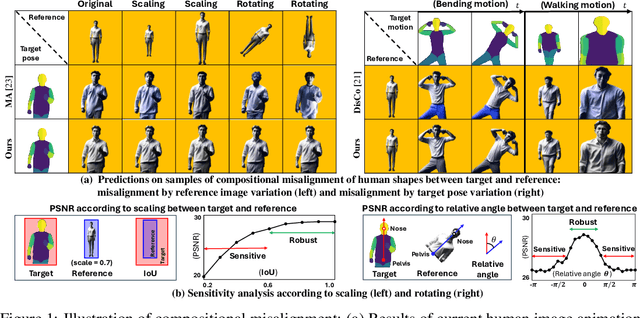
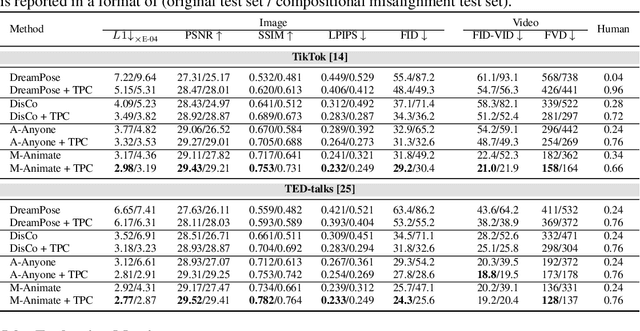
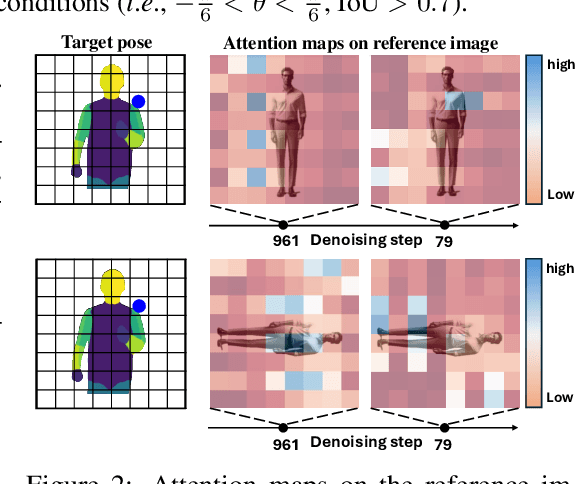
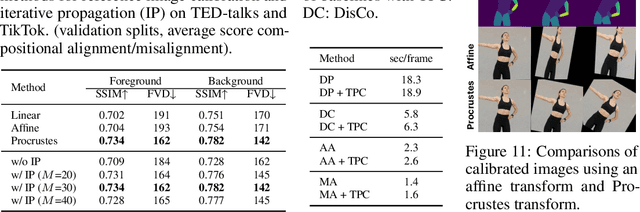
Human image animation aims to generate a human motion video from the inputs of a reference human image and a target motion video. Current diffusion-based image animation systems exhibit high precision in transferring human identity into targeted motion, yet they still exhibit irregular quality in their outputs. Their optimal precision is achieved only when the physical compositions (i.e., scale and rotation) of the human shapes in the reference image and target pose frame are aligned. In the absence of such alignment, there is a noticeable decline in fidelity and consistency. Especially, in real-world environments, this compositional misalignment commonly occurs, posing significant challenges to the practical usage of current systems. To this end, we propose Test-time Procrustes Calibration (TPC), which enhances the robustness of diffusion-based image animation systems by maintaining optimal performance even when faced with compositional misalignment, effectively addressing real-world scenarios. The TPC provides a calibrated reference image for the diffusion model, enhancing its capability to understand the correspondence between human shapes in the reference and target images. Our method is simple and can be applied to any diffusion-based image animation system in a model-agnostic manner, improving the effectiveness at test time without additional training.
FlexiEdit: Frequency-Aware Latent Refinement for Enhanced Non-Rigid Editing
Jul 25, 2024
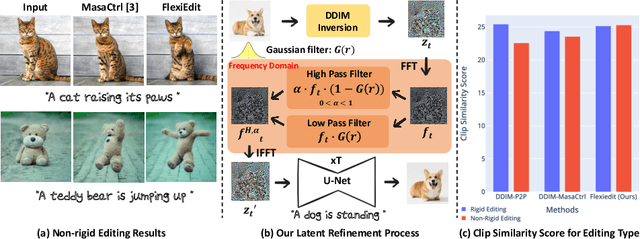
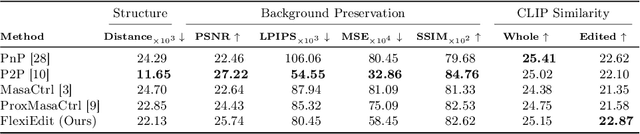
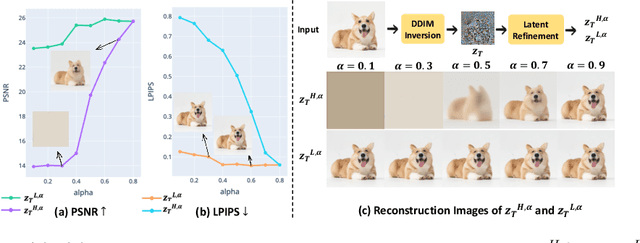
Current image editing methods primarily utilize DDIM Inversion, employing a two-branch diffusion approach to preserve the attributes and layout of the original image. However, these methods encounter challenges with non-rigid edits, which involve altering the image's layout or structure. Our comprehensive analysis reveals that the high-frequency components of DDIM latent, crucial for retaining the original image's key features and layout, significantly contribute to these limitations. Addressing this, we introduce FlexiEdit, which enhances fidelity to input text prompts by refining DDIM latent, by reducing high-frequency components in targeted editing areas. FlexiEdit comprises two key components: (1) Latent Refinement, which modifies DDIM latent to better accommodate layout adjustments, and (2) Edit Fidelity Enhancement via Re-inversion, aimed at ensuring the edits more accurately reflect the input text prompts. Our approach represents notable progress in image editing, particularly in performing complex non-rigid edits, showcasing its enhanced capability through comparative experiments.
FRAG: Frequency Adapting Group for Diffusion Video Editing
Jun 10, 2024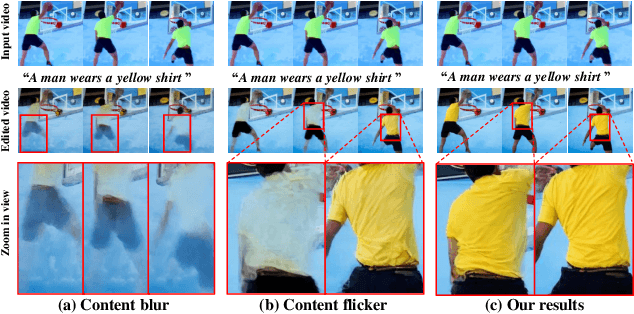
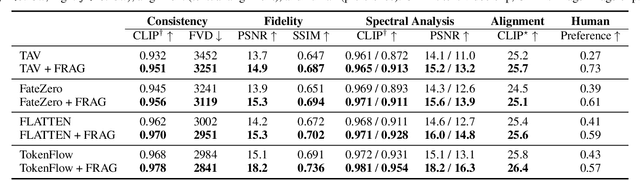
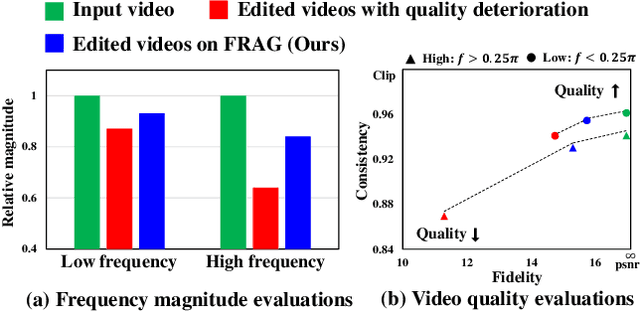
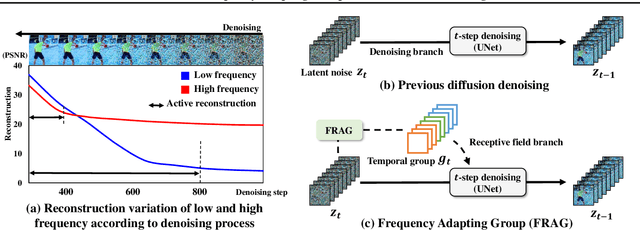
In video editing, the hallmark of a quality edit lies in its consistent and unobtrusive adjustment. Modification, when integrated, must be smooth and subtle, preserving the natural flow and aligning seamlessly with the original vision. Therefore, our primary focus is on overcoming the current challenges in high quality edit to ensure that each edit enhances the final product without disrupting its intended essence. However, quality deterioration such as blurring and flickering is routinely observed in recent diffusion video editing systems. We confirm that this deterioration often stems from high-frequency leak: the diffusion model fails to accurately synthesize high-frequency components during denoising process. To this end, we devise Frequency Adapting Group (FRAG) which enhances the video quality in terms of consistency and fidelity by introducing a novel receptive field branch to preserve high-frequency components during the denoising process. FRAG is performed in a model-agnostic manner without additional training and validates the effectiveness on video editing benchmarks (i.e., TGVE, DAVIS).
Wavelet-Guided Acceleration of Text Inversion in Diffusion-Based Image Editing
Jan 18, 2024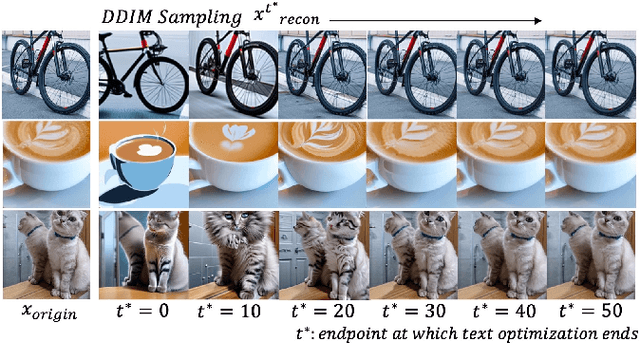
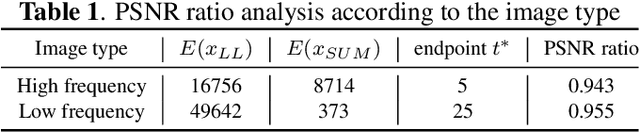
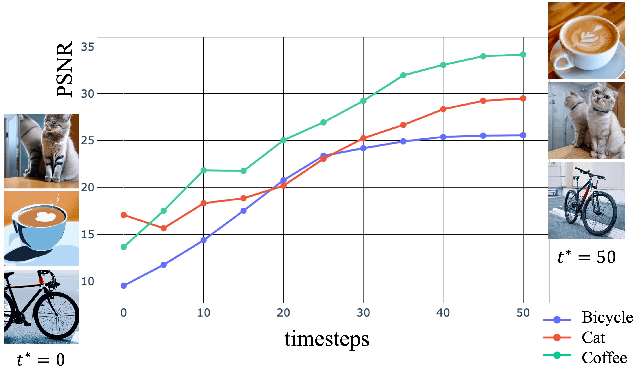
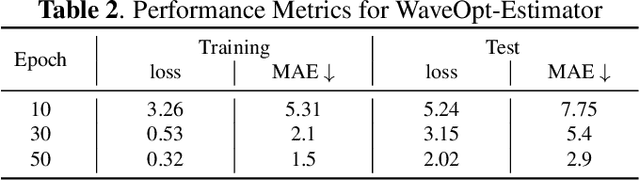
In the field of image editing, Null-text Inversion (NTI) enables fine-grained editing while preserving the structure of the original image by optimizing null embeddings during the DDIM sampling process. However, the NTI process is time-consuming, taking more than two minutes per image. To address this, we introduce an innovative method that maintains the principles of the NTI while accelerating the image editing process. We propose the WaveOpt-Estimator, which determines the text optimization endpoint based on frequency characteristics. Utilizing wavelet transform analysis to identify the image's frequency characteristics, we can limit text optimization to specific timesteps during the DDIM sampling process. By adopting the Negative-Prompt Inversion (NPI) concept, a target prompt representing the original image serves as the initial text value for optimization. This approach maintains performance comparable to NTI while reducing the average editing time by over 80% compared to the NTI method. Our method presents a promising approach for efficient, high-quality image editing based on diffusion models.