 Add to Chrome
 Add to Firefox
 Add to Edge
Token-level Response-visual Attention Guidance for Multimodal LLMs Knowledge Distillation
Jul 01, 2026
While knowledge distillation (KD) is widely adopted for training lightweight models by leveraging supervision from larger teacher models, relying solely on output token distributions has proven insufficient for compressing Multimodal Large Language Models (MLLMs). Since output tokens are a byproduct of the model attending to visual inputs, prior works have explored explicitly distilling attention to provide a direct supervisory signal. While promising, the precise utility of which attention signals to distill remains under-explored. In this work, we challenge the conventional reliance on prompt-to-vision attention by revealing that downstream performance correlates strongly with response-to-vision attention similarity to the teacher, but negligibly with that of prompt-conditioned attention. Furthermore, we observe that attention distributions exhibit significant variance across individual tokens, indicating that a uniform distillation objective is suboptimal. To this end, we introduce Token-level Response-visual Attention Guidance (TRAG), a distillation objective that 1) shifts the focus to response-to-vision signals and 2) employs token-specific objectives by adaptively weighting the Kullback-Leibler divergence based on attention entropy, effectively guiding the student to mirror the teacher's precise visual focus. Extensive experimental results on multiple benchmarks demonstrate that TRAG significantly outperforms prior distillation baselines.

Transcript-Free Flow-Matching Text-to-Speech via Speech Feature Conditioning
Jun 18, 2026Recent flow-matching text-to-speech (TTS) models, such as F5-TTS, rely on a reference transcript at inference time, obtained from an external ASR system. This dependency makes zero-shot TTS brittle for accented or dysarthric speakers, precisely the scenarios where it is most needed. Moreover, we find that text-based reference conditioning can propagate atypical acoustic patterns from atypical speech into synthesis, even when ground-truth transcripts are available. To address this, we propose RTFree-F5, which replaces the reference transcript with continuous self-supervised speech representations mapped into F5-TTS's text-conditioning space via a lightweight adapter, while reusing the pretrained checkpoint. On dysarthric speech, RTFree-F5 reduces WER from 24.6% to 10.4%, surpassing even the ground-truth reference transcript baselines, while improving naturalness and remaining competitive on standard benchmarks without requiring any reference transcript.
Decomposed On-Policy Distillation for Vision-Language Reasoning: Steering Gradients for Visual Grounding
May 30, 2026While on-policy distillation offers dense supervision for training small reasoning models, its optimization dynamics in the multimodal domain remain under-explored. In this work, we challenge the standard monolithic view of Vision-Language Model (VLM) distillation by mathematically decomposing the loss into two distinct components: the language prior and visual grounding. Our analysis uncovers that gradient vectors for these components are nearly orthogonal, indicating that the objective of aligning with the teacher's language distribution is geometrically independent from the objective of matching its visual perception. Consequently, standard optimization passively follows a suboptimal compromise trajectory that implicitly balances the two objectives. Hypothesizing that visual grounding constitutes the primary bottleneck for vision-language reasoning, we introduce Visual Gradient Steering (VGS), a method that dynamically reorients the update vector to prioritize the visual subspace. Experimental results on multiple distillation settings and complex multimodal benchmarks demonstrate that VGS significantly outperforms the standard monolithic formulation of on-policy distillation, achieving superior grounding with minimal training overhead.
PDCR: Perception-Decomposed Confidence Reward for Vision-Language Reasoning
May 13, 2026Reinforcement Learning with Verifiable Rewards (RLVR) traditionally relies on a sparse, outcome-based signal. Recent work shows that providing a fine-grained, model-intrinsic signal (rewarding the confidence growth in the ground-truth answer) effectively improves language reasoning training by providing step-level guidance without costly external models. While effective for unimodal text, we find that naively applying this global reward to vision-language (V-L) reasoning is a suboptimal strategy, as the task is a heterogeneous mix of sparse visual perception and dense textual reasoning. This global normalization creates mixture-induced signal degradation, where the training signal for visual steps is statistically distorted by the predominant textual steps. We propose Perception-Decomposed Confidence Reward (PDCR), a framework that solves this by aligning the reward structure with the task's heterogeneous nature. PDCR first performs an unsupervised skill decomposition, introducing a model-internal Visual Dependence Score to quantify visual reliance and applying a clustering algorithm to separate perception and reasoning steps. Based on this, PDCR computes a decomposed advantage by normalizing confidence gains within each skill cluster. This intra-cluster normalization provides a stable, correctly-scaled signal for both perception and reasoning. We demonstrate that PDCR outperforms the naive, global-reward formulation and sparse-reward baselines on key V-L reasoning benchmarks.
High-Fidelity Text-to-Image Generation from Pre-Trained Vision-Language Models via Distribution-Conditioned Diffusion Decoding
Mar 11, 2026Recent large-scale vision-language models (VLMs) have shown remarkable text-to-image generation capabilities, yet their visual fidelity remains constrained by the discrete image tokenization, which poses a major challenge. Although several studies have explored continuous representation modeling to enhance visual quality, adapting pre-trained VLM models to such representations requires large-scale data and training costs comparable to the original pre-training. To circumvent this limitation, we propose a diffusion-based decoding framework that enhances image fidelity by training only a diffusion decoder on the output image-token logits of pre-trained VLMs, thereby preserving the original model intact. At its core, Logit-to-Code Distributional Mapping converts the VLM's image-token logits into continuous, distribution-weighted code vectors with uncertainty features, providing an effective conditioning signal for diffusion decoding. A lightweight Logit Calibration aligns training-time proxy logits from the VQ-VAE encoder with VLM-generated logits, mitigating the train-inference gap. Conditioned on these representations, the Distribution-Conditioned Diffusion Decoder generates high-fidelity images. Achieved solely through short training on ImageNet-1K, our method consistently improves visual fidelity for both VQ-VAE reconstructions and text-to-image generations from VLM-predicted tokens.
ConfPO: Exploiting Policy Model Confidence for Critical Token Selection in Preference Optimization
Jun 12, 2025We introduce ConfPO, a method for preference learning in Large Language Models (LLMs) that identifies and optimizes preference-critical tokens based solely on the training policy's confidence, without requiring any auxiliary models or compute. Unlike prior Direct Alignment Algorithms (DAAs) such as Direct Preference Optimization (DPO), which uniformly adjust all token probabilities regardless of their relevance to preference, ConfPO focuses optimization on the most impactful tokens. This targeted approach improves alignment quality while mitigating overoptimization (i.e., reward hacking) by using the KL divergence budget more efficiently. In contrast to recent token-level methods that rely on credit-assignment models or AI annotators, raising concerns about scalability and reliability, ConfPO is simple, lightweight, and model-free. Experimental results on challenging alignment benchmarks, including AlpacaEval 2 and Arena-Hard, demonstrate that ConfPO consistently outperforms uniform DAAs across various LLMs, delivering better alignment with zero additional computational overhead.
Physics Informed Distillation for Diffusion Models
Nov 13, 2024


Diffusion models have recently emerged as a potent tool in generative modeling. However, their inherent iterative nature often results in sluggish image generation due to the requirement for multiple model evaluations. Recent progress has unveiled the intrinsic link between diffusion models and Probability Flow Ordinary Differential Equations (ODEs), thus enabling us to conceptualize diffusion models as ODE systems. Simultaneously, Physics Informed Neural Networks (PINNs) have substantiated their effectiveness in solving intricate differential equations through implicit modeling of their solutions. Building upon these foundational insights, we introduce Physics Informed Distillation (PID), which employs a student model to represent the solution of the ODE system corresponding to the teacher diffusion model, akin to the principles employed in PINNs. Through experiments on CIFAR 10 and ImageNet 64x64, we observe that PID achieves performance comparable to recent distillation methods. Notably, it demonstrates predictable trends concerning method-specific hyperparameters and eliminates the need for synthetic dataset generation during the distillation process. Both of which contribute to its easy-to-use nature as a distillation approach for Diffusion Models. Our code and pre-trained checkpoint are publicly available at: https://github.com/pantheon5100/pid_diffusion.git.
BI-MDRG: Bridging Image History in Multimodal Dialogue Response Generation
Aug 12, 2024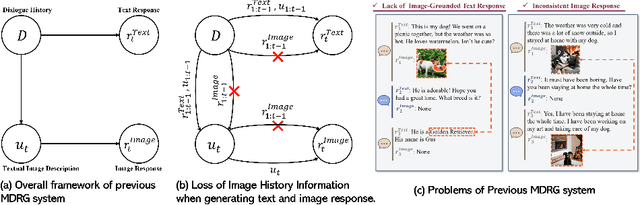
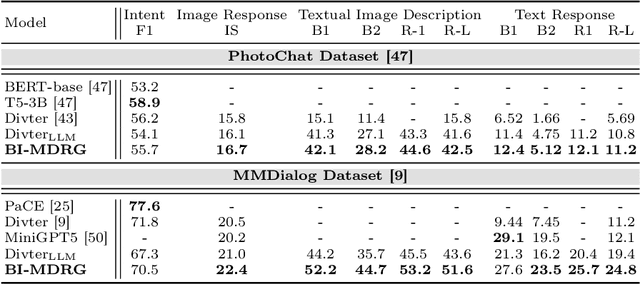
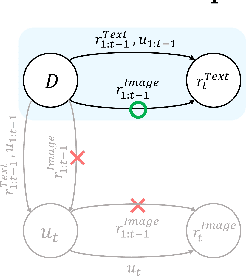
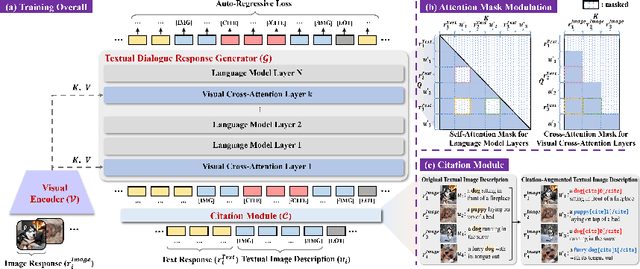
Multimodal Dialogue Response Generation (MDRG) is a recently proposed task where the model needs to generate responses in texts, images, or a blend of both based on the dialogue context. Due to the lack of a large-scale dataset specifically for this task and the benefits of leveraging powerful pre-trained models, previous work relies on the text modality as an intermediary step for both the image input and output of the model rather than adopting an end-to-end approach. However, this approach can overlook crucial information about the image, hindering 1) image-grounded text response and 2) consistency of objects in the image response. In this paper, we propose BI-MDRG that bridges the response generation path such that the image history information is utilized for enhanced relevance of text responses to the image content and the consistency of objects in sequential image responses. Through extensive experiments on the multimodal dialogue benchmark dataset, we show that BI-MDRG can effectively increase the quality of multimodal dialogue. Additionally, recognizing the gap in benchmark datasets for evaluating the image consistency in multimodal dialogue, we have created a curated set of 300 dialogues annotated to track object consistency across conversations.
LI-TTA: Language Informed Test-Time Adaptation for Automatic Speech Recognition
Aug 11, 2024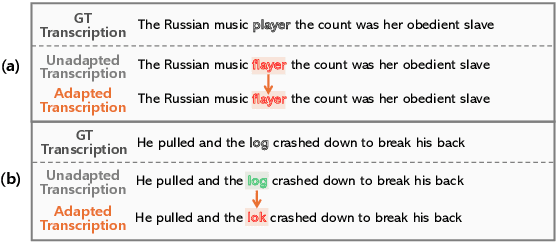
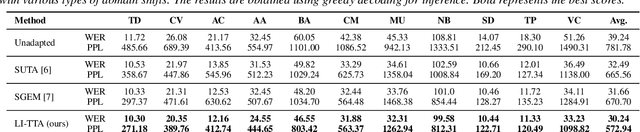
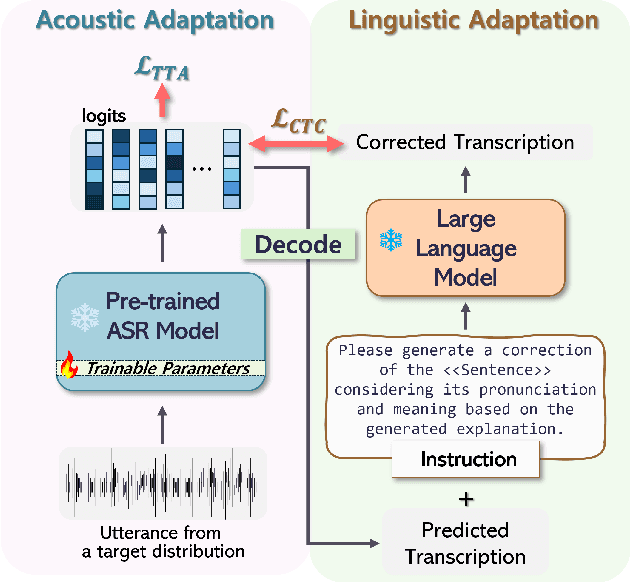
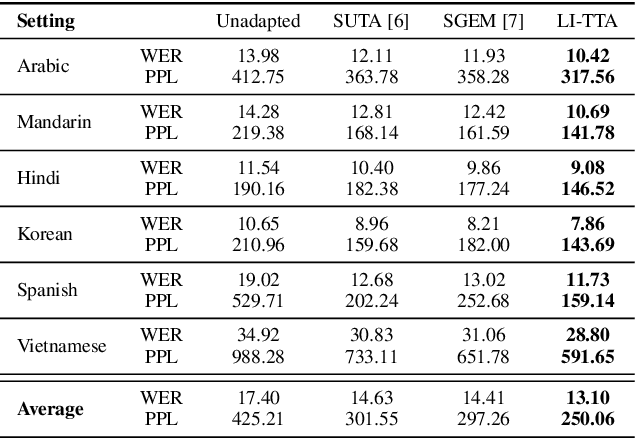
Test-Time Adaptation (TTA) has emerged as a crucial solution to the domain shift challenge, wherein the target environment diverges from the original training environment. A prime exemplification is TTA for Automatic Speech Recognition (ASR), which enhances model performance by leveraging output prediction entropy minimization as a self-supervision signal. However, a key limitation of this self-supervision lies in its primary focus on acoustic features, with minimal attention to the linguistic properties of the input. To address this gap, we propose Language Informed Test-Time Adaptation (LI-TTA), which incorporates linguistic insights during TTA for ASR. LI-TTA integrates corrections from an external language model to merge linguistic with acoustic information by minimizing the CTC loss from the correction alongside the standard TTA loss. With extensive experiments, we show that LI-TTA effectively improves the performance of TTA for ASR in various distribution shift situations.
TLCR: Token-Level Continuous Reward for Fine-grained Reinforcement Learning from Human Feedback
Jul 23, 2024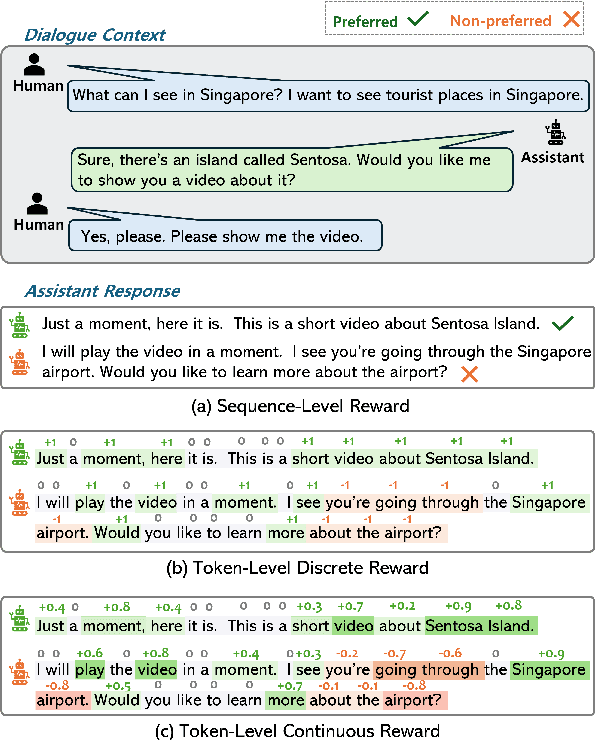
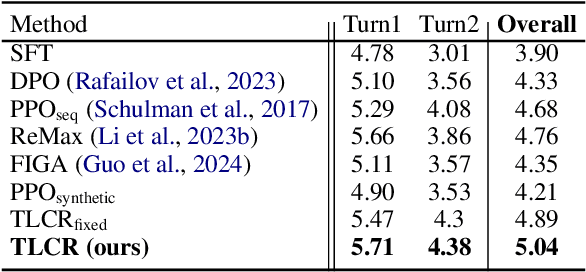
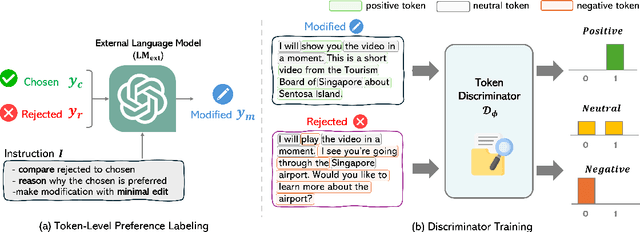
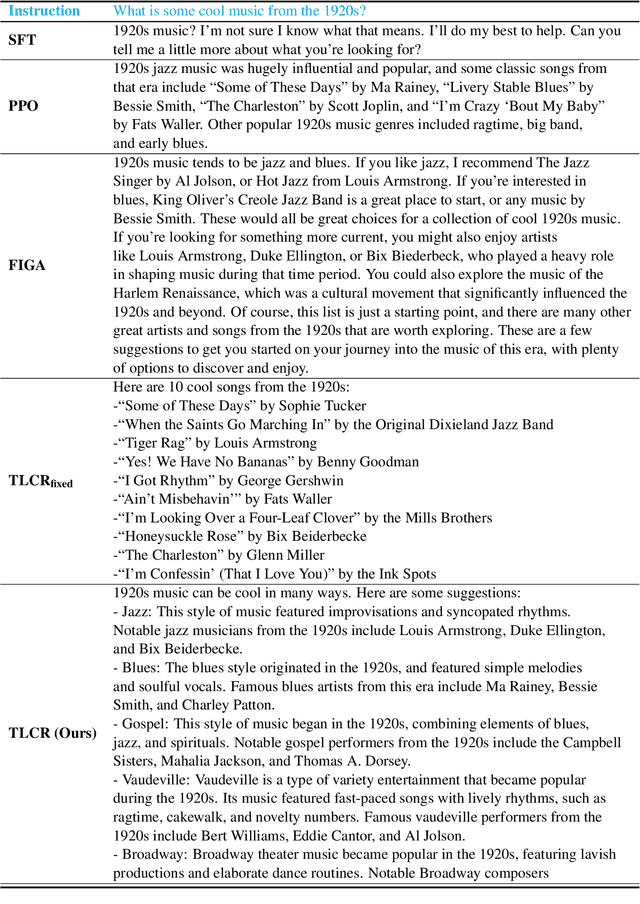
Reinforcement Learning from Human Feedback (RLHF) leverages human preference data to train language models to align more closely with human essence. These human preference data, however, are labeled at the sequence level, creating a mismatch between sequence-level preference labels and tokens, which are autoregressively generated from the language model. Although several recent approaches have tried to provide token-level (i.e., dense) rewards for each individual token, these typically rely on predefined discrete reward values (e.g., positive: +1, negative: -1, neutral: 0), failing to account for varying degrees of preference inherent to each token. To address this limitation, we introduce TLCR (Token-Level Continuous Reward) for RLHF, which incorporates a discriminator trained to distinguish positive and negative tokens, and the confidence of the discriminator is used to assign continuous rewards to each token considering the context. Extensive experiments show that our proposed TLCR leads to consistent performance improvements over previous sequence-level or token-level discrete rewards on open-ended generation benchmarks.