 Add to Chrome
 Add to Firefox
 Add to Edge
PPO-EAL: Exact Augmented Lagrangian Proximal Policy Optimization for Safe Robotic Control
Jun 26, 2026
Reinforcement learning (RL) has emerged as a promising solution to accomplish complex robotic control tasks; however, most of the current work ignores the safety requirements. Safe RL seeks to maximize task performance while satisfying explicit physical constraints, but current algorithms struggle to learn the policy efficiently with precise constraint satisfaction. This work proposes PPO-EAL, a novel first-order constrained policy optimization framework that integrates exact augmented Lagrangian optimization into proximal policy optimization for safe robotic control. By combining clipped policy updates with exact quadratic penalty terms, PPO-EAL achieves theoretically grounded constraint enforcement without requiring impractically large penalty factors. A momentum-regulated multiplier update further improves dual-variable stability, reducing constraint oscillation and unsafe behavior while preserving task performance. We provide exactness and convergence analysis under standard stochastic approximation assumptions. Extensive validation across diverse GPU-accelerated robotic benchmarks-including cart-pole balancing, cart-double-pendulum stabilization, 7-DoF Franka end-effector reaching, and quadrupedal locomotion-demonstrates superior safety precision and reward performance compared with state-of-the-art first-order safe RL baselines. Finally, we demonstrate zero-shot sim-to-real deployment in a contact-rich gear assembly task, where PPO-EAL substantially improves task success, reduces peak contact force, and enhances operational robustness. These results establish PPO-EAL as a general and practically deployable safe RL framework for diverse safety-critical robotic systems.

StruXLIP: Enhancing Vision-language Models with Multimodal Structural Cues
Feb 25, 2026Edge-based representations are fundamental cues for visual understanding, a principle rooted in early vision research and still central today. We extend this principle to vision-language alignment, showing that isolating and aligning structural cues across modalities can greatly benefit fine-tuning on long, detail-rich captions, with a specific focus on improving cross-modal retrieval. We introduce StruXLIP, a fine-tuning alignment paradigm that extracts edge maps (e.g., Canny), treating them as proxies for the visual structure of an image, and filters the corresponding captions to emphasize structural cues, making them "structure-centric". Fine-tuning augments the standard alignment loss with three structure-centric losses: (i) aligning edge maps with structural text, (ii) matching local edge regions to textual chunks, and (iii) connecting edge maps to color images to prevent representation drift. From a theoretical standpoint, while standard CLIP maximizes the mutual information between visual and textual embeddings, StruXLIP additionally maximizes the mutual information between multimodal structural representations. This auxiliary optimization is intrinsically harder, guiding the model toward more robust and semantically stable minima, enhancing vision-language alignment. Beyond outperforming current competitors on cross-modal retrieval in both general and specialized domains, our method serves as a general boosting recipe that can be integrated into future approaches in a plug-and-play manner. Code and pretrained models are publicly available at: https://github.com/intelligolabs/StruXLIP.
UDE-based Dynamic Motion Force Control of Mobile Manipulators
Mar 30, 2024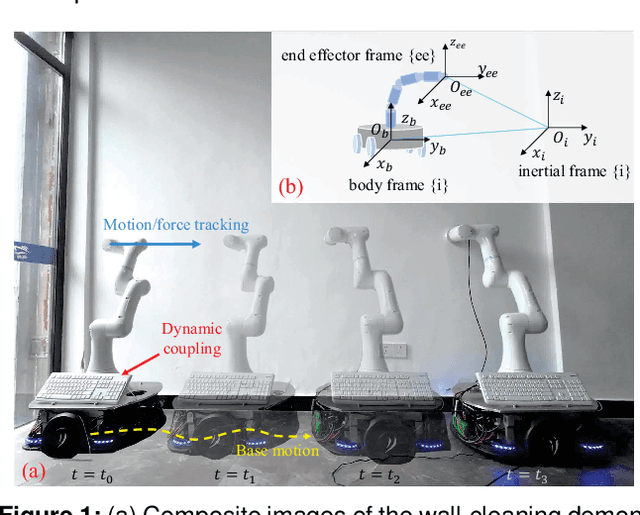
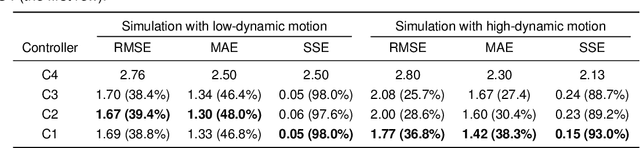
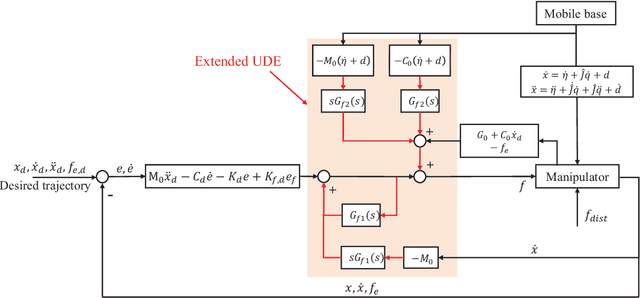
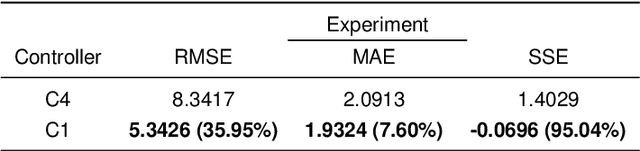
Mobile manipulators are known for their superior mobility over manipulators on fixed bases, offering promising applications in smart industry and housekeeping scenarios. However, the dynamic coupling nature between the mobile base and the manipulator presents challenges for the physical interactive tasks of the mobile manipulator. Current methods suffer from complex modeling processes and poor transferability. To address this, this article presents a novel dynamic model of the manipulator on the mobile base that requires only the manipulator dynamics and the kinematic information of the mobile base. In addition, embedding the dynamic model, an uncertainty and disturbance estimator-based (UDE-based) dynamic motion/force control scheme is proposed for the mobile manipulator, which compensates for the dynamic coupling and other unmodeled uncertainties. Passivity and stability analyses justify the proposed control law. Simulation and experimental results on our mobile manipulator platform demonstrate the feasibility and effectiveness of our proposed methodology.