 Add to Chrome
 Add to Firefox
 Add to Edge
Is SAM3 ready for pathology segmentation?
Apr 20, 2026
Is Segment Anything Model 3 (SAM3) capable in segmenting Any Pathology Images? Digital pathology segmentation spans tissue-level and nuclei-level scales, where traditional methods often suffer from high annotation costs and poor generalization. SAM3 introduces Promptable Concept Segmentation, offering a potential automated interface via text prompts. With this work, we propose a systematic evaluation protocol to explore the capability space of SAM3 in a structured manner. Specifically, we evaluate SAM3 under different supervision settings including zero-shot, few-shot, and supervised with varying prompting strategies. Our extensive evaluation on pathological datasets including NuInsSeg, PanNuke and GlaS, reveals that: 1.text-only prompts poorly activate nuclear concepts. 2.performance is highly sensitive to visual prompt types and budgets. 3.few-shot learning offers gains, but SAM3 lacks robustness against visual prompt noise. and 4.a significant gap persists between prompt-based usage and task-trained adapter-based reference. Our study delineates SAM3's boundaries in pathology image segmentation and provides practical guidance on the necessity of pathology domain adaptation.

StruXLIP: Enhancing Vision-language Models with Multimodal Structural Cues
Feb 25, 2026Edge-based representations are fundamental cues for visual understanding, a principle rooted in early vision research and still central today. We extend this principle to vision-language alignment, showing that isolating and aligning structural cues across modalities can greatly benefit fine-tuning on long, detail-rich captions, with a specific focus on improving cross-modal retrieval. We introduce StruXLIP, a fine-tuning alignment paradigm that extracts edge maps (e.g., Canny), treating them as proxies for the visual structure of an image, and filters the corresponding captions to emphasize structural cues, making them "structure-centric". Fine-tuning augments the standard alignment loss with three structure-centric losses: (i) aligning edge maps with structural text, (ii) matching local edge regions to textual chunks, and (iii) connecting edge maps to color images to prevent representation drift. From a theoretical standpoint, while standard CLIP maximizes the mutual information between visual and textual embeddings, StruXLIP additionally maximizes the mutual information between multimodal structural representations. This auxiliary optimization is intrinsically harder, guiding the model toward more robust and semantically stable minima, enhancing vision-language alignment. Beyond outperforming current competitors on cross-modal retrieval in both general and specialized domains, our method serves as a general boosting recipe that can be integrated into future approaches in a plug-and-play manner. Code and pretrained models are publicly available at: https://github.com/intelligolabs/StruXLIP.
LOTS of Fashion! Multi-Conditioning for Image Generation via Sketch-Text Pairing
Jul 30, 2025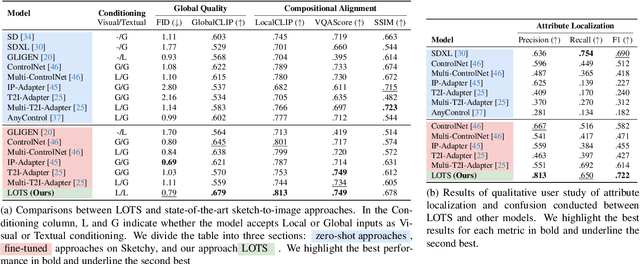
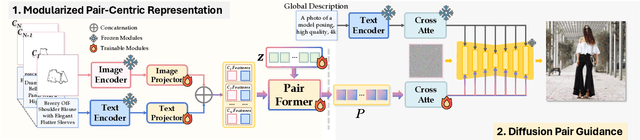
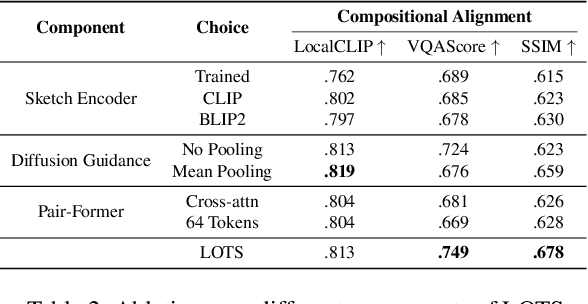
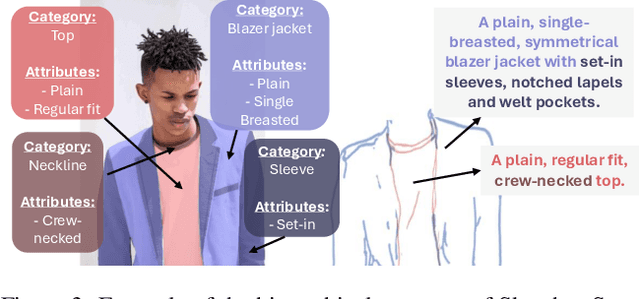
Fashion design is a complex creative process that blends visual and textual expressions. Designers convey ideas through sketches, which define spatial structure and design elements, and textual descriptions, capturing material, texture, and stylistic details. In this paper, we present LOcalized Text and Sketch for fashion image generation (LOTS), an approach for compositional sketch-text based generation of complete fashion outlooks. LOTS leverages a global description with paired localized sketch + text information for conditioning and introduces a novel step-based merging strategy for diffusion adaptation. First, a Modularized Pair-Centric representation encodes sketches and text into a shared latent space while preserving independent localized features; then, a Diffusion Pair Guidance phase integrates both local and global conditioning via attention-based guidance within the diffusion model's multi-step denoising process. To validate our method, we build on Fashionpedia to release Sketchy, the first fashion dataset where multiple text-sketch pairs are provided per image. Quantitative results show LOTS achieves state-of-the-art image generation performance on both global and localized metrics, while qualitative examples and a human evaluation study highlight its unprecedented level of design customization.