 Add to Chrome
 Add to Firefox
 Add to Edge
Rethinking Representations for Cross-Domain Infrared Small Target Detection: A Generalizable Perspective from the Frequency Domain
Apr 02, 2026
The accurate target-background separation in infrared small target detection (IRSTD) highly depends on the discriminability of extracted representations. However, most existing methods are confined to domain-consistent settings, while overlooking whether such discriminability can generalize to unseen domains. In practice, distribution shifts between training and testing data are inevitable due to variations in observational conditions and environmental factors. Meanwhile, the intrinsic indistinctiveness of infrared small targets aggravates overfitting to domain-specific patterns. Consequently, the detection performance of models trained on source domains can be severely degraded when deployed in unseen domains. To address this challenge, we propose a spatial-spectral collaborative perception network (S$^2$CPNet) for cross-domain IRSTD. Moving beyond conventional spatial learning pipelines, we rethink IRSTD representations from a frequency perspective and reveal inconsistencies in spectral phase as the primary manifestation of domain discrepancies. Based on this insight, we develop a phase rectification module (PRM) to derive generalizable target awareness. Then, we employ an orthogonal attention mechanism (OAM) in skip connections to preserve positional information while refining informative representations. Moreover, the bias toward domain-specific patterns is further mitigated through selective style recomposition (SSR). Extensive experiments have been conducted on three IRSTD datasets, and the proposed method consistently achieves state-of-the-art performance under diverse cross-domain settings.

PETformer: Long-term Time Series Forecasting via Placeholder-enhanced Transformer
Aug 09, 2023


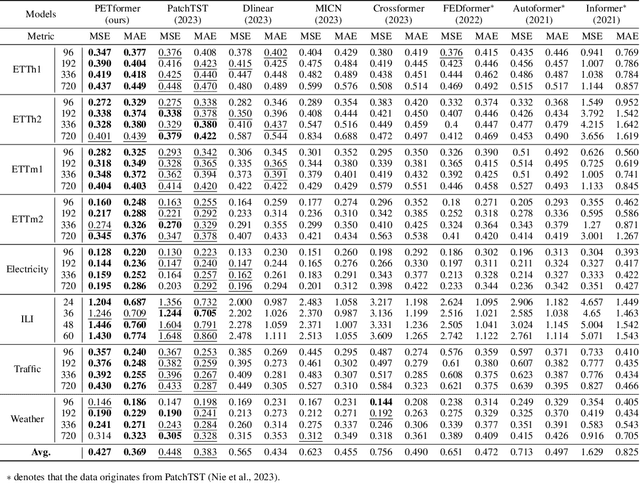
Recently, Transformer-based models have shown remarkable performance in long-term time series forecasting (LTSF) tasks due to their ability to model long-term dependencies. However, the validity of Transformers for LTSF tasks remains debatable, particularly since recent work has shown that simple linear models can outperform numerous Transformer-based approaches. This suggests that there are limitations to the application of Transformer in LTSF. Therefore, this paper investigates three key issues when applying Transformer to LTSF: temporal continuity, information density, and multi-channel relationships. Accordingly, we propose three innovative solutions, including Placeholder Enhancement Technique (PET), Long Sub-sequence Division (LSD), and Multi-channel Separation and Interaction (MSI), which together form a novel model called PETformer. These three key designs introduce prior biases suitable for LTSF tasks. Extensive experiments have demonstrated that PETformer achieves state-of-the-art (SOTA) performance on eight commonly used public datasets for LTSF, outperforming all other models currently available. This demonstrates that Transformer still possesses powerful capabilities in LTSF.
Mean Field Optimization Problem Regularized by Fisher Information
Feb 12, 2023Recently there is a rising interest in the research of mean field optimization, in particular because of its role in analyzing the training of neural networks. In this paper by adding the Fisher Information as the regularizer, we relate the regularized mean field optimization problem to a so-called mean field Schrodinger dynamics. We develop an energy-dissipation method to show that the marginal distributions of the mean field Schrodinger dynamics converge exponentially quickly towards the unique minimizer of the regularized optimization problem. Remarkably, the mean field Schrodinger dynamics is proved to be a gradient flow on the probability measure space with respect to the relative entropy. Finally we propose a Monte Carlo method to sample the marginal distributions of the mean field Schrodinger dynamics.
Uniform-in-Time Propagation of Chaos for Mean Field Langevin Dynamics
Dec 06, 2022


We study the uniform-in-time propagation of chaos for mean field Langevin dynamics with convex mean field potenital. Convergences in both Wasserstein-$2$ distance and relative entropy are established. We do not require the mean field potenital functional to bear either small mean field interaction or displacement convexity, which are common constraints in the literature. In particular, it allows us to study the efficiency of the noisy gradient descent algorithm for training two-layer neural networks.