 Add to Chrome
 Add to Firefox
 Add to Edge
Imputation-free and Alignment-free: Incomplete Multi-view Clustering Driven by Consensus Semantic Learning
May 16, 2025
In incomplete multi-view clustering (IMVC), missing data induce prototype shifts within views and semantic inconsistencies across views. A feasible solution is to explore cross-view consistency in paired complete observations, further imputing and aligning the similarity relationships inherently shared across views. Nevertheless, existing methods are constrained by two-tiered limitations: (1) Neither instance- nor cluster-level consistency learning construct a semantic space shared across views to learn consensus semantics. The former enforces cross-view instances alignment, and wrongly regards unpaired observations with semantic consistency as negative pairs; the latter focuses on cross-view cluster counterparts while coarsely handling fine-grained intra-cluster relationships within views. (2) Excessive reliance on consistency results in unreliable imputation and alignment without incorporating view-specific cluster information. Thus, we propose an IMVC framework, imputation- and alignment-free for consensus semantics learning (FreeCSL). To bridge semantic gaps across all observations, we learn consensus prototypes from available data to discover a shared space, where semantically similar observations are pulled closer for consensus semantics learning. To capture semantic relationships within specific views, we design a heuristic graph clustering based on modularity to recover cluster structure with intra-cluster compactness and inter-cluster separation for cluster semantics enhancement. Extensive experiments demonstrate, compared to state-of-the-art competitors, FreeCSL achieves more confident and robust assignments on IMVC task.

Soft Reasoning Paths for Knowledge Graph Completion
May 06, 2025Reasoning paths are reliable information in knowledge graph completion (KGC) in which algorithms can find strong clues of the actual relation between entities. However, in real-world applications, it is difficult to guarantee that computationally affordable paths exist toward all candidate entities. According to our observation, the prediction accuracy drops significantly when paths are absent. To make the proposed algorithm more stable against the missing path circumstances, we introduce soft reasoning paths. Concretely, a specific learnable latent path embedding is concatenated to each relation to help better model the characteristics of the corresponding paths. The combination of the relation and the corresponding learnable embedding is termed a soft path in our paper. By aligning the soft paths with the reasoning paths, a learnable embedding is guided to learn a generalized path representation of the corresponding relation. In addition, we introduce a hierarchical ranking strategy to make full use of information about the entity, relation, path, and soft path to help improve both the efficiency and accuracy of the model. Extensive experimental results illustrate that our algorithm outperforms the compared state-of-the-art algorithms by a notable margin. The code will be made publicly available after the paper is officially accepted.
Purifying, Labeling, and Utilizing: A High-Quality Pipeline for Small Object Detection
Apr 29, 2025Small object detection is a broadly investigated research task and is commonly conceptualized as a "pipeline-style" engineering process. In the upstream, images serve as raw materials for processing in the detection pipeline, where pre-trained models are employed to generate initial feature maps. In the midstream, an assigner selects training positive and negative samples. Subsequently, these samples and features are fed into the downstream for classification and regression. Previous small object detection methods often focused on improving isolated stages of the pipeline, thereby neglecting holistic optimization and consequently constraining overall performance gains. To address this issue, we have optimized three key aspects, namely Purifying, Labeling, and Utilizing, in this pipeline, proposing a high-quality Small object detection framework termed PLUSNet. Specifically, PLUSNet comprises three sequential components: the Hierarchical Feature Purifier (HFP) for purifying upstream features, the Multiple Criteria Label Assignment (MCLA) for improving the quality of midstream training samples, and the Frequency Decoupled Head (FDHead) for more effectively exploiting information to accomplish downstream tasks. The proposed PLUS modules are readily integrable into various object detectors, thus enhancing their detection capabilities in multi-scale scenarios. Extensive experiments demonstrate the proposed PLUSNet consistently achieves significant and consistent improvements across multiple datasets for small object detection.
Learning with Limited Shared Information in Multi-agent Multi-armed Bandit
Feb 21, 2025Multi-agent multi-armed bandit (MAMAB) is a classic collaborative learning model and has gained much attention in recent years. However, existing studies do not consider the case where an agent may refuse to share all her information with others, e.g., when some of the data contains personal privacy. In this paper, we propose a novel limited shared information multi-agent multi-armed bandit (LSI-MAMAB) model in which each agent only shares the information that she is willing to share, and propose the Balanced-ETC algorithm to help multiple agents collaborate efficiently with limited shared information. Our analysis shows that Balanced-ETC is asymptotically optimal and its average regret (on each agent) approaches a constant when there are sufficient agents involved. Moreover, to encourage agents to participate in this collaborative learning, an incentive mechanism is proposed to make sure each agent can benefit from the collaboration system. Finally, we present experimental results to validate our theoretical results.
Continuous K-Max Bandits
Feb 19, 2025We study the $K$-Max combinatorial multi-armed bandits problem with continuous outcome distributions and weak value-index feedback: each base arm has an unknown continuous outcome distribution, and in each round the learning agent selects $K$ arms, obtains the maximum value sampled from these $K$ arms as reward and observes this reward together with the corresponding arm index as feedback. This setting captures critical applications in recommendation systems, distributed computing, server scheduling, etc. The continuous $K$-Max bandits introduce unique challenges, including discretization error from continuous-to-discrete conversion, non-deterministic tie-breaking under limited feedback, and biased estimation due to partial observability. Our key contribution is the computationally efficient algorithm DCK-UCB, which combines adaptive discretization with bias-corrected confidence bounds to tackle these challenges. For general continuous distributions, we prove that DCK-UCB achieves a $\widetilde{\mathcal{O}}(T^{3/4})$ regret upper bound, establishing the first sublinear regret guarantee for this setting. Furthermore, we identify an important special case with exponential distributions under full-bandit feedback. In this case, our proposed algorithm MLE-Exp enables $\widetilde{\mathcal{O}}(\sqrt{T})$ regret upper bound through maximal log-likelihood estimation, achieving near-minimax optimality.
Efficient and Optimal Policy Gradient Algorithm for Corrupted Multi-armed Bandits
Feb 19, 2025In this paper, we consider the stochastic multi-armed bandits problem with adversarial corruptions, where the random rewards of the arms are partially modified by an adversary to fool the algorithm. We apply the policy gradient algorithm SAMBA to this setting, and show that it is computationally efficient, and achieves a state-of-the-art $O(K\log T/\Delta) + O(C/\Delta)$ regret upper bound, where $K$ is the number of arms, $C$ is the unknown corruption level, $\Delta$ is the minimum expected reward gap between the best arm and other ones, and $T$ is the time horizon. Compared with the best existing efficient algorithm (e.g., CBARBAR), whose regret upper bound is $O(K\log^2 T/\Delta) + O(C)$, we show that SAMBA reduces one $\log T$ factor in the regret bound, while maintaining the corruption-dependent term to be linear with $C$. This is indeed asymptotically optimal. We also conduct simulations to demonstrate the effectiveness of SAMBA, and the results show that SAMBA outperforms existing baselines.
Offline Learning for Combinatorial Multi-armed Bandits
Jan 31, 2025The combinatorial multi-armed bandit (CMAB) is a fundamental sequential decision-making framework, extensively studied over the past decade. However, existing work primarily focuses on the online setting, overlooking the substantial costs of online interactions and the readily available offline datasets. To overcome these limitations, we introduce Off-CMAB, the first offline learning framework for CMAB. Central to our framework is the combinatorial lower confidence bound (CLCB) algorithm, which combines pessimistic reward estimations with combinatorial solvers. To characterize the quality of offline datasets, we propose two novel data coverage conditions and prove that, under these conditions, CLCB achieves a near-optimal suboptimality gap, matching the theoretical lower bound up to a logarithmic factor. We validate Off-CMAB through practical applications, including learning to rank, large language model (LLM) caching, and social influence maximization, showing its ability to handle nonlinear reward functions, general feedback models, and out-of-distribution action samples that excludes optimal or even feasible actions. Extensive experiments on synthetic and real-world datasets further highlight the superior performance of CLCB.
"Stones from Other Hills can Polish Jade": Zero-shot Anomaly Image Synthesis via Cross-domain Anomaly Injection
Jan 25, 2025


Industrial image anomaly detection (IAD) is a pivotal topic with huge value. Due to anomaly's nature, real anomalies in a specific modern industrial domain (i.e. domain-specific anomalies) are usually too rare to collect, which severely hinders IAD. Thus, zero-shot anomaly synthesis (ZSAS), which synthesizes pseudo anomaly images without any domain-specific anomaly, emerges as a vital technique for IAD. However, existing solutions are either unable to synthesize authentic pseudo anomalies, or require cumbersome training. Thus, we focus on ZSAS and propose a brand-new paradigm that can realize both authentic and training-free ZSAS. It is based on a chronically-ignored fact: Although domain-specific anomalies are rare, real anomalies from other domains (i.e. cross-domain anomalies) are actually abundant and directly applicable to ZSAS. Specifically, our new ZSAS paradigm makes three-fold contributions: First, we propose a novel method named Cross-domain Anomaly Injection (CAI), which directly exploits cross-domain anomalies to enable highly authentic ZSAS in a training-free manner. Second, to supply CAI with sufficient cross-domain anomalies, we build the first domain-agnostic anomaly dataset within our best knowledge, which provides ZSAS with abundant real anomaly patterns. Third, we propose a CAI-guided Diffusion Mechanism, which further breaks the quantity limit of real anomalies and enable unlimited anomaly synthesis. Our head-to-head comparison with existing ZSAS solutions justifies our paradigm's superior performance for IAD and demonstrates it as an effective and pragmatic ZSAS solution.
Combinatorial Rising Bandit
Dec 01, 2024
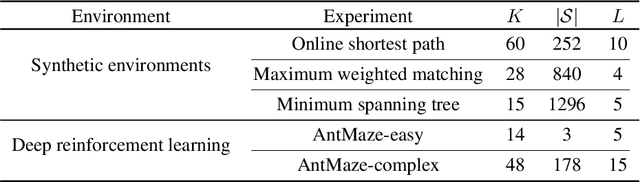


Combinatorial online learning is a fundamental task to decide the optimal combination of base arms in sequential interactions with systems providing uncertain rewards, which is applicable to diverse domains such as robotics, social advertising, network routing and recommendation systems. In real-world scenarios, we often observe rising rewards, where the selection of a base arm not only provides an instantaneous reward but also contributes to the enhancement of future rewards, {\it e.g.}, robots enhancing proficiency through practice and social influence strengthening in the history of successful recommendations. To address this, we introduce the problem of combinatorial rising bandit to minimize policy regret and propose a provably efficient algorithm, called Combinatorial Rising Upper Confidence Bound (CRUCB), of which regret upper bound is close to a regret lower bound. To the best of our knowledge, previous studies do not provide a sub-linear regret lower bound, making it impossible to assess the efficiency of their algorithms. However, we provide the sub-linear regret lower bound for combinatorial rising bandit and show that CRUCB is provably efficient by showing that the regret upper bound is close to the regret lower bound. In addition, we empirically demonstrate the effectiveness and superiority of CRUCB not only in synthetic environments but also in realistic applications of deep reinforcement learning.
Combinatorial Multivariant Multi-Armed Bandits with Applications to Episodic Reinforcement Learning and Beyond
Jun 03, 2024We introduce a novel framework of combinatorial multi-armed bandits (CMAB) with multivariant and probabilistically triggering arms (CMAB-MT), where the outcome of each arm is a $d$-dimensional multivariant random variable and the feedback follows a general arm triggering process. Compared with existing CMAB works, CMAB-MT not only enhances the modeling power but also allows improved results by leveraging distinct statistical properties for multivariant random variables. For CMAB-MT, we propose a general 1-norm multivariant and triggering probability-modulated smoothness condition, and an optimistic CUCB-MT algorithm built upon this condition. Our framework can include many important problems as applications, such as episodic reinforcement learning (RL) and probabilistic maximum coverage for goods distribution, all of which meet the above smoothness condition and achieve matching or improved regret bounds compared to existing works. Through our new framework, we build the first connection between the episodic RL and CMAB literature, by offering a new angle to solve the episodic RL through the lens of CMAB, which may encourage more interactions between these two important directions.