 Add to Chrome
 Add to Firefox
 Add to Edge
Audio-Zero: Label-Free Self-Evolution for Fine-Grained Audio Reasoning
Jul 22, 2026
Large Audio Language models (LALMs) have made rapid progress on acoustic understanding, yet they still struggle with fine-grained audio reasoning (e.g., recognizing event order, repetitions and duration). Existing post-training methods heavily rely on expensive external labels or provide only coarse semantic signals. To bridge this gap, we introduce Audio-Zero, the first label-free self-evolution framework in the field of LALMs that improves fine-grained auditory perception and reasoning. Audio-Zero constructs an auditory self-play game from unlabeled audio contrast pairs: most players hear a reference audio, while one odd listener hears a subtle variant. The model first generates clues describing what it hears and then identifies the odd listener by reasoning over inconsistencies among clues. Since the odd listener is known by construction, the game provides verifiable rewards without any annotated answers. Experiments with Qwen2-Audio-7B-Instruct and Qwen2.5-Omni-7B on TREA, MMAU Test-mini and MMAR show that Audio-Zero improves fine-grained audio reasoning while preserving broad audio understanding. Evolutionary and diagnostic analyses further reveal that increasingly fine-grained auditory descriptions emerge naturally from game pressure.

SAW: Stage-Aware Dynamic Weighting for Multi-Objective Reinforcement Learning in Large Language Models
Jun 05, 2026Although multi-objective reinforcement learning (MORL) is central to aligning large language models with complex human preferences, the prevailing practice of static weighted summation overlooks a more fundamental phenomenon: reward learning is markedly asynchronous across objectives. Well-learned dimensions quickly produce homogeneous, low-variance signals whose residual noise contaminates the aggregated reward (in GRPO) or occupies a fixed share of the advantage budget (in GDPO), interfering with the scarce yet high-value signals carried by under-learned dimensions. To address this asynchrony, we propose Stage-Aware Dynamic Weighting (SAW), a lightweight, algorithm-agnostic dynamic weighting mechanism. SAW utilizes the coefficient of variation (CV) as a scale-invariant proxy for real-time informativeness, reweighting each dimension's reward or advantage contribution by its relative informativeness within the batch. Unlike gradient-based methods that require multiple forward and backward passes, SAW relies solely on batch-level statistics, introducing nearly negligible computational overhead. Experiments on tool-calling and text summarization tasks demonstrate that SAW consistently improves both training efficiency and final performance under both GRPO and GDPO frameworks, confirming it as a general-purpose plug-in for multi-reward LLM alignment. Our code is available at https://github.com/Zhaolutuan/SAW
PromptCD: Test-Time Behavior Enhancement via Polarity-Prompt Contrastive Decoding
Feb 24, 2026Reliable AI systems require large language models (LLMs) to exhibit behaviors aligned with human preferences and values. However, most existing alignment approaches operate at training time and rely on additional high-quality data, incurring significant computational and annotation costs. While recent work has shown that contrastive decoding can leverage a model's internal distributions to improve specific capabilities, its applicability remains limited to narrow behavioral scopes and scenarios. In this work, we introduce Polarity-Prompt Contrastive Decoding (PromptCD), a test-time behavior control method that generalizes contrastive decoding to broader enhancement settings. PromptCD constructs paired positive and negative guiding prompts for a target behavior and contrasts model responses-specifically token-level probability distributions in LLMs and visual attention patterns in VLMs-to reinforce desirable outcomes. This formulation extends contrastive decoding to a wide range of enhancement objectives and is applicable to both LLMs and Vision-Language Models (VLMs) without additional training. For LLMs, experiments on the "3H" alignment objectives (helpfulness, honesty, and harmlessness) demonstrate consistent and substantial improvements, indicating that post-trained models can achieve meaningful self-enhancement purely at test time. For VLMs, we further analyze contrastive effects on visual attention, showing that PromptCD significantly improves VQA performance by reinforcing behavior-consistent visual grounding. Collectively, these results highlight PromptCD as a simple, general, and cost-efficient strategy for reliable behavior control across modalities.
AuTAgent: A Reinforcement Learning Framework for Tool-Augmented Audio Reasoning
Feb 14, 2026Large Audio Language Models (LALMs) excel at perception but struggle with complex reasoning requiring precise acoustic measurements. While external tools can extract fine-grained features like exact tempo or pitch, effective integration remains challenging: naively using all tools causes information overload, while prompt-based selection fails to assess context-dependent utility. To address this, we propose AuTAgent (Audio Tool Agent), a reinforcement learning framework that learns when and which tools to invoke. By employing a sparse-feedback training strategy with a novel Differential Reward mechanism, the agent learns to filter out irrelevant tools and invokes external assistance only when it yields a net performance gain over the base model. Experimental results confirm that AuTAgent complements the representation bottleneck of LALMs by providing verifiable acoustic evidence. It improves accuracy by 4.20% / 6.20% and 9.80% / 8.00% for open-source and closed-source backbones on the MMAU Test-mini and the MMAR benchmarks, respectively. In addition, further experiments demonstrate exceptional transferability. We highlight the complementary role of external tools in augmenting audio model reasoning.
Reward and Guidance through Rubrics: Promoting Exploration to Improve Multi-Domain Reasoning
Nov 18, 2025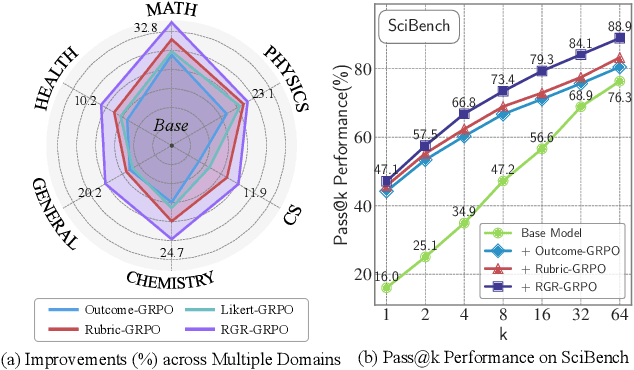
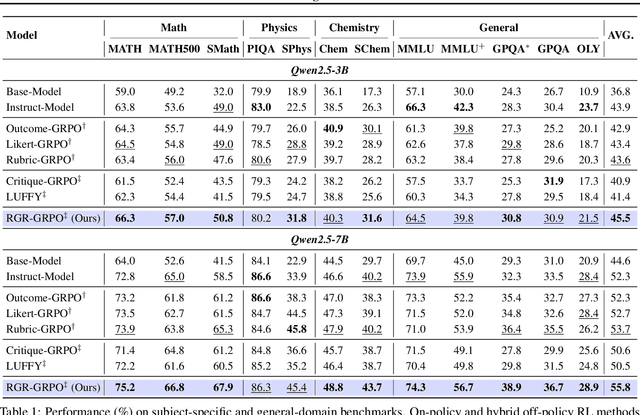
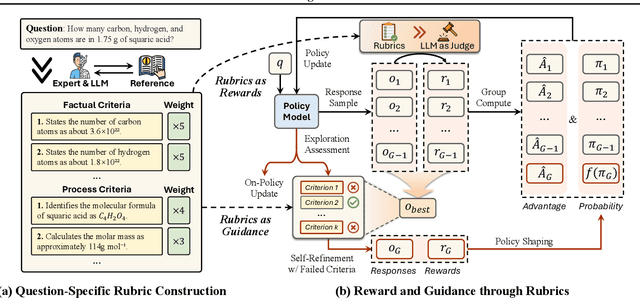
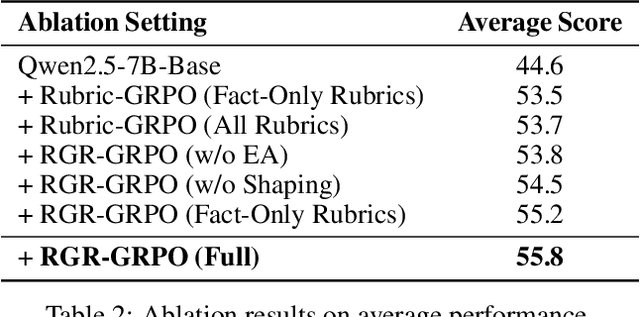
Recent advances in reinforcement learning (RL) have significantly improved the complex reasoning capabilities of large language models (LLMs). Despite these successes, existing methods mainly focus on single-domain RL (e.g., mathematics) with verifiable rewards (RLVR), and their reliance on purely online RL frameworks restricts the exploration space, thereby limiting reasoning performance. In this paper, we address these limitations by leveraging rubrics to provide both fine-grained reward signals and offline guidance. We propose $\textbf{RGR-GRPO}$ (Reward and Guidance through Rubrics), a rubric-driven RL framework for multi-domain reasoning. RGR-GRPO enables LLMs to receive dense and informative rewards while exploring a larger solution space during GRPO training. Extensive experiments across 14 benchmarks spanning multiple domains demonstrate that RGR-GRPO consistently outperforms RL methods that rely solely on alternative reward schemes or offline guidance. Compared with verifiable online RL baseline, RGR-GRPO achieves average improvements of +7.0%, +5.4%, +8.4%, and +6.6% on mathematics, physics, chemistry, and general reasoning tasks, respectively. Notably, RGR-GRPO maintains stable entropy fluctuations during off-policy training and achieves superior pass@k performance, reflecting sustained exploration and effective breakthrough beyond existing performance bottlenecks.