 Add to Chrome
 Add to Firefox
 Add to Edge
Visual Instruction-Finetuned Language Model for Versatile Brain MR Image Tasks
Apr 03, 2026
LLMs have demonstrated remarkable capabilities in linguistic reasoning and are increasingly adept at vision-language tasks. The integration of image tokens into transformers has enabled direct visual input and output, advancing research from image-to-text descriptions to text-to-image generation. However, simple text-to-image generation holds limited clinical utility. In medical imaging, tasks such as image segmentation for localizing pathologies or image translation for reconstructing missing sequences have much greater clinical importance. Despite this, integrating these diverse, clinically relevant tasks within a single, versatile language model remains unexplored. Our method, LLaBIT (Large Language Model for Brain Image Translation), extends the visual reasoning of LLMs to these clinically meaningful tasks in the brain MRI domain. To mitigate the spatial information loss inherent in image tokenization, we incorporate a mechanism to reuse feature maps from the image encoder, minimizing data degradation. We also generate text data using LLMs with strict predefined instructions to augment limited image-text paired data in brain MRI. We comprehensively evaluated our method on five brain MRI datasets across four distinct tasks: report generation, visual question answering, image segmentation, and image translation. Our model not only demonstrated superior performance across all tasks but also outperformed specialized, task-specific models in direct comparisons, highlighting its efficacy and versatility

Benchmarking the CoW with the TopCoW Challenge: Topology-Aware Anatomical Segmentation of the Circle of Willis for CTA and MRA
Dec 29, 2023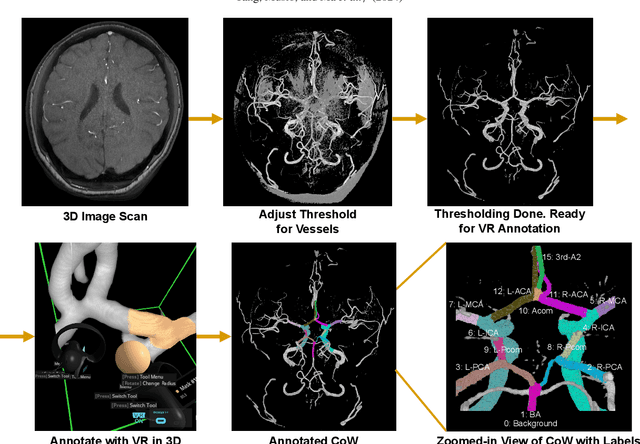
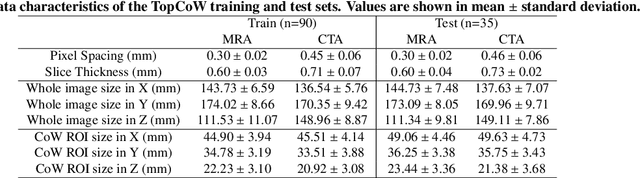
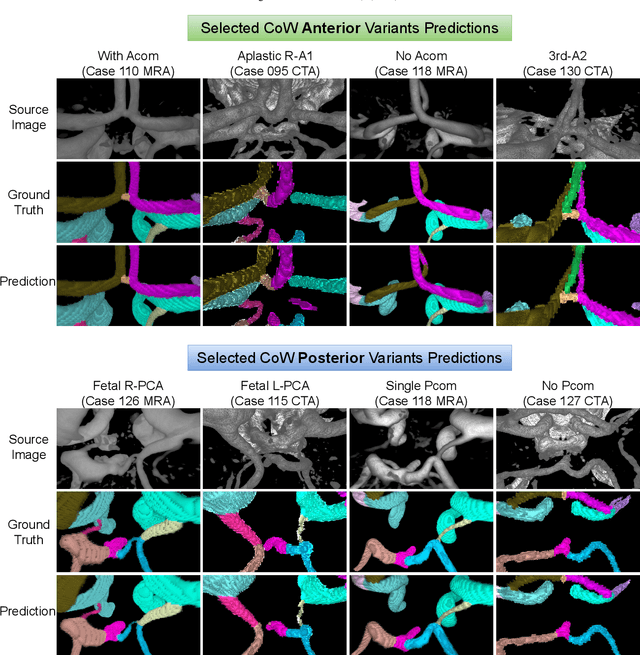
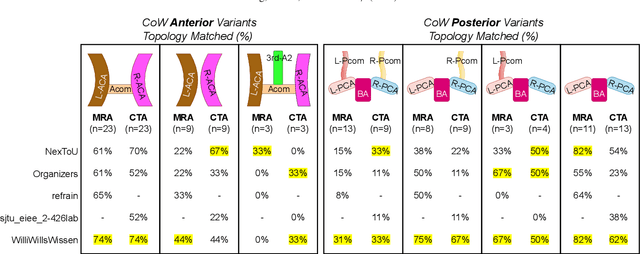
The Circle of Willis (CoW) is an important network of arteries connecting major circulations of the brain. Its vascular architecture is believed to affect the risk, severity, and clinical outcome of serious neuro-vascular diseases. However, characterizing the highly variable CoW anatomy is still a manual and time-consuming expert task. The CoW is usually imaged by two angiographic imaging modalities, magnetic resonance angiography (MRA) and computed tomography angiography (CTA), but there exist limited public datasets with annotations on CoW anatomy, especially for CTA. Therefore we organized the TopCoW Challenge in 2023 with the release of an annotated CoW dataset and invited submissions worldwide for the CoW segmentation task, which attracted over 140 registered participants from four continents. TopCoW dataset was the first public dataset with voxel-level annotations for CoW's 13 vessel components, made possible by virtual-reality (VR) technology. It was also the first dataset with paired MRA and CTA from the same patients. TopCoW challenge aimed to tackle the CoW characterization problem as a multiclass anatomical segmentation task with an emphasis on topological metrics. The top performing teams managed to segment many CoW components to Dice scores around 90%, but with lower scores for communicating arteries and rare variants. There were also topological mistakes for predictions with high Dice scores. Additional topological analysis revealed further areas for improvement in detecting certain CoW components and matching CoW variant's topology accurately. TopCoW represented a first attempt at benchmarking the CoW anatomical segmentation task for MRA and CTA, both morphologically and topologically.