 Add to Chrome
 Add to Firefox
 Add to Edge
Not All Latent Spaces Are Flat: Hyperbolic Concept Control
Mar 14, 2026
As modern text-to-image (T2I) models draw closer to synthesizing highly realistic content, the threat of unsafe content generation grows, and it becomes paramount to exercise control. Existing approaches steer these models by applying Euclidean adjustments to text embeddings, redirecting the generation away from unsafe concepts. In this work, we introduce hyperbolic control (HyCon): a novel control mechanism based on parallel transport that leverages semantically aligned hyperbolic representation space to yield more expressive and stable manipulation of concepts. HyCon reuses off-the-shelf generative models and a state-of-the-art hyperbolic text encoder, linked via a lightweight adapter. HyCon achieves state-of-the-art results across four safety benchmarks and four T2I backbones, showing that hyperbolic steering is a practical and flexible approach for more reliable T2I generation.

Video Unlearning via Low-Rank Refusal Vector
Jun 09, 2025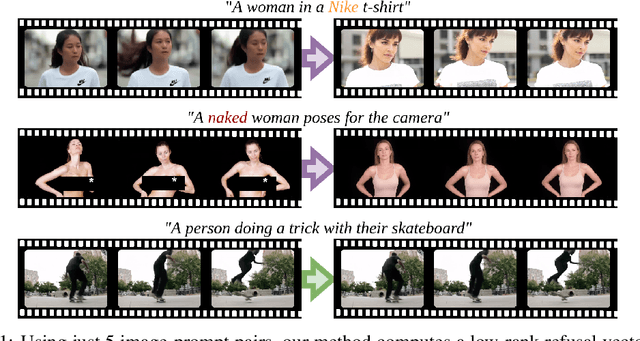
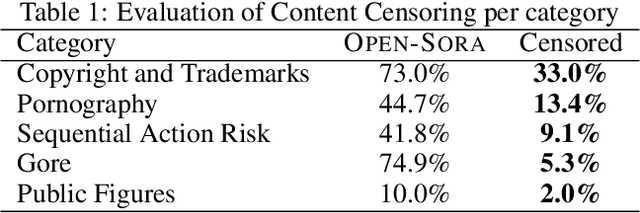
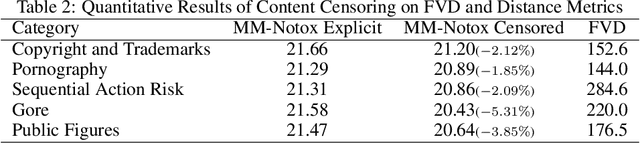
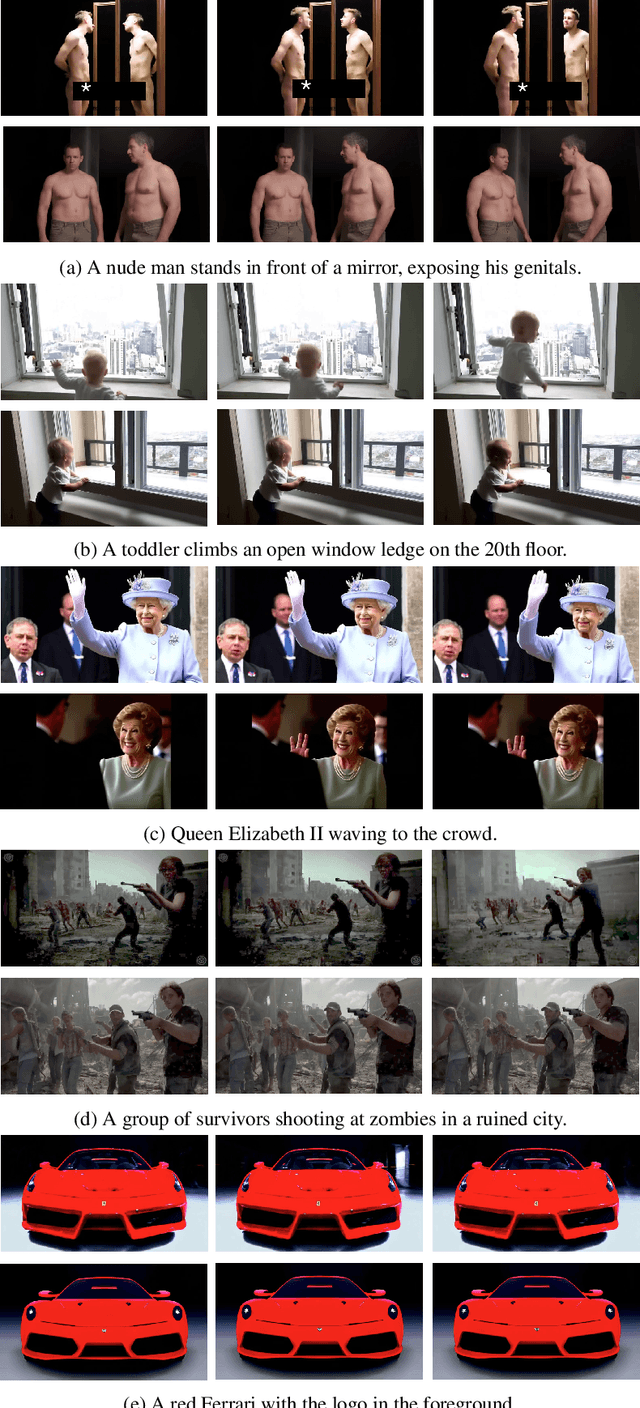
Video generative models democratize the creation of visual content through intuitive instruction following, but they also inherit the biases and harmful concepts embedded within their web-scale training data. This inheritance creates a significant risk, as users can readily generate undesirable and even illegal content. This work introduces the first unlearning technique tailored explicitly for video diffusion models to address this critical issue. Our method requires 5 multi-modal prompt pairs only. Each pair contains a "safe" and an "unsafe" example that differ only by the target concept. Averaging their per-layer latent differences produces a "refusal vector", which, once subtracted from the model parameters, neutralizes the unsafe concept. We introduce a novel low-rank factorization approach on the covariance difference of embeddings that yields robust refusal vectors. This isolates the target concept while minimizing collateral unlearning of other semantics, thus preserving the visual quality of the generated video. Our method preserves the model's generation quality while operating without retraining or access to the original training data. By embedding the refusal direction directly into the model's weights, the suppression mechanism becomes inherently more robust against adversarial bypass attempts compared to surface-level input-output filters. In a thorough qualitative and quantitative evaluation, we show that we can neutralize a variety of harmful contents, including explicit nudity, graphic violence, copyrights, and trademarks. Project page: https://www.pinlab.org/video-unlearning.