 Add to Chrome
 Add to Firefox
 Add to Edge
Affect Decoding in Phonated and Silent Speech Production from Surface EMG
Mar 12, 2026
The expression of affect is integral to spoken communication, yet, its link to underlying articulatory execution remains unclear. Measures of articulatory muscle activity such as EMG could reveal how speech production is modulated by emotion alongside acoustic speech analyses. We investigate affect decoding from facial and neck surface electromyography (sEMG) during phonated and silent speech production. For this purpose, we introduce a dataset comprising 2,780 utterances from 12 participants across 3 tasks, on which we evaluate both intra- and inter-subject decoding using a range of features and model embeddings. Our results reveal that EMG representations reliably discriminate frustration with up to 0.845 AUC, and generalize well across articulation modes. Our ablation study further demonstrates that affective signatures are embedded in facial motor activity and persist in the absence of phonation, highlighting the potential of EMG sensing for affect-aware silent speech interfaces.

Articulatory Feature Prediction from Surface EMG during Speech Production
May 20, 2025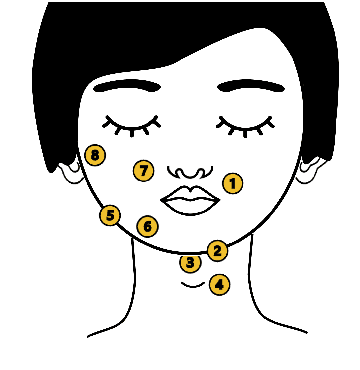
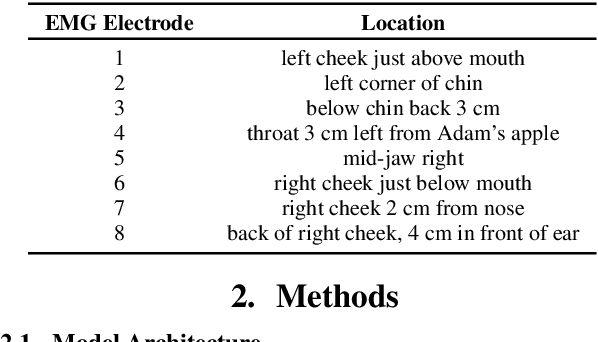
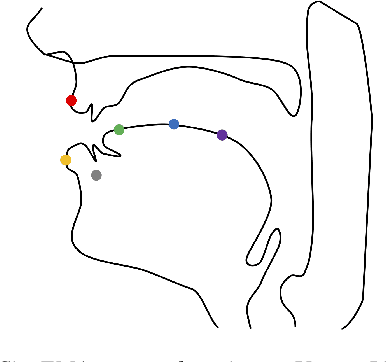
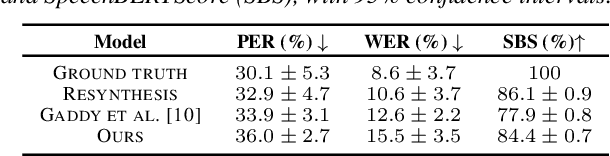
We present a model for predicting articulatory features from surface electromyography (EMG) signals during speech production. The proposed model integrates convolutional layers and a Transformer block, followed by separate predictors for articulatory features. Our approach achieves a high prediction correlation of approximately 0.9 for most articulatory features. Furthermore, we demonstrate that these predicted articulatory features can be decoded into intelligible speech waveforms. To our knowledge, this is the first method to decode speech waveforms from surface EMG via articulatory features, offering a novel approach to EMG-based speech synthesis. Additionally, we analyze the relationship between EMG electrode placement and articulatory feature predictability, providing knowledge-driven insights for optimizing EMG electrode configurations. The source code and decoded speech samples are publicly available.