 Add to Chrome
 Add to Firefox
 Add to Edge
TD-DPO: Difference-Aware Preference Optimization for Mitigating Sycophancy in Clinical Autism Intervention Dialogue
Jul 17, 2026
The sycophancy of large language models can increase the safety risk in intervention dialogue for autistic children. Supervised fine-tuning can somewhat reduce sycophancy, but relying solely on positive examples is often insufficient to identify and correct failure patterns. We observe that sycophancy behaviors can often be localized to a limited span within the model response. In this regime, sequence-level preference optimization can over-update preference-irrelevant tokens and degrade intervention ability. To address this, we propose the \textbf{M}inimal \textbf{E}dit \textbf{D}ata \textbf{A}ugmentation (MEDA) strategy to construct controlled, stable, minimal edit preference pairs and \textbf{T}oken-level \textbf{D}ifference \textbf{D}irect \textbf{P}reference \textbf{O}ptimization (TD-DPO), which upweights difference tokens between chosen and rejected responses while downweighting shared tokens to suppress background drift. Extensive experiments across multiple backbones and evaluators show that TD-DPO achieves a better trade-off between sycophancy mitigation and intervention ability retention in our offline settings, highlighting its potential as a practical alignment approach for autism intervention.

Copiloting Diagnosis of Autism in Real Clinical Scenarios via LLMs
Oct 10, 2024
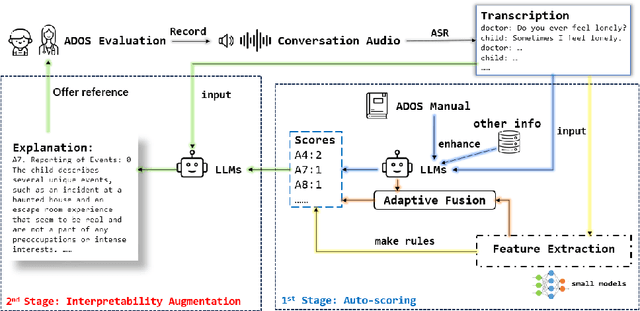

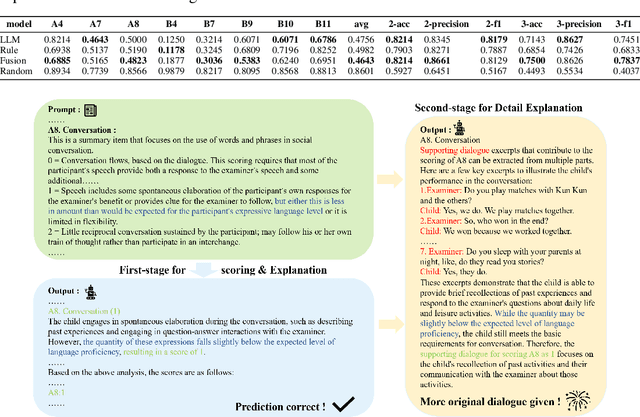
Autism spectrum disorder(ASD) is a pervasive developmental disorder that significantly impacts the daily functioning and social participation of individuals. Despite the abundance of research focused on supporting the clinical diagnosis of ASD, there is still a lack of systematic and comprehensive exploration in the field of methods based on Large Language Models (LLMs), particularly regarding the real-world clinical diagnostic scenarios based on Autism Diagnostic Observation Schedule, Second Edition (ADOS-2). Therefore, we have proposed a framework called ADOS-Copilot, which strikes a balance between scoring and explanation and explored the factors that influence the performance of LLMs in this task. The experimental results indicate that our proposed framework is competitive with the diagnostic results of clinicians, with a minimum MAE of 0.4643, binary classification F1-score of 81.79\%, and ternary classification F1-score of 78.37\%. Furthermore, we have systematically elucidated the strengths and limitations of current LLMs in this task from the perspectives of ADOS-2, LLMs' capabilities, language, and model scale aiming to inspire and guide the future application of LLMs in a broader fields of mental health disorders. We hope for more research to be transferred into real clinical practice, opening a window of kindness to the world for eccentric children.