 Add to Chrome
 Add to Firefox
 Add to Edge
GraphDLG: Exploring Deep Leakage from Gradients in Federated Graph Learning
Jan 27, 2026
Federated graph learning (FGL) has recently emerged as a promising privacy-preserving paradigm that enables distributed graph learning across multiple data owners. A critical privacy concern in federated learning is whether an adversary can recover raw data from shared gradients, a vulnerability known as deep leakage from gradients (DLG). However, most prior studies on the DLG problem focused on image or text data, and it remains an open question whether graphs can be effectively recovered, particularly when the graph structure and node features are uniquely entangled in GNNs. In this work, we first theoretically analyze the components in FGL and derive a crucial insight: once the graph structure is recovered, node features can be obtained through a closed-form recursive rule. Building on this analysis, we propose GraphDLG, a novel approach to recover raw training graphs from shared gradients in FGL, which can utilize randomly generated graphs or client-side training graphs as auxiliaries to enhance recovery. Extensive experiments demonstrate that GraphDLG outperforms existing solutions by successfully decoupling the graph structure and node features, achieving improvements of over 5.46% (by MSE) for node feature reconstruction and over 25.04% (by AUC) for graph structure reconstruction.

Unlocking Dynamic Inter-Client Spatial Dependencies: A Federated Spatio-Temporal Graph Learning Method for Traffic Flow Forecasting
Nov 13, 2025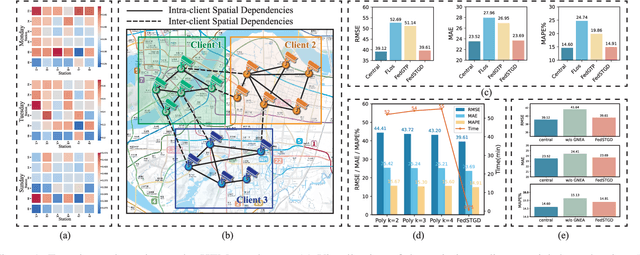
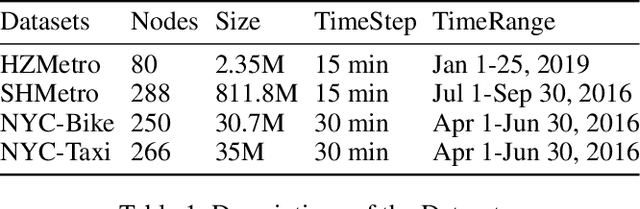
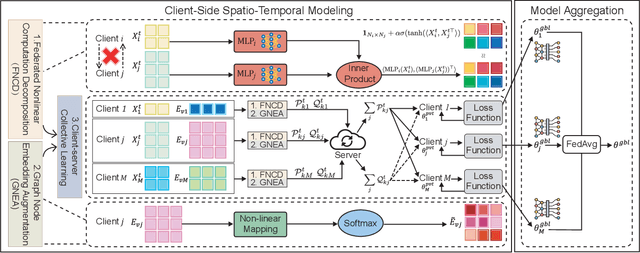
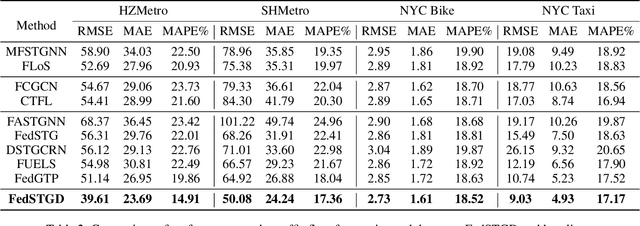
Spatio-temporal graphs are powerful tools for modeling complex dependencies in traffic time series. However, the distributed nature of real-world traffic data across multiple stakeholders poses significant challenges in modeling and reconstructing inter-client spatial dependencies while adhering to data locality constraints. Existing methods primarily address static dependencies, overlooking their dynamic nature and resulting in suboptimal performance. In response, we propose Federated Spatio-Temporal Graph with Dynamic Inter-Client Dependencies (FedSTGD), a framework designed to model and reconstruct dynamic inter-client spatial dependencies in federated learning. FedSTGD incorporates a federated nonlinear computation decomposition module to approximate complex graph operations. This is complemented by a graph node embedding augmentation module, which alleviates performance degradation arising from the decomposition. These modules are coordinated through a client-server collective learning protocol, which decomposes dynamic inter-client spatial dependency learning tasks into lightweight, parallelizable subtasks. Extensive experiments on four real-world datasets demonstrate that FedSTGD achieves superior performance over state-of-the-art baselines in terms of RMSE, MAE, and MAPE, approaching that of centralized baselines. Ablation studies confirm the contribution of each module in addressing dynamic inter-client spatial dependencies, while sensitivity analysis highlights the robustness of FedSTGD to variations in hyperparameters.
Efficient Data Valuation Approximation in Federated Learning: A Sampling-based Approach
Apr 23, 2025Federated learning paradigm to utilize datasets across multiple data providers. In FL, cross-silo data providers often hesitate to share their high-quality dataset unless their data value can be fairly assessed. Shapley value (SV) has been advocated as the standard metric for data valuation in FL due to its desirable properties. However, the computational overhead of SV is prohibitive in practice, as it inherently requires training and evaluating an FL model across an exponential number of dataset combinations. Furthermore, existing solutions fail to achieve high accuracy and efficiency, making practical use of SV still out of reach, because they ignore choosing suitable computation scheme for approximation framework and overlook the property of utility function in FL. We first propose a unified stratified-sampling framework for two widely-used schemes. Then, we analyze and choose the more promising scheme under the FL linear regression assumption. After that, we identify a phenomenon termed key combinations, where only limited dataset combinations have a high-impact on final data value. Building on these insights, we propose a practical approximation algorithm, IPSS, which strategically selects high-impact dataset combinations rather than evaluating all possible combinations, thus substantially reducing time cost with minor approximation error. Furthermore, we conduct extensive evaluations on the FL benchmark datasets to demonstrate that our proposed algorithm outperforms a series of representative baselines in terms of efficiency and effectiveness.