 Add to Chrome
 Add to Firefox
 Add to Edge
AmbiBench: Benchmarking Mobile GUI Agents Beyond One-Shot Instructions in the Wild
Feb 12, 2026
Benchmarks are paramount for gauging progress in the domain of Mobile GUI Agents. In practical scenarios, users frequently fail to articulate precise directives containing full task details at the onset, and their expressions are typically ambiguous. Consequently, agents are required to converge on the user's true intent via active clarification and interaction during execution. However, existing benchmarks predominantly operate under the idealized assumption that user-issued instructions are complete and unequivocal. This paradigm focuses exclusively on assessing single-turn execution while overlooking the alignment capability of the agent. To address this limitation, we introduce AmbiBench, the first benchmark incorporating a taxonomy of instruction clarity to shift evaluation from unidirectional instruction following to bidirectional intent alignment. Grounded in Cognitive Gap theory, we propose a taxonomy of four clarity levels: Detailed, Standard, Incomplete, and Ambiguous. We construct a rigorous dataset of 240 ecologically valid tasks across 25 applications, subject to strict review protocols. Furthermore, targeting evaluation in dynamic environments, we develop MUSE (Mobile User Satisfaction Evaluator), an automated framework utilizing an MLLM-as-a-judge multi-agent architecture. MUSE performs fine-grained auditing across three dimensions: Outcome Effectiveness, Execution Quality, and Interaction Quality. Empirical results on AmbiBench reveal the performance boundaries of SoTA agents across different clarity levels, quantify the gains derived from active interaction, and validate the strong correlation between MUSE and human judgment. This work redefines evaluation standards, laying the foundation for next-generation agents capable of truly understanding user intent.

Seal: Advancing Speech Language Models to be Few-Shot Learners
Jul 20, 2024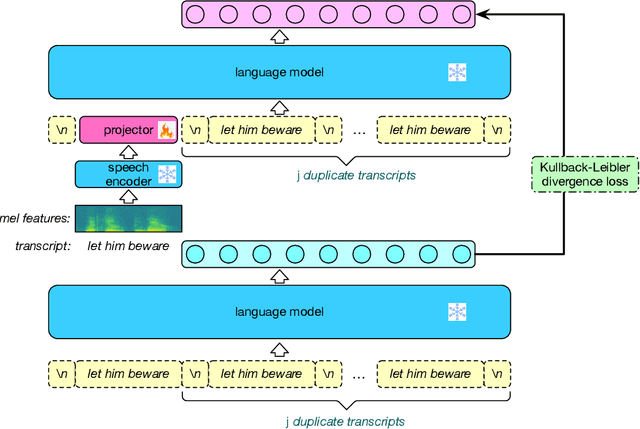
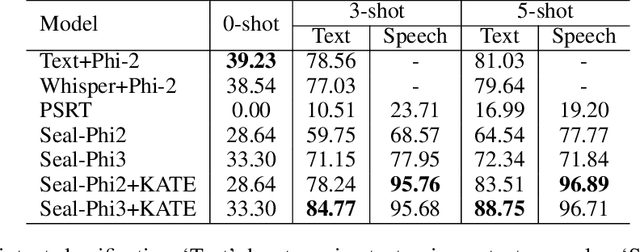
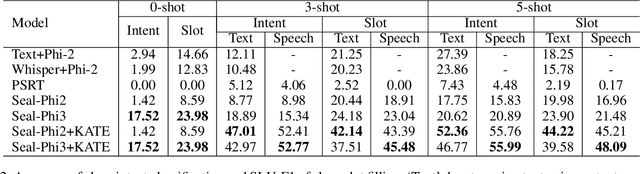
Existing auto-regressive language models have demonstrated a remarkable capability to perform a new task with just a few examples in prompt, without requiring any additional training. In order to extend this capability to a multi-modal setting (i.e. speech and language), this paper introduces the Seal model, an abbreviation for speech language model. It incorporates a novel alignment method, in which Kullback-Leibler divergence loss is performed to train a projector that bridges a frozen speech encoder with a frozen language model decoder. The resulting Seal model exhibits robust performance as a few-shot learner on two speech understanding tasks. Additionally, consistency experiments are conducted to validate its robustness on different pre-trained language models.
GRASS: Unified Generation Model for Speech-to-Semantic Tasks
Sep 11, 2023
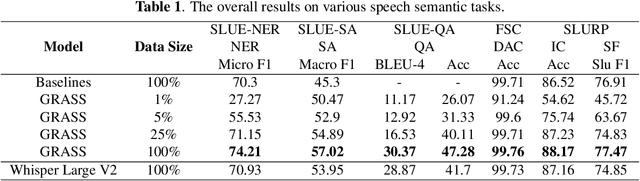

This paper explores the instruction fine-tuning technique for speech-to-semantic tasks by introducing a unified end-to-end (E2E) framework that generates target text conditioned on a task-related prompt for audio data. We pre-train the model using large and diverse data, where instruction-speech pairs are constructed via a text-to-speech (TTS) system. Extensive experiments demonstrate that our proposed model achieves state-of-the-art (SOTA) results on many benchmarks covering speech named entity recognition, speech sentiment analysis, speech question answering, and more, after fine-tuning. Furthermore, the proposed model achieves competitive performance in zero-shot and few-shot scenarios. To facilitate future work on instruction fine-tuning for speech-to-semantic tasks, we release our instruction dataset and code.