 Add to Chrome
 Add to Firefox
 Add to Edge
DreamQAS: Learning a Decision-Useful World Model for VQE-Efficient Quantum Architecture Search
Jul 31, 2026
Reinforcement-learning-based quantum architecture search (RL-QAS) repeatedly optimizes a variational quantum eigensolver (VQE) after extending a circuit, although circuit construction and action legality are deterministic and known. We introduce DreamQAS, a model-based RL framework that preserves these exact circuit dynamics and learns only the expensive post-VQE feedback. A recurrent randomized-prior ensemble predicts an oracle-free score relative to an empirical energy frontier and supports multi-step imagined policy learning over explicit legal circuits. Ranking-based activation, uncertainty-aware pessimism and truncation, and selective real-VQE verification form a reliability-controlled learning loop. Under a common 15,000-episode budget and frozen evaluation for the RL methods, DreamQAS has the lowest mean frozen-policy energy error on four of five molecular tasks and the second-lowest on one. At fine-error targets reached by all seeds of both methods, it uses 1.6x to 2.0x fewer real VQE calls on four tasks and 10.6x fewer on BeH2-8q. Counterfactual action-ranking utility increases across all five tasks, with a mean increase of 0.346 and a 95 percent confidence interval of [0.185, 0.507], while direct greedy and beam use of the same model does not recover the gains of imagined policy learning. Ensemble disagreement also improves risk-coverage over random rejection on all three probed tasks. These results establish a world-model design for QAS whose value lies in decision-useful feedback rather than exact energy prediction.

HamQASBench: A Hamiltonian-Informed Diagnostic Benchmark for Evaluating Quantum Architecture Search
Jul 06, 2026Quantum Architecture Search (QAS) automates the design of parameterized quantum circuits for variational quantum algorithms, yet existing benchmarks organize instances by molecular identity or qubit count -- criteria agnostic to Hamiltonian structure -- and rely solely on energy accuracy, which cannot detect structural failures such as over-parameterization on near-product ground states. We introduce HamQASBench, a Hamiltonian-informed diagnostic benchmark organizing 11 molecules into five structural tiers via fingerprints derived from the Pauli operator basis, computational basis representation, and ground-state entanglement. A post-hoc critical-structure extraction procedure identifies minimal circuits consistent with each tier's requirements, complementing energy-based evaluation with per-qubit entanglement analysis and pairwise state fidelity. Benchmarking five QAS methods across four paradigms reveals failure modes invisible to conventional metrics: over-parameterization in the minimalism regime, eigenstate commitment under degeneracy, a representation bottleneck in strongly correlated systems, topology-induced routing failure, and circuit search space growth as a scalability bottleneck.
AmbiBench: Benchmarking Mobile GUI Agents Beyond One-Shot Instructions in the Wild
Feb 12, 2026Benchmarks are paramount for gauging progress in the domain of Mobile GUI Agents. In practical scenarios, users frequently fail to articulate precise directives containing full task details at the onset, and their expressions are typically ambiguous. Consequently, agents are required to converge on the user's true intent via active clarification and interaction during execution. However, existing benchmarks predominantly operate under the idealized assumption that user-issued instructions are complete and unequivocal. This paradigm focuses exclusively on assessing single-turn execution while overlooking the alignment capability of the agent. To address this limitation, we introduce AmbiBench, the first benchmark incorporating a taxonomy of instruction clarity to shift evaluation from unidirectional instruction following to bidirectional intent alignment. Grounded in Cognitive Gap theory, we propose a taxonomy of four clarity levels: Detailed, Standard, Incomplete, and Ambiguous. We construct a rigorous dataset of 240 ecologically valid tasks across 25 applications, subject to strict review protocols. Furthermore, targeting evaluation in dynamic environments, we develop MUSE (Mobile User Satisfaction Evaluator), an automated framework utilizing an MLLM-as-a-judge multi-agent architecture. MUSE performs fine-grained auditing across three dimensions: Outcome Effectiveness, Execution Quality, and Interaction Quality. Empirical results on AmbiBench reveal the performance boundaries of SoTA agents across different clarity levels, quantify the gains derived from active interaction, and validate the strong correlation between MUSE and human judgment. This work redefines evaluation standards, laying the foundation for next-generation agents capable of truly understanding user intent.
Performance-Driven QUBO for Recommender Systems on Quantum Annealers
Oct 20, 2024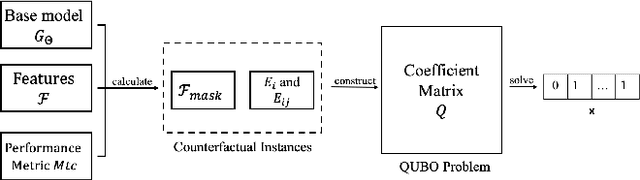
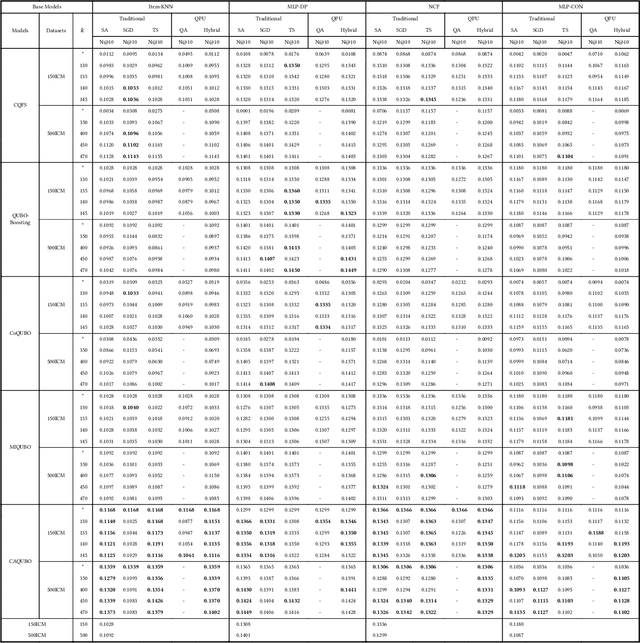
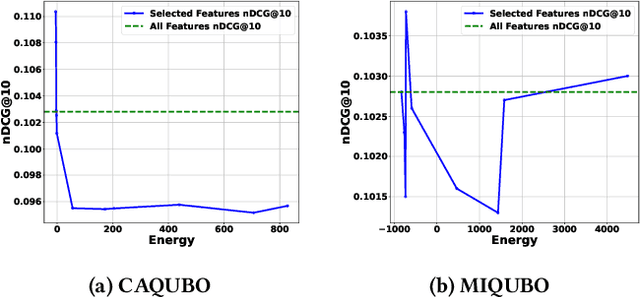
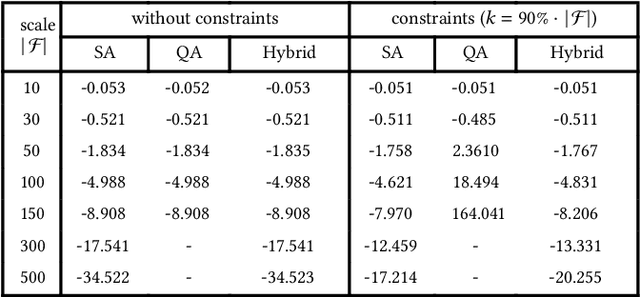
We propose Counterfactual Analysis Quadratic Unconstrained Binary Optimization (CAQUBO) to solve QUBO problems for feature selection in recommender systems. CAQUBO leverages counterfactual analysis to measure the impact of individual features and feature combinations on model performance and employs the measurements to construct the coefficient matrix for a quantum annealer to select the optimal feature combinations for recommender systems, thereby improving their final recommendation performance. By establishing explicit connections between features and the recommendation performance, the proposed approach demonstrates superior performance compared to the state-of-the-art quantum annealing methods. Extensive experiments indicate that integrating quantum computing with counterfactual analysis holds great promise for addressing these challenges.
CRUISE on Quantum Computing for Feature Selection in Recommender Systems
Jul 03, 2024Using Quantum Computers to solve problems in Recommender Systems that classical computers cannot address is a worthwhile research topic. In this paper, we use Quantum Annealers to address the feature selection problem in recommendation algorithms. This feature selection problem is a Quadratic Unconstrained Binary Optimization(QUBO) problem. By incorporating Counterfactual Analysis, we significantly improve the performance of the item-based KNN recommendation algorithm compared to using pure Mutual Information. Extensive experiments have demonstrated that the use of Counterfactual Analysis holds great promise for addressing such problems.
A Superimposed Divide-and-Conquer Image Recognition Method for SEM Images of Nanoparticles on The Surface of Monocrystalline silicon with High Aggregation Degree
Jun 04, 2022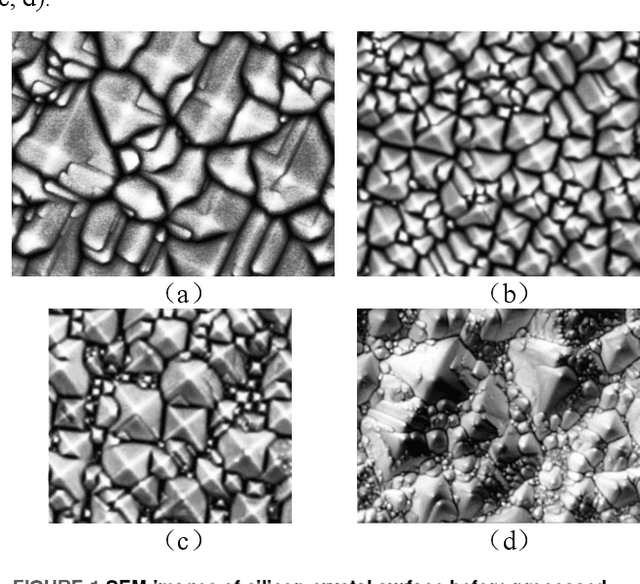
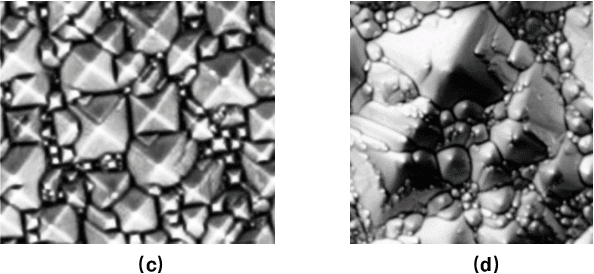
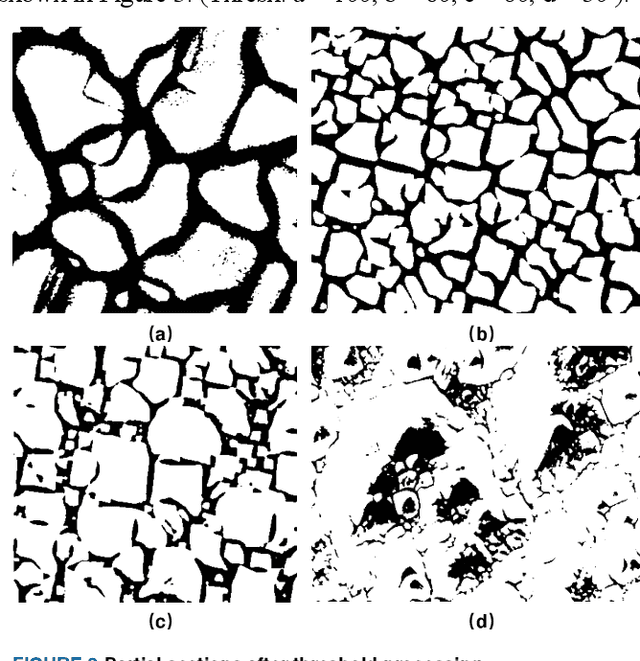
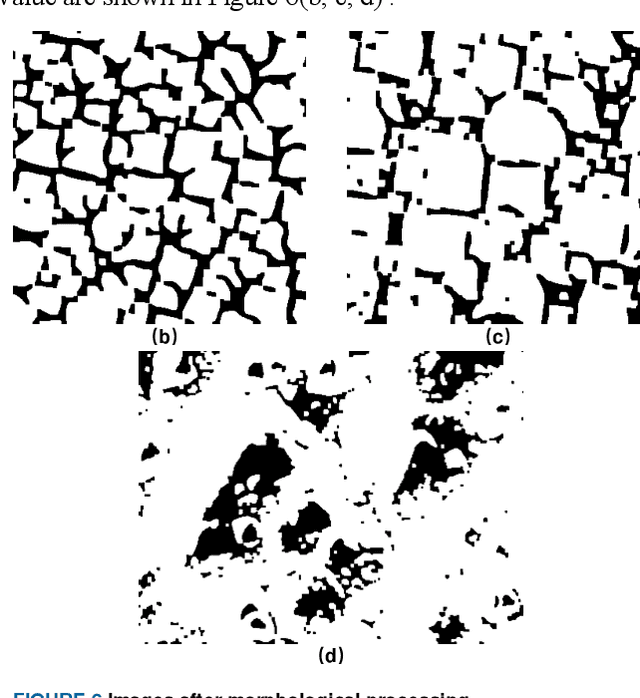
The nanoparticle size and distribution information in the SEM images of silicon crystals are generally counted by manual methods. The realization of automatic machine recognition is significant in materials science. This paper proposed a superposition partitioning image recognition method to realize automatic recognition and information statistics of silicon crystal nanoparticle SEM images. Especially for the complex and highly aggregated characteristics of silicon crystal particle size, an accurate recognition step and contour statistics method based on morphological processing are given. This method has technical reference value for the recognition of Monocrystalline silicon surface nanoparticle images under different SEM shooting conditions. Besides, it outperforms other methods in terms of recognition accuracy and algorithm efficiency.