 Add to Chrome
 Add to Firefox
 Add to Edge
AIvilization v0: Toward Large-Scale Artificial Social Simulation with a Unified Agent Architecture and Adaptive Agent Profiles
Feb 11, 2026
AIvilization v0 is a publicly deployed large-scale artificial society that couples a resource-constrained sandbox economy with a unified LLM-agent architecture, aiming to sustain long-horizon autonomy while remaining executable under rapidly changing environment. To mitigate the tension between goal stability and reactive correctness, we introduce (i) a hierarchical branch-thinking planner that decomposes life goals into parallel objective branches and uses simulation-guided validation plus tiered re-planning to ensure feasibility; (ii) an adaptive agent profile with dual-process memory that separates short-term execution traces from long-term semantic consolidation, enabling persistent yet evolving identity; and (iii) a human-in-the-loop steering interface that injects long-horizon objectives and short commands at appropriate abstraction levels, with effects propagated through memory rather than brittle prompt overrides. The environment integrates physiological survival costs, non-substitutable multi-tier production, an AMM-based price mechanism, and a gated education-occupation system. Using high-frequency transactions from the platforms mature phase, we find stable markets that reproduce key stylized facts (heavy-tailed returns and volatility clustering) and produce structured wealth stratification driven by education and access constraints. Ablations show simplified planners can match performance on narrow tasks, while the full architecture is more robust under multi-objective, long-horizon settings, supporting delayed investment and sustained exploration.

GraphAD: Interaction Scene Graph for End-to-end Autonomous Driving
Apr 07, 2024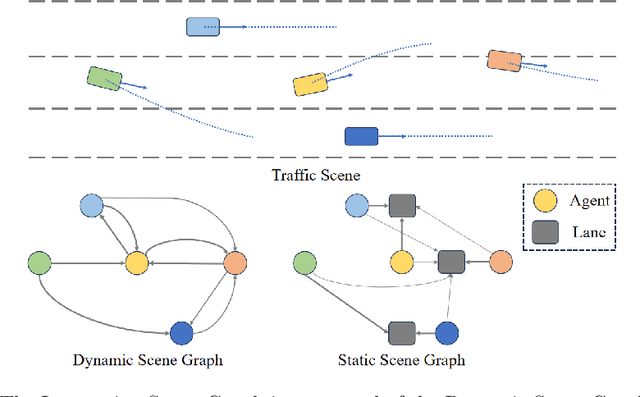

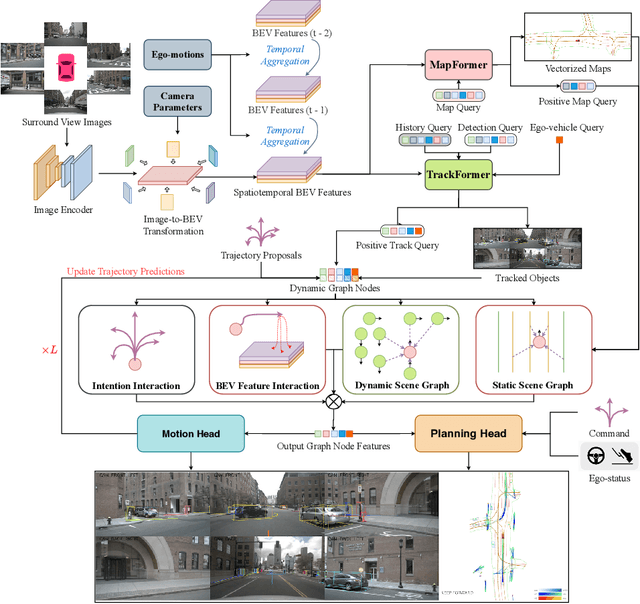

Modeling complicated interactions among the ego-vehicle, road agents, and map elements has been a crucial part for safety-critical autonomous driving. Previous works on end-to-end autonomous driving rely on the attention mechanism for handling heterogeneous interactions, which fails to capture the geometric priors and is also computationally intensive. In this paper, we propose the Interaction Scene Graph (ISG) as a unified method to model the interactions among the ego-vehicle, road agents, and map elements. With the representation of the ISG, the driving agents aggregate essential information from the most influential elements, including the road agents with potential collisions and the map elements to follow. Since a mass of unnecessary interactions are omitted, the more efficient scene-graph-based framework is able to focus on indispensable connections and leads to better performance. We evaluate the proposed method for end-to-end autonomous driving on the nuScenes dataset. Compared with strong baselines, our method significantly outperforms in the full-stack driving tasks, including perception, prediction, and planning. Code will be released at https://github.com/zhangyp15/GraphAD.