 Add to Chrome
 Add to Firefox
 Add to Edge
Baseline-Relative Counterfactual Refinement for Bit-Aware Visual Token Communication
Aug 17, 2026
Generative visual-token communication reduces transmission load by sending only selected discrete tokens and reconstructing missing content at the receiver. However, existing token-selection criteria based on local uncertainty, importance, or diversity do not directly determine whether changing the current selection improves the final reconstruction under the same packet budget. To address this problem, we propose Gated Counterfactual Refinement for Communication (GCR-C), a rollout-style correction layer over Local-MDL. GCR-C constructs a compact diversified candidate set, evaluates each candidate through matched full-budget Local-MDL continuation, and replaces the baseline action only when a positive baseline-relative reconstruction gain is obtained. Experiments on CIFAR-10, STL-10, a coded 5G-LDPC link, and a limited high-resolution Kodak transfer show that GCR-C consistently improves reconstruction quality at active low- and medium-rate operating points without increasing the realized packet rate, while remaining effective across changes in dataset, channel condition, resolution, token grid, and tokenizer. The results also reveal a clear quality--computation tradeoff due to the additional encoder-side counterfactual evaluation.

Semantic-Aware Generative Image Transmission for Resource-Constrained Visual IoT Systems
Jun 24, 2026Resource-constrained visual Internet of Things (IoT) systems, such as edge cameras, unmanned sensing platforms, industrial inspection nodes, and remote monitoring sensors, often need to transmit task-relevant visual evidence over low-rate wireless links to an edge/cloud service. Existing image communication methods usually compress or transmit complete global representations, leaving limited room to exploit receiver-side generative restoration. This paper proposes a semantic-aware generative image transmission framework for edge-assisted visual IoT. The image captured by an IoT visual sensor is encoded into a discrete token grid by a VQ encoder. At the IoT transmitter or nearby gateway, token recoverability, estimated from prediction entropy and local structure complexity, is fused with semantic importance obtained from instance segmentation and category-aware scoring. A spatial dispersal sampler then selects the tokens to be transmitted under a bitrate budget. The transmitter sends only the quantization indices of kept tokens and a binary mask map, while the edge/cloud receiver recovers masked tokens through MaskGIT with Halton sequence scheduling. Experiments on Kodak and VisDrone scenes under AWGN and Rayleigh channels show that the proposed method provides a flexible bitrate-quality tradeoff for narrowband visual IoT links. At 0.074 bpp, it uses 44.6% of the transmitted bits of the 0.167-bpp DeepJSCC/WITT reference while achieving 29.9 dB PSNR. A pseudo-GT downstream detection study on Kodak further shows that semantic-aware masking preserves task-relevant objects better than random masking at both 30% and 50% mask ratios.
Semantic Similarity Computing Model Based on Multi Model Fine-Grained Nonlinear Fusion
Feb 05, 2022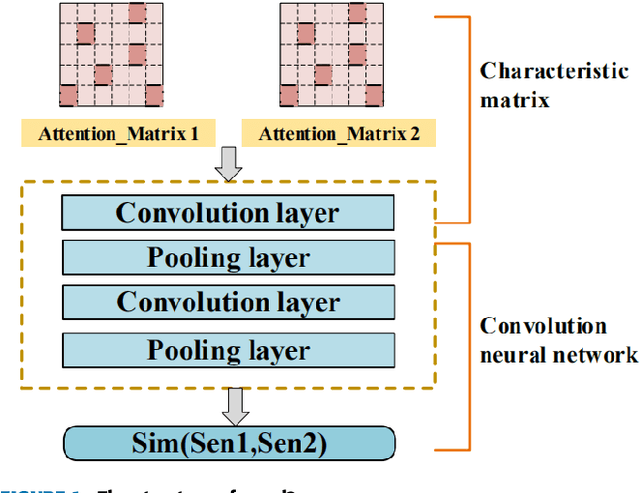
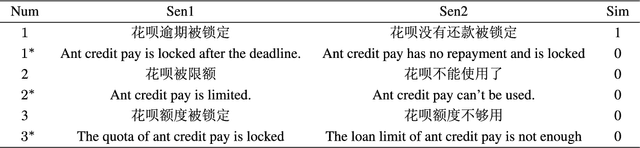
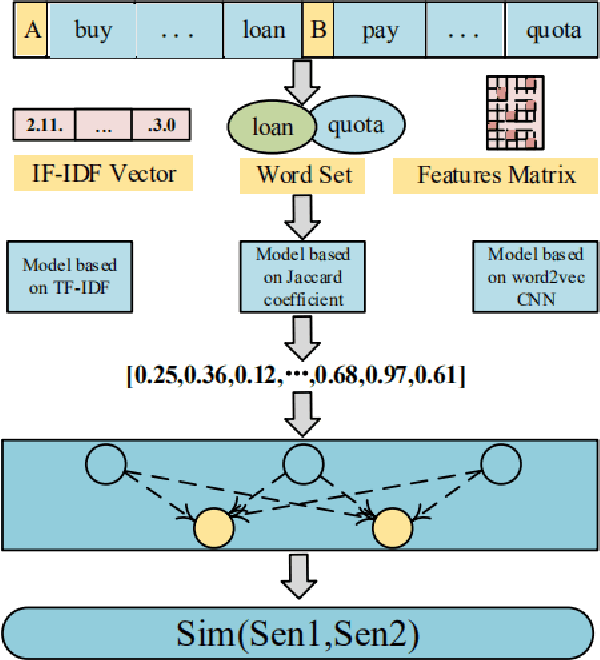
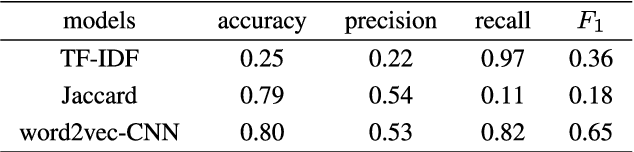
Natural language processing (NLP) task has achieved excellent performance in many fields, including semantic understanding, automatic summarization, image recognition and so on. However, most of the neural network models for NLP extract the text in a fine-grained way, which is not conducive to grasp the meaning of the text from a global perspective. To alleviate the problem, the combination of the traditional statistical method and deep learning model as well as a novel model based on multi model nonlinear fusion are proposed in this paper. The model uses the Jaccard coefficient based on part of speech, Term Frequency-Inverse Document Frequency (TF-IDF) and word2vec-CNN algorithm to measure the similarity of sentences respectively. According to the calculation accuracy of each model, the normalized weight coefficient is obtained and the calculation results are compared. The weighted vector is input into the fully connected neural network to give the final classification results. As a result, the statistical sentence similarity evaluation algorithm reduces the granularity of feature extraction, so it can grasp the sentence features globally. Experimental results show that the matching of sentence similarity calculation method based on multi model nonlinear fusion is 84%, and the F1 value of the model is 75%.