 Add to Chrome
 Add to Firefox
 Add to Edge
Baseline-Relative Counterfactual Refinement for Bit-Aware Visual Token Communication
Aug 17, 2026
Generative visual-token communication reduces transmission load by sending only selected discrete tokens and reconstructing missing content at the receiver. However, existing token-selection criteria based on local uncertainty, importance, or diversity do not directly determine whether changing the current selection improves the final reconstruction under the same packet budget. To address this problem, we propose Gated Counterfactual Refinement for Communication (GCR-C), a rollout-style correction layer over Local-MDL. GCR-C constructs a compact diversified candidate set, evaluates each candidate through matched full-budget Local-MDL continuation, and replaces the baseline action only when a positive baseline-relative reconstruction gain is obtained. Experiments on CIFAR-10, STL-10, a coded 5G-LDPC link, and a limited high-resolution Kodak transfer show that GCR-C consistently improves reconstruction quality at active low- and medium-rate operating points without increasing the realized packet rate, while remaining effective across changes in dataset, channel condition, resolution, token grid, and tokenizer. The results also reveal a clear quality--computation tradeoff due to the additional encoder-side counterfactual evaluation.

Semantic-Aware Generative Image Transmission for Resource-Constrained Visual IoT Systems
Jun 24, 2026Resource-constrained visual Internet of Things (IoT) systems, such as edge cameras, unmanned sensing platforms, industrial inspection nodes, and remote monitoring sensors, often need to transmit task-relevant visual evidence over low-rate wireless links to an edge/cloud service. Existing image communication methods usually compress or transmit complete global representations, leaving limited room to exploit receiver-side generative restoration. This paper proposes a semantic-aware generative image transmission framework for edge-assisted visual IoT. The image captured by an IoT visual sensor is encoded into a discrete token grid by a VQ encoder. At the IoT transmitter or nearby gateway, token recoverability, estimated from prediction entropy and local structure complexity, is fused with semantic importance obtained from instance segmentation and category-aware scoring. A spatial dispersal sampler then selects the tokens to be transmitted under a bitrate budget. The transmitter sends only the quantization indices of kept tokens and a binary mask map, while the edge/cloud receiver recovers masked tokens through MaskGIT with Halton sequence scheduling. Experiments on Kodak and VisDrone scenes under AWGN and Rayleigh channels show that the proposed method provides a flexible bitrate-quality tradeoff for narrowband visual IoT links. At 0.074 bpp, it uses 44.6% of the transmitted bits of the 0.167-bpp DeepJSCC/WITT reference while achieving 29.9 dB PSNR. A pseudo-GT downstream detection study on Kodak further shows that semantic-aware masking preserves task-relevant objects better than random masking at both 30% and 50% mask ratios.
Filter Pruning For CNN With Enhanced Linear Representation Redundancy
Oct 10, 2023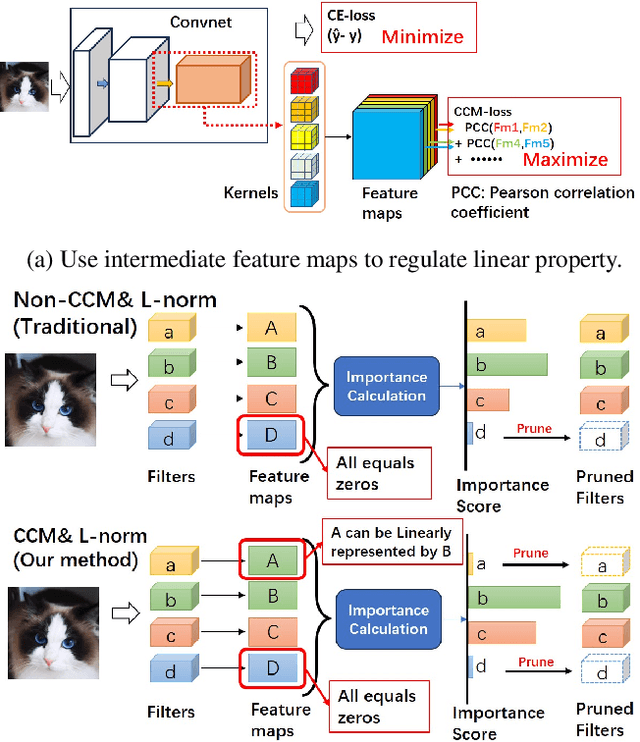
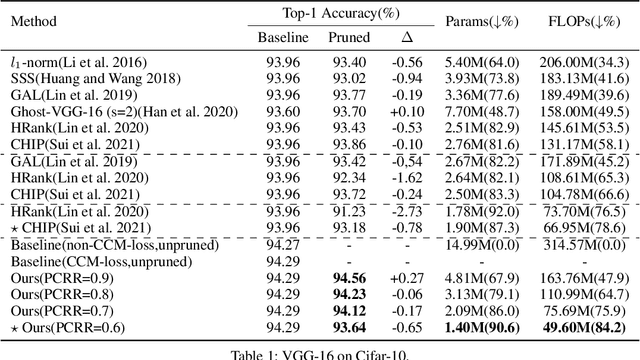
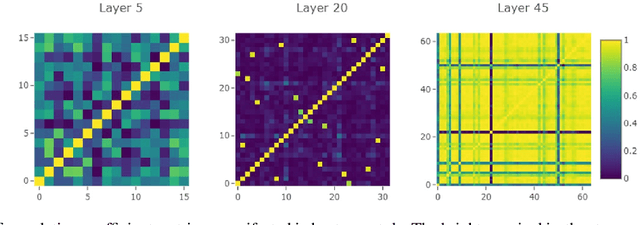

Structured network pruning excels non-structured methods because they can take advantage of the thriving developed parallel computing techniques. In this paper, we propose a new structured pruning method. Firstly, to create more structured redundancy, we present a data-driven loss function term calculated from the correlation coefficient matrix of different feature maps in the same layer, named CCM-loss. This loss term can encourage the neural network to learn stronger linear representation relations between feature maps during the training from the scratch so that more homogenous parts can be removed later in pruning. CCM-loss provides us with another universal transcendental mathematical tool besides L*-norm regularization, which concentrates on generating zeros, to generate more redundancy but for the different genres. Furthermore, we design a matching channel selection strategy based on principal components analysis to exploit the maximum potential ability of CCM-loss. In our new strategy, we mainly focus on the consistency and integrality of the information flow in the network. Instead of empirically hard-code the retain ratio for each layer, our channel selection strategy can dynamically adjust each layer's retain ratio according to the specific circumstance of a per-trained model to push the prune ratio to the limit. Notably, on the Cifar-10 dataset, our method brings 93.64% accuracy for pruned VGG-16 with only 1.40M parameters and 49.60M FLOPs, the pruned ratios for parameters and FLOPs are 90.6% and 84.2%, respectively. For ResNet-50 trained on the ImageNet dataset, our approach achieves 42.8% and 47.3% storage and computation reductions, respectively, with an accuracy of 76.23%. Our code is available at https://github.com/Bojue-Wang/CCM-LRR.