 Add to Chrome
 Add to Firefox
 Add to Edge
SemantiCache: Efficient KV Cache Compression via Semantic Chunking and Clustered Merging
Mar 15, 2026
Existing KV cache compression methods generally operate on discrete tokens or non-semantic chunks. However, such approaches often lead to semantic fragmentation, where linguistically coherent units are disrupted, causing irreversible information loss and degradation in model performance. To address this, we introduce SemantiCache, a novel compression framework that preserves semantic integrity by aligning the compression process with the semantic hierarchical nature of language. Specifically, we first partition the cache into semantically coherent chunks by delimiters, which are natural semantic boundaries. Within each chunk, we introduce a computationally efficient Greedy Seed-Based Clustering (GSC) algorithm to group tokens into semantic clusters. These clusters are further merged into semantic cores, enhanced by a Proportional Attention mechanism that rebalances the reduced attention contributions of the merged tokens. Extensive experiments across diverse benchmarks and models demonstrate that SemantiCache accelerates the decoding stage of inference by up to 2.61 times and substantially reduces memory footprint, while maintaining performance comparable to the original model.

GMSA: Enhancing Context Compression via Group Merging and Layer Semantic Alignment
May 18, 2025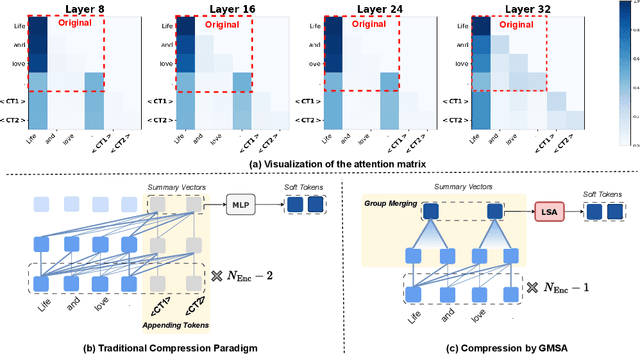
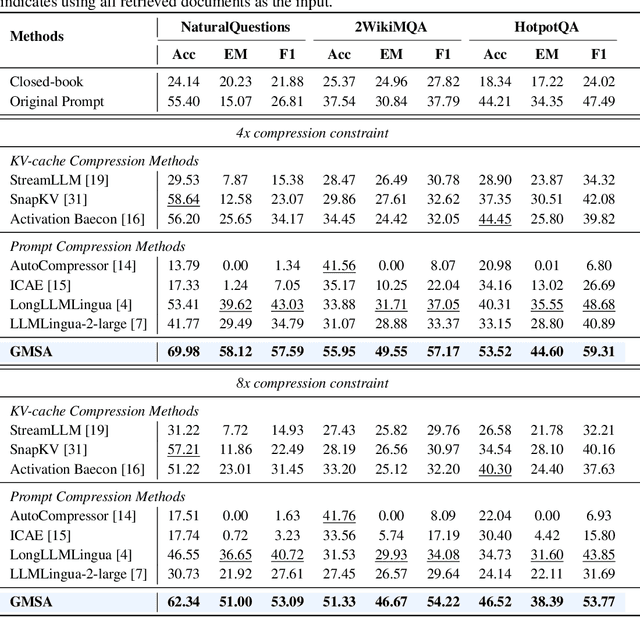
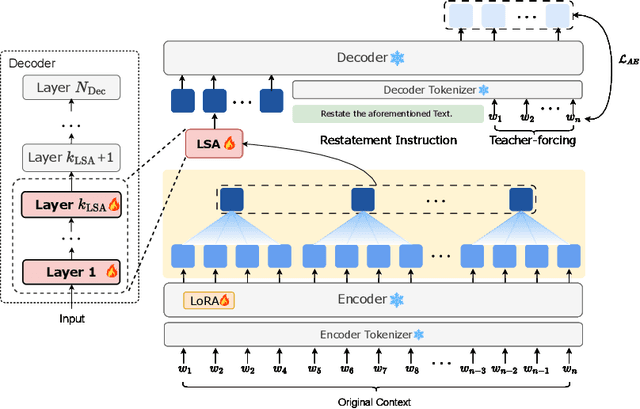
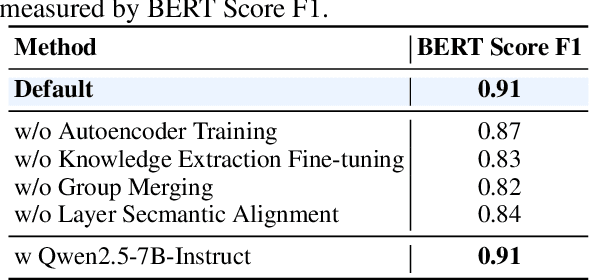
Large language models (LLMs) have achieved impressive performance in a variety of natural language processing (NLP) tasks. However, when applied to long-context scenarios, they face two challenges, i.e., low computational efficiency and much redundant information. This paper introduces GMSA, a context compression framework based on the encoder-decoder architecture, which addresses these challenges by reducing input sequence length and redundant information. Structurally, GMSA has two key components: Group Merging and Layer Semantic Alignment (LSA). Group merging is used to effectively and efficiently extract summary vectors from the original context. Layer semantic alignment, on the other hand, aligns the high-level summary vectors with the low-level primary input semantics, thus bridging the semantic gap between different layers. In the training process, GMSA first learns soft tokens that contain complete semantics through autoencoder training. To furtherly adapt GMSA to downstream tasks, we propose Knowledge Extraction Fine-tuning (KEFT) to extract knowledge from the soft tokens for downstream tasks. We train GMSA by randomly sampling the compression rate for each sample in the dataset. Under this condition, GMSA not only significantly outperforms the traditional compression paradigm in context restoration but also achieves stable and significantly faster convergence with only a few encoder layers. In downstream question-answering (QA) tasks, GMSA can achieve approximately a 2x speedup in end-to-end inference while outperforming both the original input prompts and various state-of-the-art (SOTA) methods by a large margin.