 Add to Chrome
 Add to Firefox
 Add to Edge
The Speedup Paradox: Rethinking Inference Speed-Quality Trade-off in Embodied Tasks
Jun 30, 2026
Embodied foundation models have recently been widely used to improve robot generalization and task success rates. Previous works apply lossy efficient-inference techniques such as quantization, pruning, and asynchronous inference, accepting small action quality degradation in exchange for lower per-step computation cost and inter-action latency. However, unlike traditional static ML tasks, embodied tasks involve repeated interaction with the environment, and task-level performance is determined not only by per-step cost, but also by closed-loop effects unique to embodied execution, which remain insufficiently characterized in current efficient-inference studies. In this work, we propose TISED (\underline{T}ask-level \underline{I}nference \underline{S}peedup \underline{E}ffect \underline{D}ecomposition), an analytical framework that unifies diverse lossy inference optimization techniques and decomposes their effects on static and dynamic tasks, and uncovers some paradoxical effects on task-level performance: (1) on \textit{static tasks}, optimization sometimes can lengthen end-to-end per-task completion time even as per-step latency drops; (2) on \textit{dynamic tasks}, moderate lossy optimization can raise task success rate even above the baseline; and (3) the monotonicity and sweet-spot location of both effects can shift with hardware configuration. Together, our findings provide a new perspective on adapting inference optimization techniques to embodied tasks.

Perceive, Reflect, and Plan: Designing LLM Agent for Goal-Directed City Navigation without Instructions
Aug 08, 2024

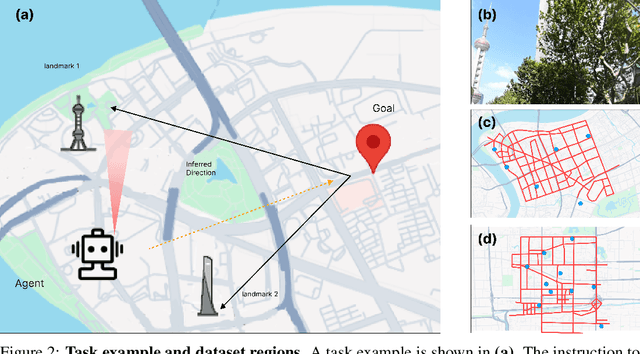

This paper considers a scenario in city navigation: an AI agent is provided with language descriptions of the goal location with respect to some well-known landmarks; By only observing the scene around, including recognizing landmarks and road network connections, the agent has to make decisions to navigate to the goal location without instructions. This problem is very challenging, because it requires agent to establish self-position and acquire spatial representation of complex urban environment, where landmarks are often invisible. In the absence of navigation instructions, such abilities are vital for the agent to make high-quality decisions in long-range city navigation. With the emergent reasoning ability of large language models (LLMs), a tempting baseline is to prompt LLMs to "react" on each observation and make decisions accordingly. However, this baseline has very poor performance that the agent often repeatedly visits same locations and make short-sighted, inconsistent decisions. To address these issues, this paper introduces a novel agentic workflow featured by its abilities to perceive, reflect and plan. Specifically, we find LLaVA-7B can be fine-tuned to perceive the direction and distance of landmarks with sufficient accuracy for city navigation. Moreover, reflection is achieved through a memory mechanism, where past experiences are stored and can be retrieved with current perception for effective decision argumentation. Planning uses reflection results to produce long-term plans, which can avoid short-sighted decisions in long-range navigation. We show the designed workflow significantly improves navigation ability of the LLM agent compared with the state-of-the-art baselines.