 Add to Chrome
 Add to Firefox
 Add to Edge
The Speedup Paradox: Rethinking Inference Speed-Quality Trade-off in Embodied Tasks
Jun 30, 2026
Embodied foundation models have recently been widely used to improve robot generalization and task success rates. Previous works apply lossy efficient-inference techniques such as quantization, pruning, and asynchronous inference, accepting small action quality degradation in exchange for lower per-step computation cost and inter-action latency. However, unlike traditional static ML tasks, embodied tasks involve repeated interaction with the environment, and task-level performance is determined not only by per-step cost, but also by closed-loop effects unique to embodied execution, which remain insufficiently characterized in current efficient-inference studies. In this work, we propose TISED (\underline{T}ask-level \underline{I}nference \underline{S}peedup \underline{E}ffect \underline{D}ecomposition), an analytical framework that unifies diverse lossy inference optimization techniques and decomposes their effects on static and dynamic tasks, and uncovers some paradoxical effects on task-level performance: (1) on \textit{static tasks}, optimization sometimes can lengthen end-to-end per-task completion time even as per-step latency drops; (2) on \textit{dynamic tasks}, moderate lossy optimization can raise task success rate even above the baseline; and (3) the monotonicity and sweet-spot location of both effects can shift with hardware configuration. Together, our findings provide a new perspective on adapting inference optimization techniques to embodied tasks.

A Microprocessor implemented in 65nm CMOS with Configurable and Bit-scalable Accelerator for Programmable In-memory Computing
Nov 09, 2018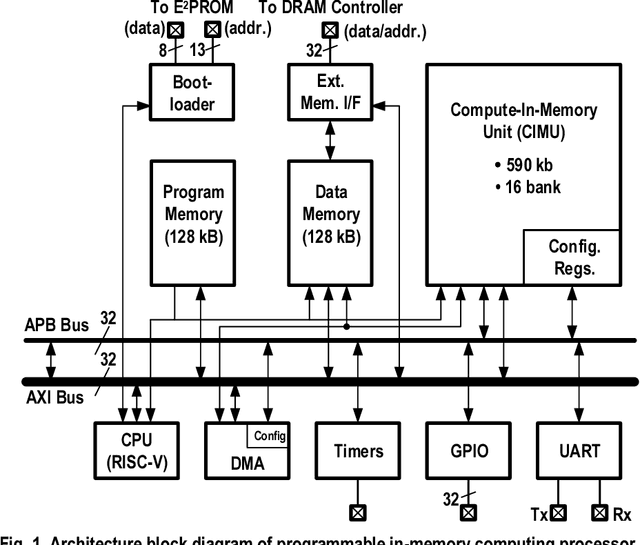
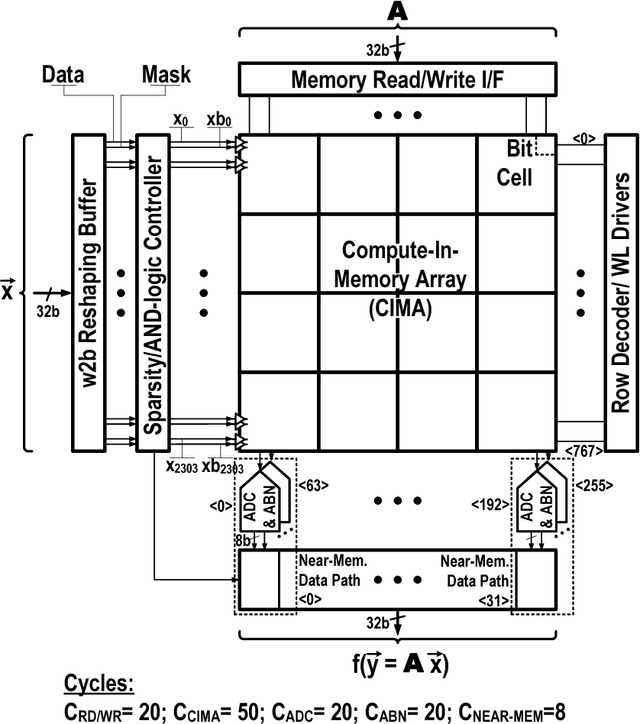
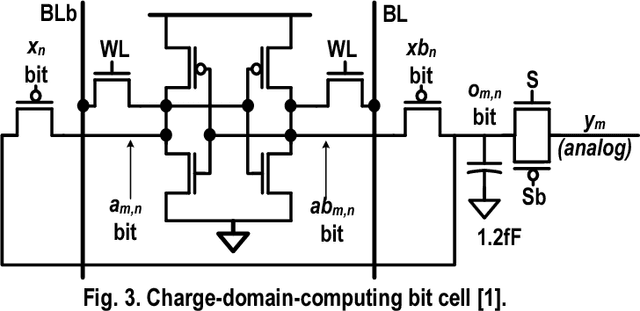
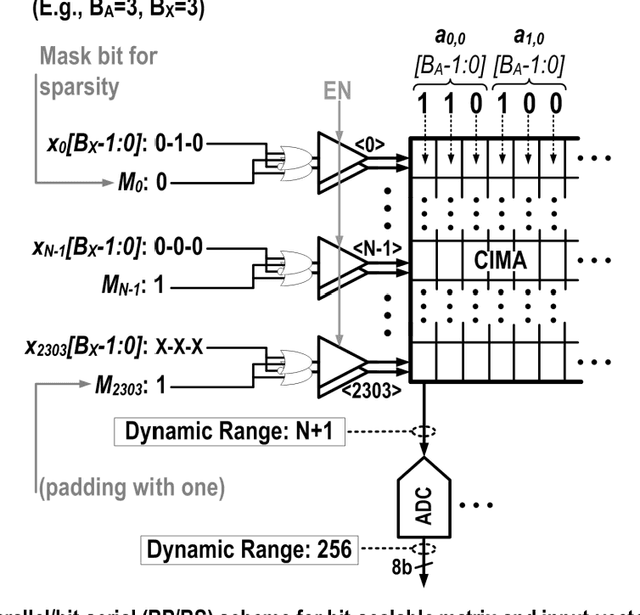
This paper presents a programmable in-memory-computing processor, demonstrated in a 65nm CMOS technology. For data-centric workloads, such as deep neural networks, data movement often dominates when implemented with today's computing architectures. This has motivated spatial architectures, where the arrangement of data-storage and compute hardware is distributed and explicitly aligned to the computation dataflow, most notably for matrix-vector multiplication. In-memory computing is a spatial architecture where processing elements correspond to dense bit cells, providing local storage and compute, typically employing analog operation. Though this raises the potential for high energy efficiency and throughput, analog operation has significantly limited robustness, scale, and programmability. This paper describes a 590kb in-memory-computing accelerator integrated in a programmable processor architecture, by exploiting recent approaches to charge-domain in-memory computing. The architecture takes the approach of tight coupling with an embedded CPU, through accelerator interfaces enabling integration in the standard processor memory space. Additionally, a near-memory-computing datapath both enables diverse computations locally, to address operations required across applications, and enables bit-precision scalability for matrix/input-vector elements, through a bit-parallel/bit-serial (BP/BS) scheme. Chip measurements show an energy efficiency of 152/297 1b-TOPS/W and throughput of 4.7/1.9 1b-TOPS (scaling linearly with the matrix/input-vector element precisions) at VDD of 1.2/0.85V. Neural network demonstrations with 1-b/4-b weights and activations for CIFAR-10 classification consume 5.3/105.2 $\mu$J/image at 176/23 fps, with accuracy at the level of digital/software implementation (89.3/92.4 $\%$ accuracy).