 Add to Chrome
 Add to Firefox
 Add to Edge
A Polynomial Architecture-Attribution Co-Design Framework for Exact Aumann-Shapley Attribution in GNNs
Jul 23, 2026
We study feature-level and node-level explanations for graph neural networks (GNNs) through the lens of Aumann-Shapley attribution. Path-integral methods such as Integrated Gradients provide an axiomatic formulation of attribution, but their practical use in deep GNNs typically relies on finite-sample numerical approximations to the path integral, requiring a trade-off between quadrature error and computational cost. This paper proposes APEX, a model-attribution co-design framework that makes the attribution integral exactly computable under a polynomial GNN architecture. The key component is PolyGIN, a GIN-style graph network whose message-passing, normalization, and transformation operations preserve a bounded multivariate polynomial form for scalar model scores, such as pre-softmax logits. We show that, for a PolyGIN with $L$ polynomial transformation blocks, the derivative along the attribution path has degree at most $2^L-1$. Therefore, Gauss--Legendre quadrature can evaluate the Aumann--Shapley path integral exactly, up to floating-point precision, with $2^{L-1}$ deterministic evaluation points. The resulting attributions can be computed at the feature level and then aggregated into node-level scores while preserving completeness. Experiments on synthetic and real-world graph benchmarks show that PolyGIN maintains competitive predictive performance, while the complete APEX framework achieves higher attribution fidelity than the compared baselines and substantially reduces the number of evaluations required for path integration.

Aperture Diffraction for Compact Snapshot Spectral Imaging
Sep 27, 2023
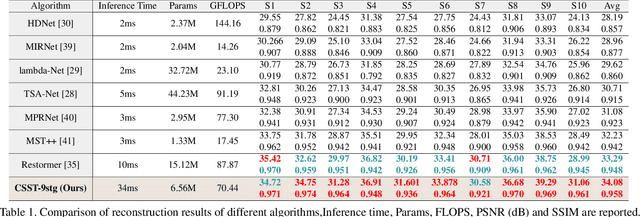
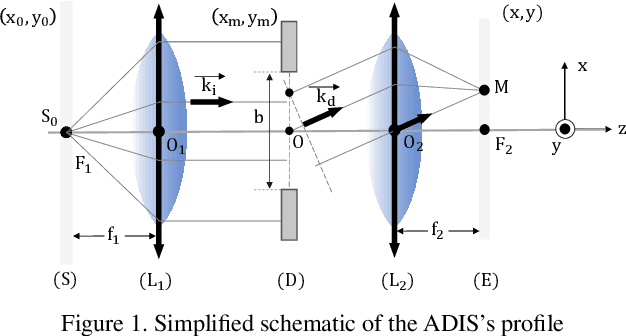
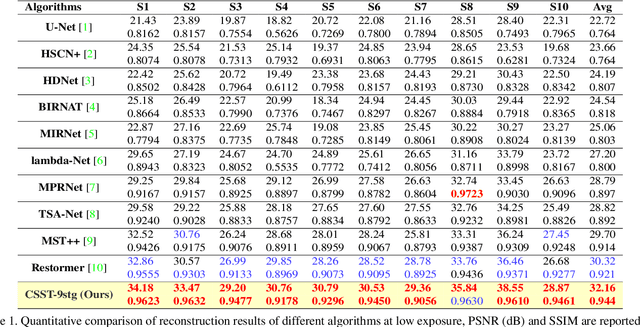
We demonstrate a compact, cost-effective snapshot spectral imaging system named Aperture Diffraction Imaging Spectrometer (ADIS), which consists only of an imaging lens with an ultra-thin orthogonal aperture mask and a mosaic filter sensor, requiring no additional physical footprint compared to common RGB cameras. Then we introduce a new optical design that each point in the object space is multiplexed to discrete encoding locations on the mosaic filter sensor by diffraction-based spatial-spectral projection engineering generated from the orthogonal mask. The orthogonal projection is uniformly accepted to obtain a weakly calibration-dependent data form to enhance modulation robustness. Meanwhile, the Cascade Shift-Shuffle Spectral Transformer (CSST) with strong perception of the diffraction degeneration is designed to solve a sparsity-constrained inverse problem, realizing the volume reconstruction from 2D measurements with Large amount of aliasing. Our system is evaluated by elaborating the imaging optical theory and reconstruction algorithm with demonstrating the experimental imaging under a single exposure. Ultimately, we achieve the sub-super-pixel spatial resolution and high spectral resolution imaging. The code will be available at: https://github.com/Krito-ex/CSST.