 Add to Chrome
 Add to Firefox
 Add to Edge
A Polynomial Architecture-Attribution Co-Design Framework for Exact Aumann-Shapley Attribution in GNNs
Jul 23, 2026
We study feature-level and node-level explanations for graph neural networks (GNNs) through the lens of Aumann-Shapley attribution. Path-integral methods such as Integrated Gradients provide an axiomatic formulation of attribution, but their practical use in deep GNNs typically relies on finite-sample numerical approximations to the path integral, requiring a trade-off between quadrature error and computational cost. This paper proposes APEX, a model-attribution co-design framework that makes the attribution integral exactly computable under a polynomial GNN architecture. The key component is PolyGIN, a GIN-style graph network whose message-passing, normalization, and transformation operations preserve a bounded multivariate polynomial form for scalar model scores, such as pre-softmax logits. We show that, for a PolyGIN with $L$ polynomial transformation blocks, the derivative along the attribution path has degree at most $2^L-1$. Therefore, Gauss--Legendre quadrature can evaluate the Aumann--Shapley path integral exactly, up to floating-point precision, with $2^{L-1}$ deterministic evaluation points. The resulting attributions can be computed at the feature level and then aggregated into node-level scores while preserving completeness. Experiments on synthetic and real-world graph benchmarks show that PolyGIN maintains competitive predictive performance, while the complete APEX framework achieves higher attribution fidelity than the compared baselines and substantially reduces the number of evaluations required for path integration.

FSX: Message Flow Sensitivity Enhanced Structural Explainer for Graph Neural Networks
Jan 21, 2026Despite the widespread success of Graph Neural Networks (GNNs), understanding the reasons behind their specific predictions remains challenging. Existing explainability methods face a trade-off that gradient-based approaches are computationally efficient but often ignore structural interactions, while game-theoretic techniques capture interactions at the cost of high computational overhead and potential deviation from the model's true reasoning path. To address this gap, we propose FSX (Message Flow Sensitivity Enhanced Structural Explainer), a novel hybrid framework that synergistically combines the internal message flows of the model with a cooperative game approach applied to the external graph data. FSX first identifies critical message flows via a novel flow-sensitivity analysis: during a single forward pass, it simulates localized node perturbations and measures the resulting changes in message flow intensities. These sensitivity-ranked flows are then projected onto the input graph to define compact, semantically meaningful subgraphs. Within each subgraph, a flow-aware cooperative game is conducted, where node contributions are evaluated fairly through a Shapley-like value that incorporates both node-feature importance and their roles in sustaining or destabilizing the identified critical flows. Extensive evaluation across multiple datasets and GNN architectures demonstrates that FSX achieves superior explanation fidelity with significantly reduced runtime, while providing unprecedented insights into the structural logic underlying model predictions--specifically, how important sub-structures exert influence by governing the stability of key internal computational pathways.
Exploring Kolmogorov-Arnold networks for realistic image sharpness assessment
Sep 12, 2024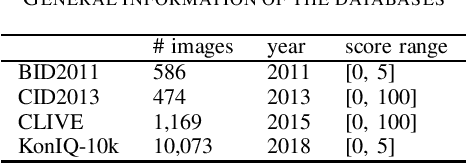
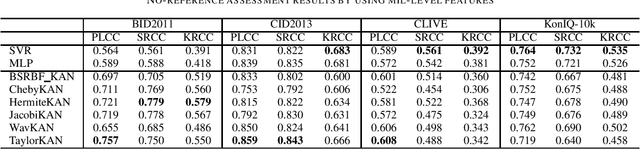
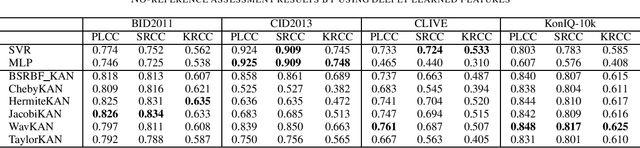
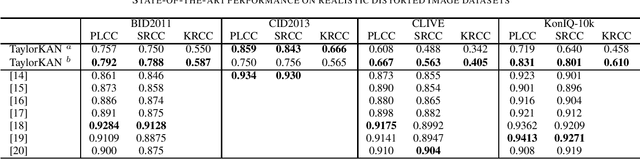
Score prediction is crucial in realistic image sharpness assessment after informative features are collected. Recently, Kolmogorov-Arnold networks (KANs) have been developed and witnessed remarkable success in data fitting. This study presents Taylor series based KAN (TaylorKAN). Then, different KANs are explored on four realistic image databases (BID2011, CID2013, CLIVE, and KonIQ-10k) for score prediction by using 15 mid-level features and 2048 high-level features. When setting support vector regression as the baseline, experimental results indicate KANs are generally better or competitive, TaylorKAN is the best on three databases using mid-level feature input, while KANs are inferior on CLIVE when high-level features are used. This is the first study that explores KANs for image quality assessment. It sheds lights on how to select and improve KANs on related tasks.