 Add to Chrome
 Add to Firefox
 Add to Edge
UniDot: A Unified Network for Sequence Modeling and Feature Interaction in Large-scale Recommendation
Aug 17, 2026
Industrial recommenders rely on two model families that have evolved largely independently: feature-interaction models over multi-field user/item features, and sequential models over user-behavior histories. Production systems couple them only loosely. To unify the two, we present UniDot, a novel architecture for post-click conversion prediction built from the factorization-machine (FM) point of view: the embedding inner product---which powers collaborative filtering and lets a recommender generalize to unseen user--item pairs---is the same primitive as attention's query dot key scoring, so a single dot-product of tokens can underlie both feature interaction and sequence modeling. UniDot tokenizes non-sequential fields and multi-domain behavioral sequences into one shared token space and stacks a single macro-block in which a token-mixing bus and a sequence-retrieval bus (item tokens cross-attending the histories) run in parallel and exchange state each layer through an MLP-Mixer fusion, while an FM Highway carries explicit per-layer dot-product interactions around the residual stack directly to the classifier. The sequence side is embedded once per forward pass and shared by all consumers, bounding inference latency. Trained with a dual sparse/dense (Adagrad + Muon) optimizer, an auxiliary conversion-delay head, and multi-path mutual learning, UniDot finished as the runner-up on the Industrial track of the TAAC KDD Cup 2026.

Dear Algo: A Precision-First Agentic Intent Layer for Unified Search and Recommendation
Aug 16, 2026Search and recommendation serve a shared discovery objective but encode intent differently. We study this boundary through Dear Algo on Threads, a deployed product where open-ended requests such as \emph{more NBA news} or \emph{less politics} steer subsequent feed recommendations rather than return a one-shot result list. Its agentic intent layer compiles explicit, inferred, negative, and compound intent into a grounded executable plan, then invokes conventional retrieval and optional semantic or multimodal reranking. The layer shares an intent-to-retrieval contract without requiring one model or serving path across search-like and recommendation-like modes. We evaluate Dear Algo under a precision-first objective. In a blinded audit of 300 public request-item pairs (296 evaluable), a strict categorical LLM-as-a-judge gate achieved 94.4\% exact-Relevant precision [88.8\%, 98.9\%]. Across 72 normalized request clusters, the full configuration produced 7.73 judge-qualified candidates per 20 slots versus 6.61 for an LLM-derived-query baseline, a gain of 1.11 [0.12, 2.12]. In a candidate-randomized serving-path study restricted to the reranker path's first 72 eligible hours, the user-weighted judge-Irrelevant share among judged admissions was 2.80\% versus 4.78\% off (-1.97 points [-3.02, -0.94]), while Exact-Relevant share was 2.24 points higher [0.08, 4.41]. Together, these studies show how explicit natural-language intent can be carried into feed recommendation under a precision-first evaluation framework
Prioritizing Original News on Facebook
Mar 14, 2021
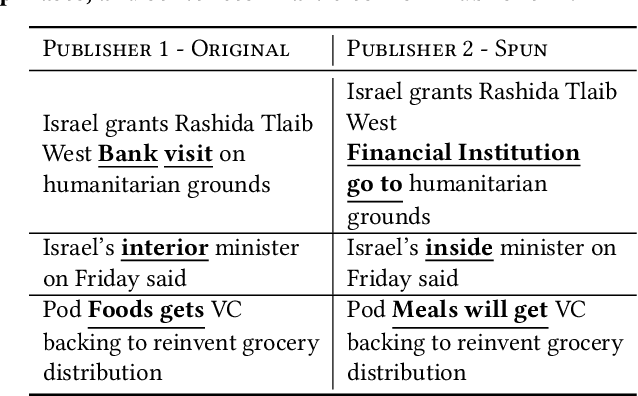
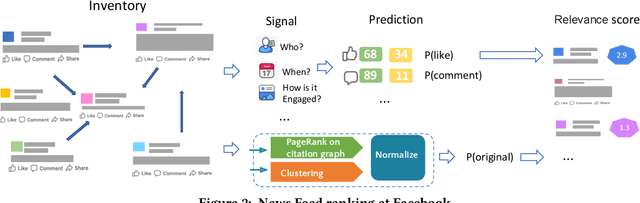
This work outlines how we prioritize original news, a critical indicator of news quality. By examining the landscape and life-cycle of news posts on our social media platform, we identify challenges of building and deploying an originality score. We pursue an approach based on normalized PageRank values and three-step clustering, and refresh the score on an hourly basis to capture the dynamics of online news. We describe a near real-time system architecture, evaluate our methodology, and deploy it to production. Our empirical results validate individual components and show that prioritizing original news increases user engagement with news and improves proprietary cumulative metrics.