 Add to Chrome
 Add to Firefox
 Add to Edge
UniDot: A Unified Network for Sequence Modeling and Feature Interaction in Large-scale Recommendation
Aug 17, 2026
Industrial recommenders rely on two model families that have evolved largely independently: feature-interaction models over multi-field user/item features, and sequential models over user-behavior histories. Production systems couple them only loosely. To unify the two, we present UniDot, a novel architecture for post-click conversion prediction built from the factorization-machine (FM) point of view: the embedding inner product---which powers collaborative filtering and lets a recommender generalize to unseen user--item pairs---is the same primitive as attention's query dot key scoring, so a single dot-product of tokens can underlie both feature interaction and sequence modeling. UniDot tokenizes non-sequential fields and multi-domain behavioral sequences into one shared token space and stacks a single macro-block in which a token-mixing bus and a sequence-retrieval bus (item tokens cross-attending the histories) run in parallel and exchange state each layer through an MLP-Mixer fusion, while an FM Highway carries explicit per-layer dot-product interactions around the residual stack directly to the classifier. The sequence side is embedded once per forward pass and shared by all consumers, bounding inference latency. Trained with a dual sparse/dense (Adagrad + Muon) optimizer, an auxiliary conversion-delay head, and multi-path mutual learning, UniDot finished as the runner-up on the Industrial track of the TAAC KDD Cup 2026.

MOD: A Deep Mixture Model with Online Knowledge Distillation for Large Scale Video Temporal Concept Localization
Oct 27, 2019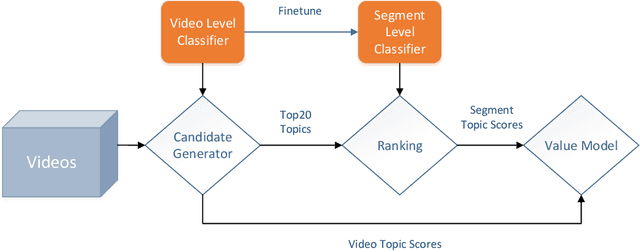
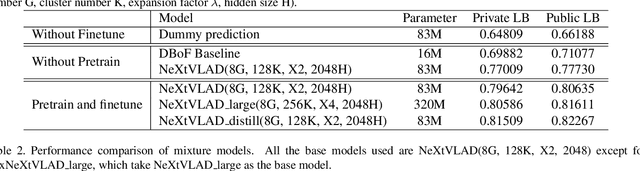
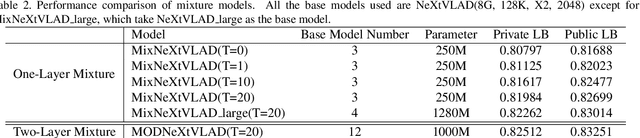
In this paper, we present and discuss a deep mixture model with online knowledge distillation (MOD) for large-scale video temporal concept localization, which is ranked 3rd in the 3rd YouTube-8M Video Understanding Challenge. Specifically, we find that by enabling knowledge sharing with online distillation, fintuning a mixture model on a smaller dataset can achieve better evaluation performance. Based on this observation, in our final solution, we trained and fintuned 12 NeXtVLAD models in parallel with a 2-layer online distillation structure. The experimental results show that the proposed distillation structure can effectively avoid overfitting and shows superior generalization performance. The code is publicly available at: https://github.com/linrongc/solution_youtube8m_v3
* ICCV 2019 YouTube8M workshop
NeXtVLAD: An Efficient Neural Network to Aggregate Frame-level Features for Large-scale Video Classification
Nov 12, 2018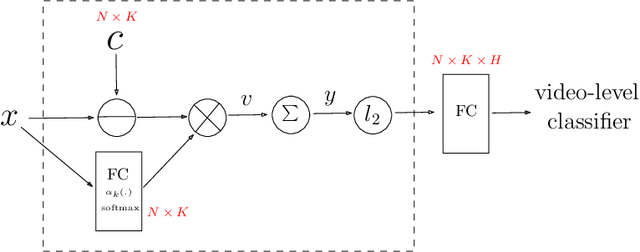
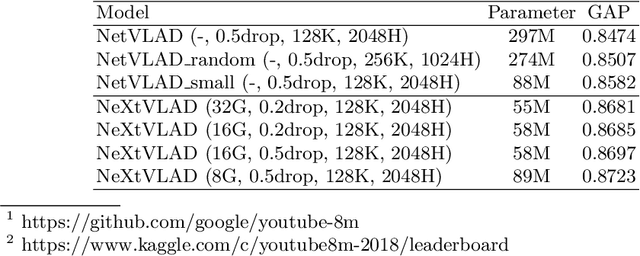
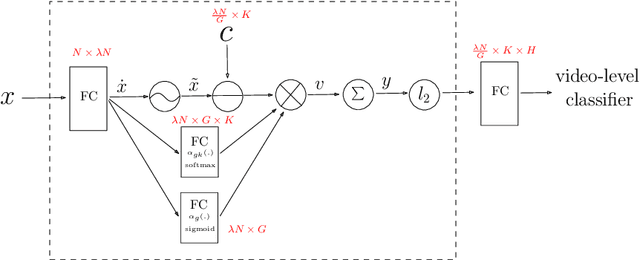
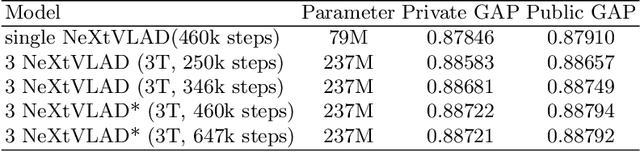
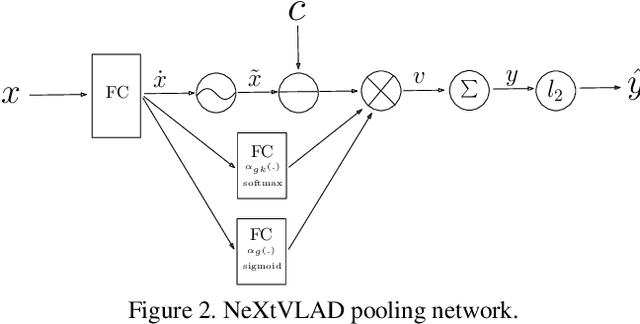
This paper introduces a fast and efficient network architecture, NeXtVLAD, to aggregate frame-level features into a compact feature vector for large-scale video classification. Briefly speaking, the basic idea is to decompose a high-dimensional feature into a group of relatively low-dimensional vectors with attention before applying NetVLAD aggregation over time. This NeXtVLAD approach turns out to be both effective and parameter efficient in aggregating temporal information. In the 2nd Youtube-8M video understanding challenge, a single NeXtVLAD model with less than 80M parameters achieves a GAP score of 0.87846 in private leaderboard. A mixture of 3 NeXtVLAD models results in 0.88722, which is ranked 3rd over 394 teams. The code is publicly available at https://github.com/linrongc/youtube-8m.