 Add to Chrome
 Add to Firefox
 Add to Edge
Knowing the Self, Understanding the World: A Dual-Cognition Benchmark for UAV Spatio-temporal Reasoning with MLLMs
Jul 17, 2026
Multimodal large language models have achieved strong performance across diverse vision-language tasks, yet their capabilities in UAV scenarios remain insufficiently explored. Recent UAV-oriented benchmarks have begun to evaluate MLLMs in aerial scenarios, but they typically focus on scene understanding, event recognition, or navigation completion, rather than jointly assessing the dual-cognition capability required for UAV agents: reasoning about both the UAV's own state and the external environment in multiview spatio-temporal contexts. To address this gap, we present UAV-DualCog, a benchmark for aerial multiview spatio-temporal reasoning built on this dual-cognition perspective. UAV-DualCog includes both image and video tasks to jointly evaluate self-state and environment-state reasoning, while requiring spatial or temporal grounding beyond discrete answer prediction. We also develop an automated pipeline that constructs data from scene-level semantic point clouds, yielding a scalable benchmark with diverse scenes, hundreds of landmarks, and thousands of QA samples. Extensive evaluations show that current MLLMs remain far from reliable in UAV dual cognition. Self-state reasoning, viewpoint transformation, precise spatial grounding, and temporal interval localization are persistent bottlenecks, and additional validation with thinking/frontier models and a human baseline confirms that the benchmark is understandable to humans but challenging for existing models. We further construct UAV-DualCog-Train from disjoint scenes and show through a lightweight optimization probe that it provides useful structured supervision, suggesting its value not only as an evaluation benchmark but also as a data resource for advancing MLLM-based UAV agents. Project website and supplementary materials: https://uav-dualcog.lozumi.com

A Unified Plug-and-Play Algorithm with Projected Landweber Operator for Split Convex Feasibility Problems
Aug 22, 2024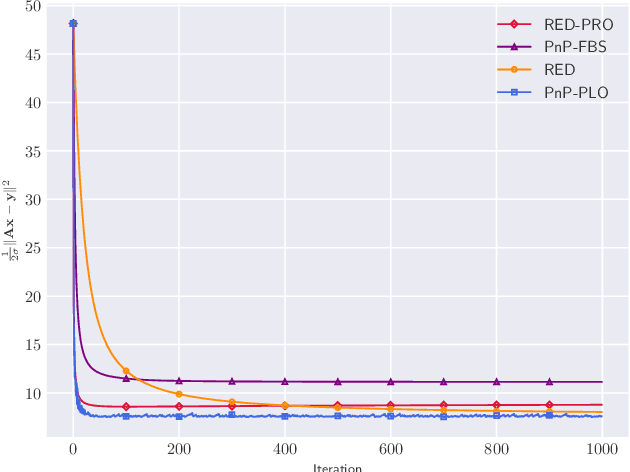
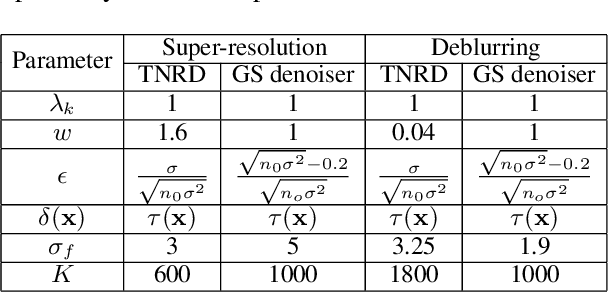
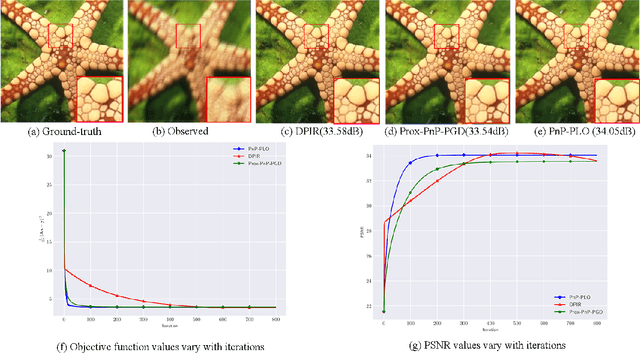

In recent years Plug-and-Play (PnP) methods have achieved state-of-the-art performance in inverse imaging problems by replacing proximal operators with denoisers. Based on the proximal gradient method, some theoretical results of PnP have appeared, where appropriate step size is crucial for convergence analysis. However, in practical applications, applying PnP methods with theoretically guaranteed step sizes is difficult, and these algorithms are limited to Gaussian noise. In this paper,from a perspective of split convex feasibility problems (SCFP), an adaptive PnP algorithm with Projected Landweber Operator (PnP-PLO) is proposed to address these issues. Numerical experiments on image deblurring, super-resolution, and compressed sensing MRI experiments illustrate that PnP-PLO with theoretical guarantees outperforms state-of-the-art methods such as RED and RED-PRO.
HPPP: Halpern-type Preconditioned Proximal Point Algorithms and Applications to Image Restoration
Jul 18, 2024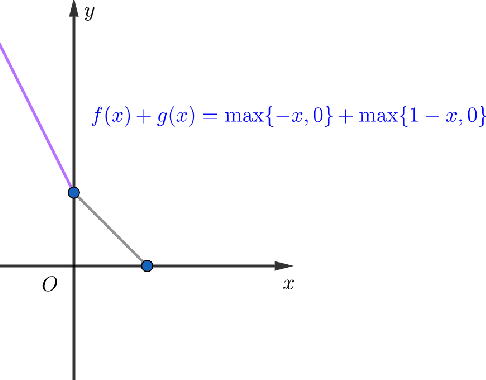

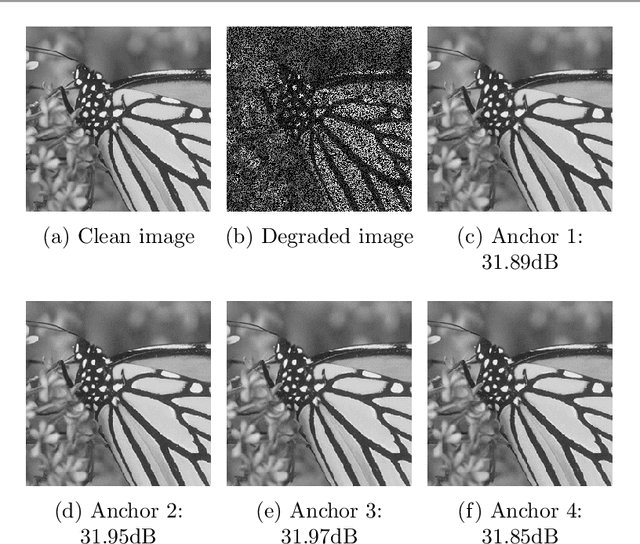
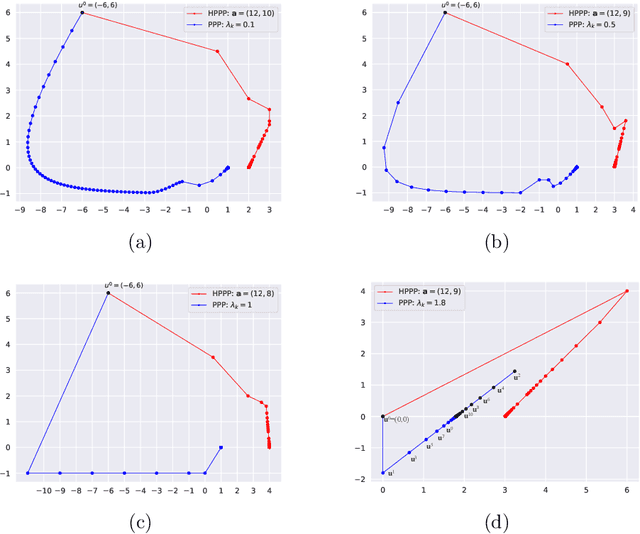
Preconditioned Proximal Point (PPP) algorithms provide a unified framework for splitting methods in image restoration. Recent advancements with RED (Regularization by Denoising) and PnP (Plug-and-Play) priors have achieved state-of-the-art performance in this domain, emphasizing the need for a meaningful particular solution. However, degenerate PPP algorithms typically exhibit weak convergence in infinite-dimensional Hilbert space, leading to uncertain solutions. To address this issue, we propose the Halpern-type Preconditioned Proximal Point (HPPP) algorithm, which leverages the strong convergence properties of Halpern iteration to achieve a particular solution. Based on the implicit regularization defined by gradient RED, we further introduce the Gradient REgularization by Denoising via HPPP called GraRED-HP3 algorithm. The HPPP algorithm is shown to have the regularity converging to a particular solution by a toy example. Additionally, experiments in image deblurring and inpainting validate the effectiveness of GraRED-HP3, showing it surpasses classical methods such as Chambolle-Pock (CP), PPP, RED, and RED-PRO.
A Novel Learning Algorithm for Bayesian Network and Its Efficient Implementation on GPU
Oct 18, 2012


Computational inference of causal relationships underlying complex networks, such as gene-regulatory pathways, is NP-complete due to its combinatorial nature when permuting all possible interactions. Markov chain Monte Carlo (MCMC) has been introduced to sample only part of the combinations while still guaranteeing convergence and traversability, which therefore becomes widely used. However, MCMC is not able to perform efficiently enough for networks that have more than 15~20 nodes because of the computational complexity. In this paper, we use general purpose processor (GPP) and general purpose graphics processing unit (GPGPU) to implement and accelerate a novel Bayesian network learning algorithm. With a hash-table-based memory-saving strategy and a novel task assigning strategy, we achieve a 10-fold acceleration per iteration than using a serial GPP. Specially, we use a greedy method to search for the best graph from a given order. We incorporate a prior component in the current scoring function, which further facilitates the searching. Overall, we are able to apply this system to networks with more than 60 nodes, allowing inferences and modeling of bigger and more complex networks than current methods.