 Add to Chrome
 Add to Firefox
 Add to Edge
Gaze-DETR: Top-Down Guidance Through Priority Maps for Infrared Weak-Small UAV Detection with DETR
Jul 21, 2026
Infrared small target detection (ISTD) remains challenging because tiny, low-contrast targets are easily overwhelmed by clutter, noise, or occlusion. Conventional single-frame and multi-frame detectors rely on bounding-box supervision, which specifies final target locations but offers little explicit guidance for prioritizing candidate regions or preserving weak-target evidence before localization. Task-driven visual search offers such guidance: top-down goals and visual evidence jointly form a spatial priority map that ranks candidate locations. Building on this principle, we propose Gaze-DETR, a bio-inspired detector that learns an internal priority map before localization. First, a priority head predicts a normalized priority map from image features. Second, Residual Priority-Guided Feature Modulation (RPFM) enhances high-priority responses while retaining multi-scale features. Finally, Priority-Guided Anchor Query Injection (PAQI) converts high-priority locations into decoder anchor queries. We train the priority head using three supervision schemes: box-derived Gaussian maps; real-gaze maps constructed from fixation-density maps; and transferred pseudo-gaze maps learned from gaze--box relations in paired annotations and applied to Anti-UAV410 training boxes. To support the latter two schemes, we construct TIR-UAV120-Gaze with paired detection and task-driven eye-tracking annotations. On TIR-UAV120-Gaze, Gaze-DETR achieves 85.76 mAP$_{50}$ and 88.77 F1 with box-derived supervision, and 86.18 mAP$_{50}$ and 89.00 F1 with real-gaze supervision. On Anti-UAV410, it achieves 87.06 mAP$_{50}$ and 90.90 F1 with box-derived supervision, and 87.08 mAP$_{50}$ and 90.43 F1 with transferred pseudo-gaze supervision. These results show that explicit spatial-priority learning provides pre-localization guidance complementary to bounding-box supervision across annotation settings and costs.

MMPhysVideo: Scaling Physical Plausibility in Video Generation via Joint Multimodal Modeling
Apr 03, 2026Despite advancements in generating visually stunning content, video diffusion models (VDMs) often yield physically inconsistent results due to pixel-only reconstruction. To address this, we propose MMPhysVideo, the first framework to scale physical plausibility in video generation through joint multimodal modeling. We recast perceptual cues, specifically semantics, geometry, and spatio-temporal trajectory, into a unified pseudo-RGB format, enabling VDMs to directly capture complex physical dynamics. To mitigate cross-modal interference, we propose a Bidirectionally Controlled Teacher architecture, which utilizes parallel branches to fully decouple RGB and perception processing and adopts two zero-initialized control links to gradually learn pixel-wise consistency. For inference efficiency, the teacher's physical prior is distilled into a single-stream student model via representation alignment. Furthermore, we present MMPhysPipe, a scalable data curation and annotation pipeline tailored for constructing physics-rich multimodal datasets. MMPhysPipe employs a vision-language model (VLM) guided by a chain-of-visual-evidence rule to pinpoint physical subjects, enabling expert models to extract multi-granular perceptual information. Without additional inference costs, MMPhysVideo consistently improves physical plausibility and visual quality over advanced models across various benchmarks and achieves state-of-the-art performance compared to existing methods.
MI-DETR: A Strong Baseline for Moving Infrared Small Target Detection with Bio-Inspired Motion Integration
Mar 05, 2026Infrared small target detection (ISTD) is challenging because tiny, low-contrast targets are easily obscured by complex and dynamic backgrounds. Conventional multi-frame approaches typically learn motion implicitly through deep neural networks, often requiring additional motion supervision or explicit alignment modules. We propose Motion Integration DETR (MI-DETR), a bio-inspired dual-pathway detector that processes one infrared frame per time step while explicitly modeling motion. First, a retina-inspired cellular automaton (RCA) converts raw frame sequences into a motion map defined on the same pixel grid as the appearance image, enabling parvocellular-like appearance and magnocellular-like motion pathways to be supervised by a single set of bounding boxes without extra motion labels or alignment operations. Second, a Parvocellular-Magnocellular Interconnection (PMI) Block facilitates bidirectional feature interaction between the two pathways, providing a biologically motivated intermediate interconnection mechanism. Finally, a RT-DETR decoder operates on features from the two pathways to produce detection results. Surprisingly, our proposed simple yet effective approach yields strong performance on three commonly used ISTD benchmarks. MI-DETR achieves 70.3% mAP@50 and 72.7% F1 on IRDST-H (+26.35 mAP@50 over the best multi-frame baseline), 98.0% mAP@50 on DAUB-R, and 88.3% mAP@50 on ITSDT-15K, demonstrating the effectiveness of biologically inspired motion-appearance integration. Code is available at https://github.com/nliu-25/MI-DETR.
HSTrack: Bootstrap End-to-End Multi-Camera 3D Multi-object Tracking with Hybrid Supervision
Nov 11, 2024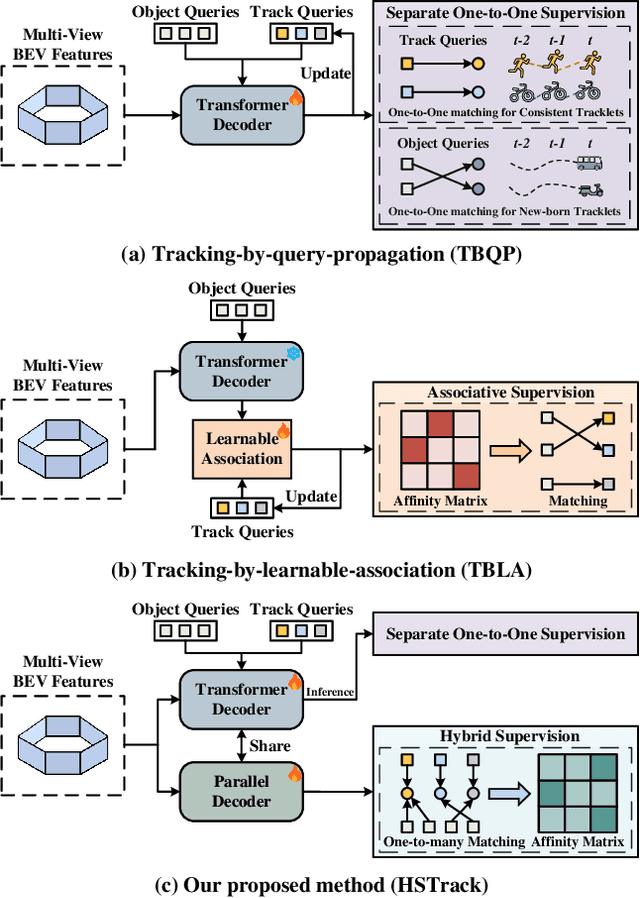
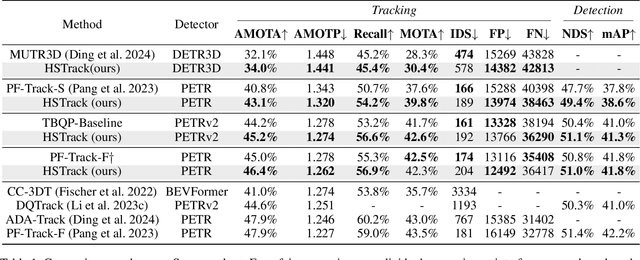
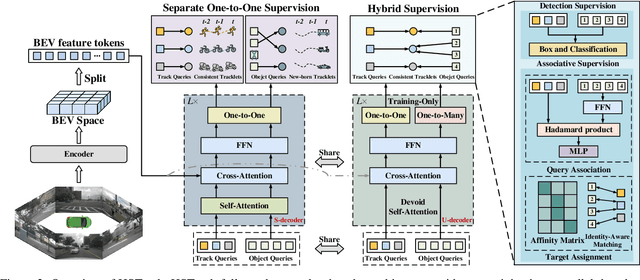
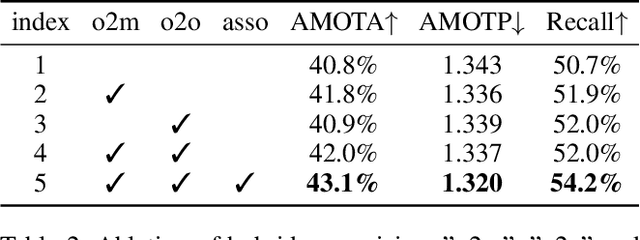
In camera-based 3D multi-object tracking (MOT), the prevailing methods follow the tracking-by-query-propagation paradigm, which employs track queries to manage the lifecycle of identity-consistent tracklets while object queries handle the detection of new-born tracklets. However, this intertwined paradigm leads the inter-temporal tracking task and the single-frame detection task utilize the same model parameters, complicating training optimization. Drawing inspiration from studies on the roles of attention components in transformer-based decoders, we identify that the dispersing effect of self-attention necessitates object queries to match with new-born tracklets. This matching strategy diverges from the detection pre-training phase, where object queries align with all ground-truth targets, resulting in insufficient supervision signals. To address these issues, we present HSTrack, a novel plug-and-play method designed to co-facilitate multi-task learning for detection and tracking. HSTrack constructs a parallel weight-share decoder devoid of self-attention layers, circumventing competition between different types of queries. Considering the characteristics of cross-attention layer and distinct query types, our parallel decoder adopt one-to-one and one-to-many label assignment strategies for track queries and object queries, respectively. Leveraging the shared architecture, HSTrack further improve trackers for spatio-temporal modeling and quality candidates generation. Extensive experiments demonstrate that HSTrack consistently delivers improvements when integrated with various query-based 3D MOT trackers. For example, HSTrack improves the state-of-the-art PF-Track method by $+2.3\%$ AMOTA and $+1.7\%$ mAP on the nuScenes dataset.
Observation, Analysis, and Solution: Exploring Strong Lightweight Vision Transformers via Masked Image Modeling Pre-Training
Apr 18, 2024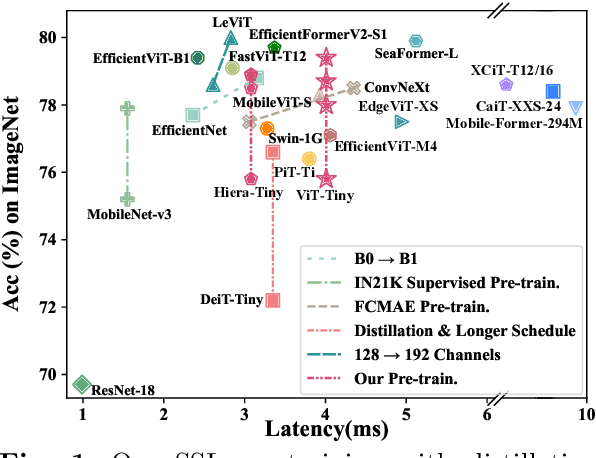
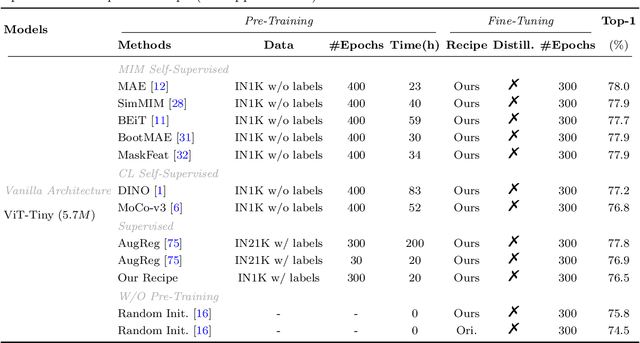

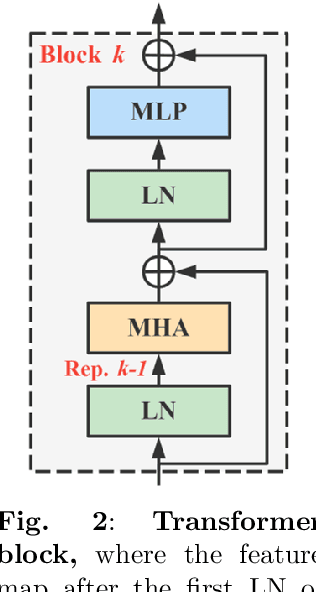
Masked image modeling (MIM) pre-training for large-scale vision transformers (ViTs) in computer vision has enabled promising downstream performance on top of the learned self-supervised ViT features. In this paper, we question if the extremely simple ViTs' fine-tuning performance with a small-scale architecture can also benefit from this pre-training paradigm, which is considerably less studied yet in contrast to the well-established lightweight architecture design methodology with sophisticated components introduced. By carefully adapting various typical MIM pre-training methods to this lightweight regime and comparing them with the contrastive learning (CL) pre-training on various downstream image classification and dense prediction tasks, we systematically observe different behaviors between MIM and CL with respect to the downstream fine-tuning data scales. Furthermore, we analyze the frozen features under linear probing evaluation and also the layer representation similarities and attention maps across the obtained models, which clearly show the inferior learning of MIM pre-training on higher layers, leading to unsatisfactory fine-tuning performance on data-insufficient downstream tasks. This finding is naturally a guide to choosing appropriate distillation strategies during pre-training to solve the above deterioration problem. Extensive experiments on various vision tasks demonstrate the effectiveness of our observation-analysis-solution flow. In particular, our pre-training with distillation on pure lightweight ViTs with vanilla/hierarchical design (5.7M/6.5M) can achieve 79.4%/78.9% top-1 accuracy on ImageNet-1K. It also enables SOTA performance on the ADE20K semantic segmentation task (42.8% mIoU) and LaSOT visual tracking task (66.1% AUC) in the lightweight regime. The latter even surpasses all the current SOTA lightweight CPU-realtime trackers.