 Add to Chrome
 Add to Firefox
 Add to Edge
JSSAnet: Theory-Guided Subchannel Partitioning and Joint Spatial Attention for Near-Field Channel Estimation
Mar 25, 2026
The deployment of extremely large-scale antenna array (ELAA) in sixth-generation (6G) communication systems introduces unique challenges for efficient near-field channel estimation. To tackle these issues, this paper presents a theory-guided approach that incorporates angular information into an attention-based estimation framework. A piecewise Fourier representation is proposed to implicitly encode the near-field channel's inherent nonlinearity, enabling the entire channel to be segmented into multiple subchannels, each mapped to the angular domain via the discrete Fourier transform (DFT). Then, we develop a joint subchannel-spatial-attention network (JSSAnet) to extract the spatial features of both intra- and inter-subchannels. To guide theoretically the design of the joint attention mechanism, we derive upper and lower bounds based on approximation criteria and DFT quantization loss mitigation, respectively. Following by both bounds, a JSSA layer of an attention block is constructed to assign independent and adaptive spatial attention weights to each subchannel in parallel. Subsequently, a feed-forward network (FFN) of an attention block further captures and refines the residual nonlinear dependencies across subchannels. Moreover, the proposed JSSA map is linearly computed via element-wise product combining large-kernel convolutions (DLKC), maintaining strong contextual learning capability. Numerical results verify the effectiveness of embedding sparsity information into the attention network and demonstrate JSSAnet achieves superior estimation performance compared with existing methods.

A Multi-Scale Spatial Attention Network for Near-field MIMO Channel Estimation
Jul 30, 2025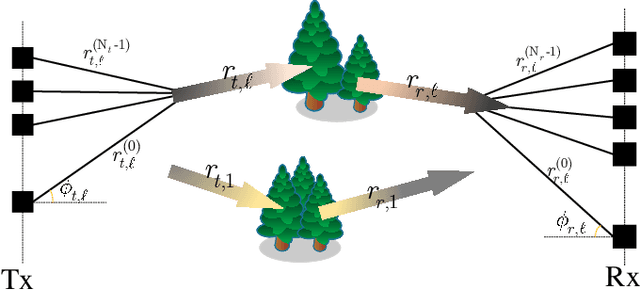
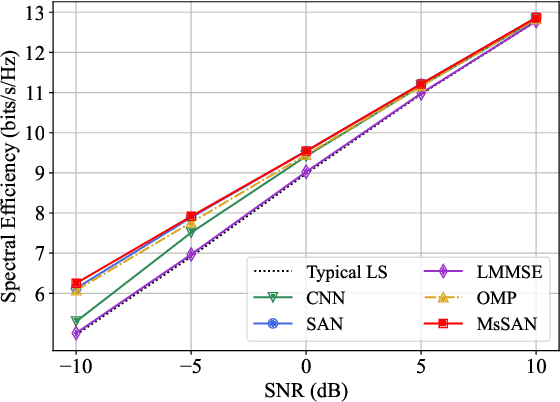
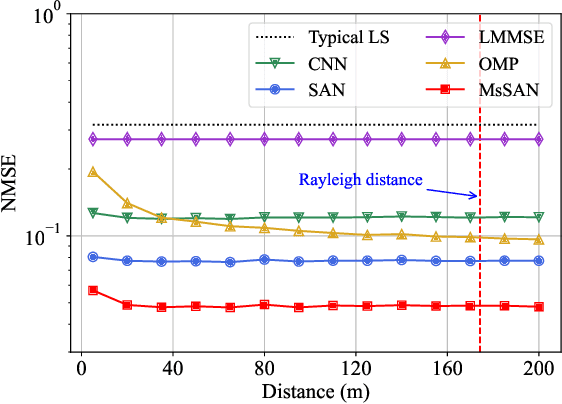
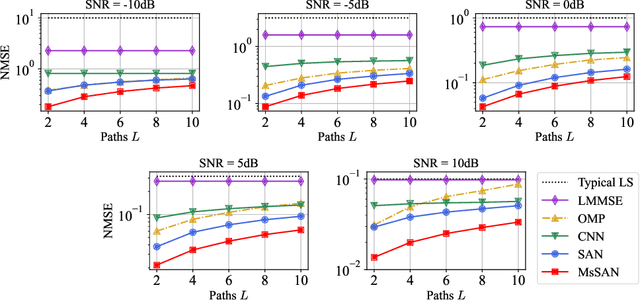
The deployment of extremely large-scale array (ELAA) brings higher spectral efficiency and spatial degree of freedom, but triggers issues on near-field channel estimation. Existing near-field channel estimation schemes primarily exploit sparsity in the transform domain. However, these schemes are sensitive to the transform matrix selection and the stopping criteria. Inspired by the success of deep learning (DL) in far-field channel estimation, this paper proposes a novel spatial-attention-based method for reconstructing extremely large-scale MIMO (XL-MIMO) channel. Initially, the spatial antenna correlations of near-field channels are analyzed as an expectation over the angle-distance space, which demonstrate correlation range of an antenna element varies with its position. Due to the strong correlation between adjacent antenna elements, interactions of inter-subchannel are applied to describe inherent correlation of near-field channels instead of inter-element. Subsequently, a multi-scale spatial attention network (MsSAN) with the inter-subchannel correlation learning capabilities is proposed tailed to near-field MIMO channel estimation. We employ the multi-scale architecture to refine the subchannel size in MsSAN. Specially, we inventively introduce the sum of dot products as spatial attention (SA) instead of cross-covariance to weight subchannel features at different scales in the SA module. Simulation results are presented to validate the proposed MsSAN achieves remarkable the inter-subchannel correlation learning capabilities and outperforms others in terms of near-field channel reconstruction.