 Add to Chrome
 Add to Firefox
 Add to Edge
Design Once, Deploy at Scale: Template-Driven ML Development for Large Model Ecosystems
Mar 26, 2026
Modern computational advertising platforms typically rely on recommendation systems to predict user responses, such as click-through rates, conversion rates, and other optimization events. To support a wide variety of product surfaces and advertiser goals, these platforms frequently maintain an extensive ecosystem of machine learning (ML) models. However, operating at this scale creates significant development and efficiency challenges. Substantial engineering effort is required to regularly refresh ML models and propagate new techniques, which results in long latencies when deploying ML innovations across the ecosystem. We present a large-scale empirical study comparing model performance, efficiency, and ML technique propagation between a standardized model-building approach and independent per-model optimization in recommendation systems. To facilitate this standardization, we propose the Standard Model Template (SMT) -- a framework that generates high-performance models adaptable to diverse data distributions and optimization events. By utilizing standardized, composable ML model components, SMT reduces technique propagation complexity from $O(n \cdot 2^k)$ to $O(n + k)$ where $n$ is the number of models and $k$ the number of techniques. Evaluating an extensive suite of models over four global development cycles within Meta's production ads ranking ecosystem, our results demonstrate: (1) a 0.63% average improvement in cross-entropy at neutral serving capacity, (2) a 92% reduction in per-model iteration engineering time, and (3) a $6.3\times$ increase in technique-model pair adoption throughput. These findings challenge the conventional wisdom that diverse optimization goals inherently require diversified ML model design.

Extending Context Window of Large Language Models via Positional Interpolation
Jun 28, 2023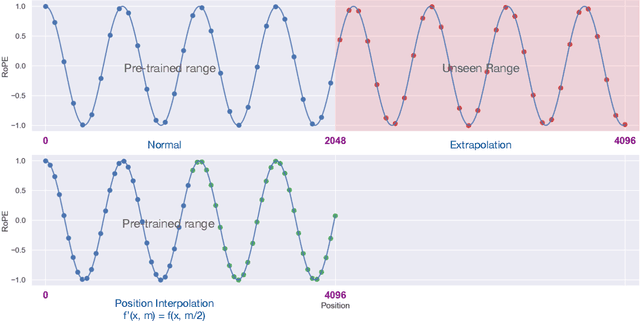
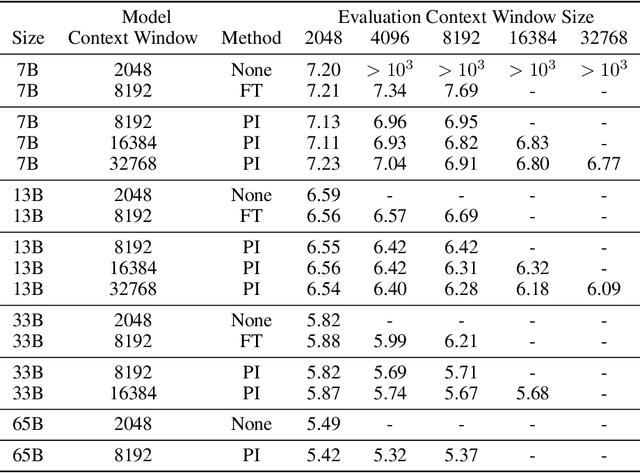
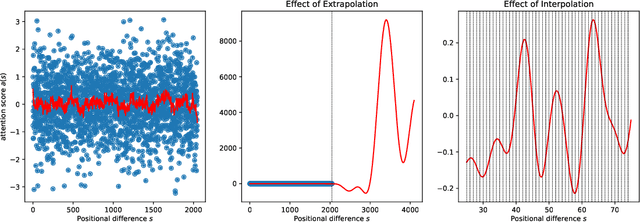
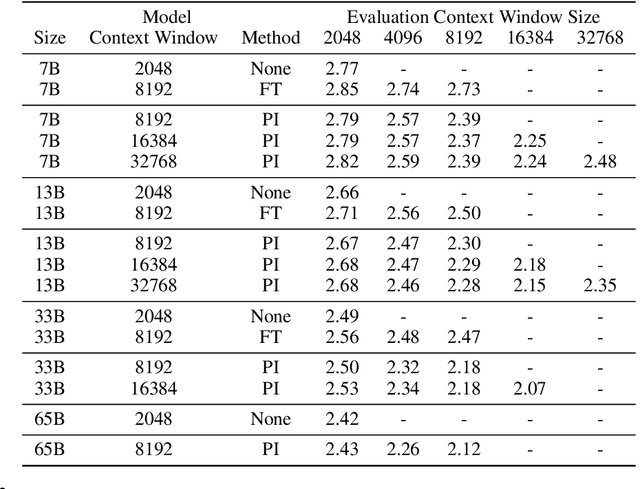
We present Position Interpolation (PI) that extends the context window sizes of RoPE-based pretrained LLMs such as LLaMA models to up to 32768 with minimal fine-tuning (within 1000 steps), while demonstrating strong empirical results on various tasks that require long context, including passkey retrieval, language modeling, and long document summarization from LLaMA 7B to 65B. Meanwhile, the extended model by Position Interpolation preserve quality relatively well on tasks within its original context window. To achieve this goal, Position Interpolation linearly down-scales the input position indices to match the original context window size, rather than extrapolating beyond the trained context length which may lead to catastrophically high attention scores that completely ruin the self-attention mechanism. Our theoretical study shows that the upper bound of interpolation is at least $\sim 600 \times$ smaller than that of extrapolation, further demonstrating its stability. Models extended via Position Interpolation retain its original architecture and can reuse most pre-existing optimization and infrastructure.