 Add to Chrome
 Add to Firefox
 Add to Edge
Linguistics-Aware Non-Distortionary LLM Watermarking
May 30, 2026
Watermarking should identify language-model output without degrading quality or limiting verification to the model provider. Multilingual deployment makes this harder because morphology, segmentation, and script change where watermark evidence can enter naturally. We introduce LUNA, a linguistically adaptive watermark that combines model-free detection with single-token non-distortion under the standard random-key model. LUNA estimates normalized next-tag entropy from part-of-speech contexts in an external corpus and uses it to set the depth of a non-distortionary binary tournament sampler; the detector reconstructs the same schedule from text, a tokenizer, a tagger, and a secret key. We evaluate six typologically diverse languages and two domains against eight primary baselines. LUNA attains an AUROC of 0.9959 and the lowest mean absolute median perplexity shift of 0.045 across the twelve settings; its 95% bootstrap interval [0.022, 0.073] lies below all baseline intervals. LUNA also records the lowest mean Self-BLEU, Distinct-1, surprisal, and entropy shifts. It is the only method that simultaneously achieves AUROC > 0.99 and an absolute median perplexity shift below 0.1 in a majority of settings, reaching this regime in 9 of the 12 settings while no baseline reaches it in more than 2. Our code is available at: https://github.com/Shinwoo-Park/luna_watermark

Steering Language Models Before They Speak: Logit-Level Interventions
Jan 16, 2026Steering LLMs is essential for specialized applications such as style-sensitive text rewriting, user-adaptive communication, and toxicity mitigation. Current steering methods, such as prompting-based and activation-based approaches, are widely used to guide model behavior. However, activation-based techniques require deep access to internal layers, while prompting-based steering often fails to provide consistent or fine-grained control. In order to address these limitations, we propose a training-free inference-time logit intervention for controllable generation. Our approach utilizes a statistical token score table derived from z-normalized log-odds of labeled corpora to shift the decoding distribution. Empirical evaluations across three diverse datasets focusing on writing complexity, formality, and toxicity demonstrate that our method effectively steers output characteristics, confirming its broad applicability and task-agnostic nature. Our results show that statistically grounded logit steering can achieve large, consistent, and multi-task control gains: up to +47%p accuracy and 50x f1 improvement.
WaterMod: Modular Token-Rank Partitioning for Probability-Balanced LLM Watermarking
Nov 13, 2025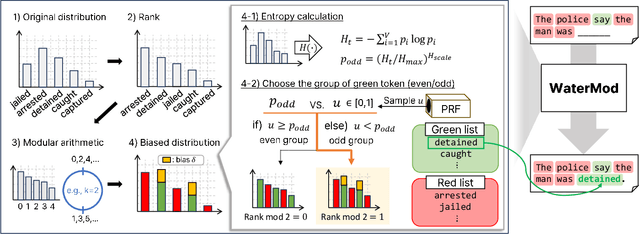
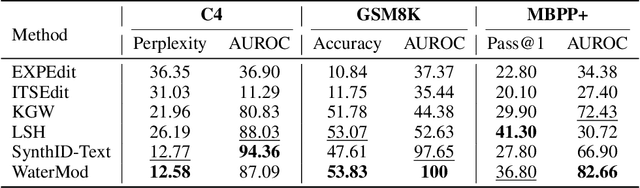
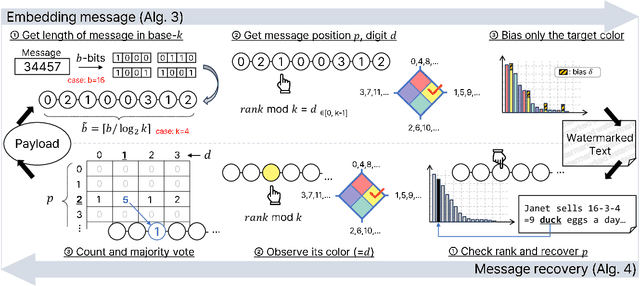

Large language models now draft news, legal analyses, and software code with human-level fluency. At the same time, regulations such as the EU AI Act mandate that each synthetic passage carry an imperceptible, machine-verifiable mark for provenance. Conventional logit-based watermarks satisfy this requirement by selecting a pseudorandom green vocabulary at every decoding step and boosting its logits, yet the random split can exclude the highest-probability token and thus erode fluency. WaterMod mitigates this limitation through a probability-aware modular rule. The vocabulary is first sorted in descending model probability; the resulting ranks are then partitioned by the residue rank mod k, which distributes adjacent-and therefore semantically similar-tokens across different classes. A fixed bias of small magnitude is applied to one selected class. In the zero-bit setting (k=2), an entropy-adaptive gate selects either the even or the odd parity as the green list. Because the top two ranks fall into different parities, this choice embeds a detectable signal while guaranteeing that at least one high-probability token remains available for sampling. In the multi-bit regime (k>2), the current payload digit d selects the color class whose ranks satisfy rank mod k = d. Biasing the logits of that class embeds exactly one base-k digit per decoding step, thereby enabling fine-grained provenance tracing. The same modular arithmetic therefore supports both binary attribution and rich payloads. Experimental results demonstrate that WaterMod consistently attains strong watermark detection performance while maintaining generation quality in both zero-bit and multi-bit settings. This robustness holds across a range of tasks, including natural language generation, mathematical reasoning, and code synthesis. Our code and data are available at https://github.com/Shinwoo-Park/WaterMod.
Marking Code Without Breaking It: Code Watermarking for Detecting LLM-Generated Code
Feb 26, 2025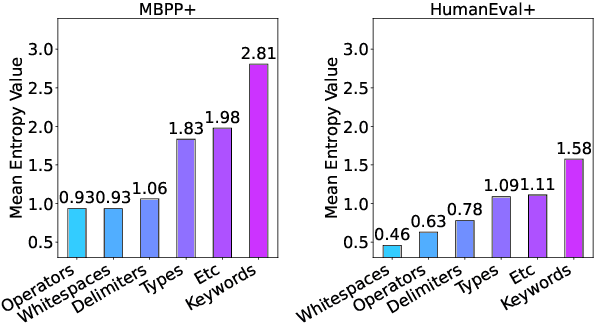
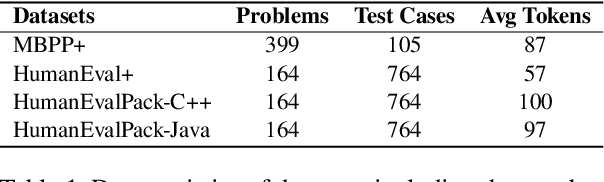
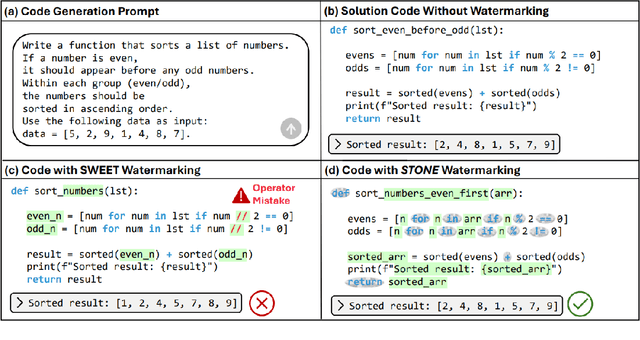

Code watermarking identifies AI-generated code by embedding patterns into the code during generation. Effective watermarking requires meeting two key conditions: the watermark should be reliably detectable, and the code should retain its original functionality. However, existing methods often modify tokens that are critical for program logic, such as keywords in conditional expressions or operators in arithmetic computations. These modifications can cause syntax errors or functional failures, limiting the practical use of watermarking. We present STONE, a method that preserves functional integrity by selectively inserting watermarks only into non-syntax tokens. By excluding tokens essential for code execution, STONE minimizes the risk of functional degradation. In addition, we introduce CWEM, a comprehensive evaluation metric that evaluates watermarking techniques based on correctness, detectability, and naturalness. While correctness and detectability have been widely used, naturalness remains underexplored despite its importance. Unnatural patterns can reveal the presence of a watermark, making it easier for adversaries to remove. We evaluate STONE using CWEM and compare its performance with the state-of-the-art approach. The results show that STONE achieves an average improvement of 7.69% in CWEM across Python, C++, and Java. Our code is available in https://github.com/inistory/STONE-watermarking/.
Detection of LLM-Paraphrased Code and Identification of the Responsible LLM Using Coding Style Features
Feb 25, 2025Recent progress in large language models (LLMs) for code generation has raised serious concerns about intellectual property protection. Malicious users can exploit LLMs to produce paraphrased versions of proprietary code that closely resemble the original. While the potential for LLM-assisted code paraphrasing continues to grow, research on detecting it remains limited, underscoring an urgent need for detection system. We respond to this need by proposing two tasks. The first task is to detect whether code generated by an LLM is a paraphrased version of original human-written code. The second task is to identify which LLM is used to paraphrase the original code. For these tasks, we construct a dataset LPcode consisting of pairs of human-written code and LLM-paraphrased code using various LLMs. We statistically confirm significant differences in the coding styles of human-written and LLM-paraphrased code, particularly in terms of naming consistency, code structure, and readability. Based on these findings, we develop LPcodedec, a detection method that identifies paraphrase relationships between human-written and LLM-generated code, and discover which LLM is used for the paraphrasing. LPcodedec outperforms the best baselines in two tasks, improving F1 scores by 2.64% and 15.17% while achieving speedups of 1,343x and 213x, respectively.
External Steering of Vine Robots via Magnetic Actuation
Sep 02, 2024This paper explores the concept of external magnetic control for vine robots to enable their high curvature steering and navigation for use in endoluminal applications. Vine robots, inspired by natural growth and locomotion strategies, present unique shape adaptation capabilities that allow passive deformation around obstacles. However, without additional steering mechanisms, they lack the ability to actively select the desired direction of growth. The principles of magnetically steered growing robots are discussed, and experimental results showcase the effectiveness of the proposed magnetic actuation approach. We present a 25 mm diameter vine robot with integrated magnetic tip capsule, including 6 Degrees of Freedom (DOF) localization and camera and demonstrate a minimum bending radius of 3.85 cm with an internal pressure of 30 kPa. Furthermore, we evaluate the robot's ability to form tight curvature through complex navigation tasks, with magnetic actuation allowing for extended free-space navigation without buckling. The suspension of the magnetic tip was also validated using the 6 DOF localization system to ensure that the shear-free nature of vine robots was preserved. Additionally, by exploiting the magnetic wrench at the tip, we showcase preliminary results of vine retraction. The findings contribute to the development of controllable vine robots for endoluminal applications, providing high tip force and shear-free navigation.