 Add to Chrome
 Add to Firefox
 Add to Edge
WaterMod: Modular Token-Rank Partitioning for Probability-Balanced LLM Watermarking
Nov 13, 2025
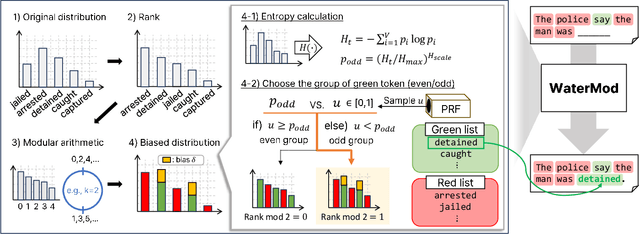
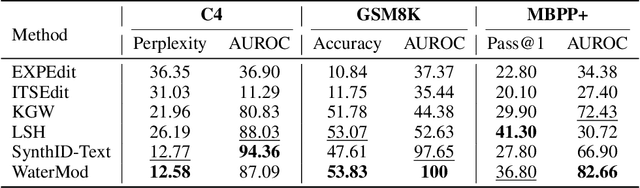
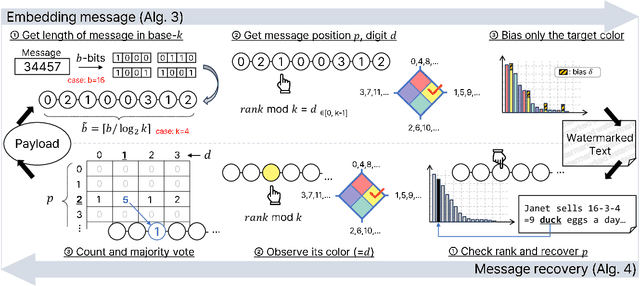

Large language models now draft news, legal analyses, and software code with human-level fluency. At the same time, regulations such as the EU AI Act mandate that each synthetic passage carry an imperceptible, machine-verifiable mark for provenance. Conventional logit-based watermarks satisfy this requirement by selecting a pseudorandom green vocabulary at every decoding step and boosting its logits, yet the random split can exclude the highest-probability token and thus erode fluency. WaterMod mitigates this limitation through a probability-aware modular rule. The vocabulary is first sorted in descending model probability; the resulting ranks are then partitioned by the residue rank mod k, which distributes adjacent-and therefore semantically similar-tokens across different classes. A fixed bias of small magnitude is applied to one selected class. In the zero-bit setting (k=2), an entropy-adaptive gate selects either the even or the odd parity as the green list. Because the top two ranks fall into different parities, this choice embeds a detectable signal while guaranteeing that at least one high-probability token remains available for sampling. In the multi-bit regime (k>2), the current payload digit d selects the color class whose ranks satisfy rank mod k = d. Biasing the logits of that class embeds exactly one base-k digit per decoding step, thereby enabling fine-grained provenance tracing. The same modular arithmetic therefore supports both binary attribution and rich payloads. Experimental results demonstrate that WaterMod consistently attains strong watermark detection performance while maintaining generation quality in both zero-bit and multi-bit settings. This robustness holds across a range of tasks, including natural language generation, mathematical reasoning, and code synthesis. Our code and data are available at https://github.com/Shinwoo-Park/WaterMod.

AmpleHate: Amplifying the Attention for Versatile Implicit Hate Detection
May 26, 2025Implicit hate speech detection is challenging due to its subtlety and reliance on contextual interpretation rather than explicit offensive words. Current approaches rely on contrastive learning, which are shown to be effective on distinguishing hate and non-hate sentences. Humans, however, detect implicit hate speech by first identifying specific targets within the text and subsequently interpreting how these target relate to their surrounding context. Motivated by this reasoning process, we propose AmpleHate, a novel approach designed to mirror human inference for implicit hate detection. AmpleHate identifies explicit target using a pretrained Named Entity Recognition model and capture implicit target information via [CLS] tokens. It computes attention-based relationships between explicit, implicit targets and sentence context and then, directly injects these relational vectors into the final sentence representation. This amplifies the critical signals of target-context relations for determining implicit hate. Experiments demonstrate that AmpleHate achieves state-of-the-art performance, outperforming contrastive learning baselines by an average of 82.14% and achieve faster convergence. Qualitative analyses further reveal that attention patterns produced by AmpleHate closely align with human judgement, underscoring its interpretability and robustness.