 Add to Chrome
 Add to Firefox
 Add to Edge
Electromagnetic Neural Network for Direction-of-Arrival Estimation
Jul 25, 2026
Accurate and real-time direction of arrival (DOA) estimation is crucial for beamforming in unmanned aerial vehicle (UAV) communication systems. However, the existing high-precision DOA estimation algorithms encounter high computational complexity when implemented on a UAV with on-board signal processing constraints. To tackle this issue, an electromagnetic neural network (EMNN) is developed for DOA estimation, which is capable of generating the angular spectrum of the incident signal based solely on amplitude observation. Specifically, the proposed EMNN consists of two components: a stacked intelligent metasurfaces (SIM) is mounted on the UAV, and each meta-atom is an artificial neuron that can process signals in the electromagnetic domain with low energy consumption and ultra-fast computing speed. Furthermore, a fully connected layer is cascaded to process the received amplitude signal, enhancing the non-linear extraction and representational ability of EMNN. Moreover, to reduce the computational complexity and observation snapshots required for high-resolution DOA estimation, we develop a hierarchical DOA estimation framework, which involves two stages for conducting coarse and fine DOA estimation, respectively. For each stage, EMNN is trained on randomly generated training samples and their corresponding spectra to achieve the desired estimation goal. Finally, the simulation results validate that the proposed EMNN achieves approximately 13 dB gain in classification error reduction over the conventional beamforming (CBF) method in dual-signal scenarios, albeit its lower cost and radio frequency (RF)-related power consumption.

Stacked Intelligent Metasurfaces for Wireless Sensing and Communication: Applications and Challenges
Jul 04, 2024The rapid advancement of wireless communication technologies has precipitated an unprecedented demand for high data rates, extremely low latency, and ubiquitous connectivity. In order to achieve these goals, stacked intelligent metasurfaces (SIM) has been developed as a novel solution to perform advanced signal processing tasks directly in the electromagnetic wave domain, thus achieving ultra-fast computing speed and reducing hardware complexity. This article provides an overview of the SIM technology by discussing its hardware architectures, advantages, and potential applications for wireless sensing and communication. Specifically, we explore the utilization of SIMs in enabling wave-domain beamforming, channel modeling and estimation in SIM-assisted communication systems. Furthermore, we elaborate on the potential of utilizing a SIM to build a hybrid optical-electronic neural network (HOENN) and demonstrate its efficacy by examining two case studies: disaster monitoring and direction-of-arrival estimation. Finally, we identify key implementation challenges, including practical hardware imperfections, efficient SIM configuration for realizing wave-domain signal processing, and performance analysis to motivate future research on this important and far-reaching topic.
Stacked Intelligent Metasurface Enabled LEO Satellite Communications Relying on Statistical CSI
Mar 09, 2024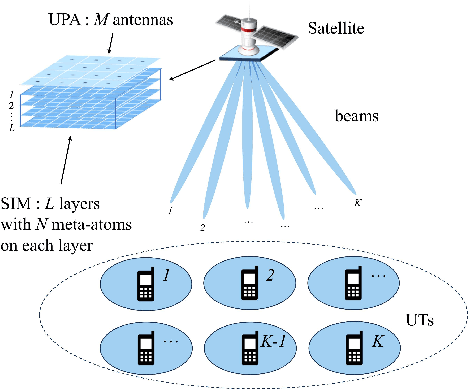

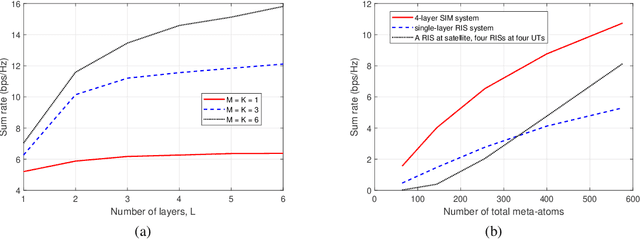
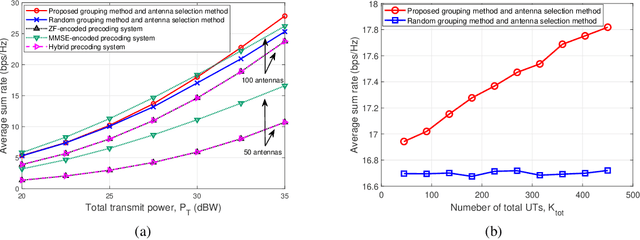
Low earth orbit (LEO) satellite communication systems have gained increasing attention as a crucial supplement to terrestrial wireless networks due to their extensive coverage area. This letter presents a novel system design for LEO satellite systems by leveraging stacked intelligent metasurface (SIM) technology. Specifically, the lightweight and energy-efficient SIM is mounted on a satellite to achieve multiuser beamforming directly in the electromagnetic wave domain, which substantially reduces the processing delay and computational load of the satellite compared to the traditional digital beamforming scheme. To overcome the challenges of obtaining instantaneous channel state information (CSI) at the transmitter and maximize the system's performance, a joint power allocation and SIM phase shift optimization problem for maximizing the ergodic sum rate is formulated based on statistical CSI, and an alternating optimization (AO) algorithm is customized to solve it efficiently. Additionally, a user grouping method based on channel correlation and an antenna selection algorithm are proposed to further improve the system performance. Simulation results demonstrate the effectiveness of the proposed SIM-based LEO satellite system design and statistical CSI-based AO algorithm.