 Add to Chrome
 Add to Firefox
 Add to Edge
READER: Reasoning-Enhanced AI-Generated Text Detection
May 26, 2026
Recent advances in large language models (LLMs) have made it increasingly difficult to distinguish human-written text from AI-generated content. Many existing detectors train supervised neural classifiers that achieve strong in-distribution performance but are often opaque and can degrade substantially under distribution shift. We present READER, a reasoning-enhanced AI text detector that outputs both a human/AI label and a structured rationale describing the evidence for its decision. A key component of our approach is READ, a curated supervision set of rationales and verdicts. We fine-tune an LLM on READ to build READER, which reasons before detecting at inference time. Despite having only 1.5B parameters, READER consistently outperforms existing detectors as well as prompted, high-capacity LLM baselines (GPT-5.2, Gemini-3-Pro, and DeepSeek-V3.2), which are 100 to 1000 times larger in scale.

BASIS: Batchwise Advantage Estimation from Single-Rollout Information Sharing for LLM Reasoning
May 26, 2026Reinforcement learning with verifiable rewards has become a standard recipe for improving the reasoning abilities of large language models. Existing algorithms face a tradeoff between computational efficiency and sample efficiency in value estimation and policy learning. We introduce BASIS, a critic-free post-training algorithm designed to address this tradeoff. At each online training step, BASIS samples only one rollout per prompt, but leverages rich information across prompts in the entire batch to improve value function estimation. Our experiments demonstrate that BASIS reduces MSE in value function estimation by 69% compared to REINFORCE++, a representative single-rollout baseline, and achieves lower MSE with one rollout than group mean estimators with 8 rollouts. This improvement in value estimation translates to better policy optimization: using substantially less training time, BASIS achieves performance close to multi-rollout GRPO-type baselines and often outperforms single-rollout REINFORCE-type baselines.
Demystifying Group Relative Policy Optimization: Its Policy Gradient is a U-Statistic
Mar 03, 2026Group relative policy optimization (GRPO), a core methodological component of DeepSeekMath and DeepSeek-R1, has emerged as a cornerstone for scaling reasoning capabilities of large language models. Despite its widespread adoption and the proliferation of follow-up works, the theoretical properties of GRPO remain less studied. This paper provides a unified framework to understand GRPO through the lens of classical U-statistics. We demonstrate that the GRPO policy gradient is inherently a U-statistic, allowing us to characterize its mean squared error (MSE), derive the finite-sample error bound and asymptotic distribution of the suboptimality gap for its learned policy. Our findings reveal that GRPO is asymptotically equivalent to an oracle policy gradient algorithm -- one with access to a value function that quantifies the goodness of its learning policy at each training iteration -- and achieves asymptotically optimal performance within a broad class of policy gradient algorithms. Furthermore, we establish a universal scaling law that offers principled guidance for selecting the optimal group size. Empirical experiments further validate our theoretical findings, demonstrating that the optimal group size is universal, and verify the oracle property of GRPO.
Deep Generative Demand Learning for Newsvendor and Pricing
Nov 13, 2024We consider data-driven inventory and pricing decisions in the feature-based newsvendor problem, where demand is influenced by both price and contextual features and is modeled without any structural assumptions. The unknown demand distribution results in a challenging conditional stochastic optimization problem, further complicated by decision-dependent uncertainty and the integration of features. Inspired by recent advances in deep generative learning, we propose a novel approach leveraging conditional deep generative models (cDGMs) to address these challenges. cDGMs learn the demand distribution and generate probabilistic demand forecasts conditioned on price and features. This generative approach enables accurate profit estimation and supports the design of algorithms for two key objectives: (1) optimizing inventory for arbitrary prices, and (2) jointly determining optimal pricing and inventory levels. We provide theoretical guarantees for our approach, including the consistency of profit estimation and convergence of our decisions to the optimal solution. Extensive simulations-ranging from simple to complex scenarios, including one involving textual features-and a real-world case study demonstrate the effectiveness of our approach. Our method opens a new paradigm in management science and operations research, is adaptable to extensions of the newsvendor and pricing problems, and holds potential for solving other conditional stochastic optimization problems.
ATFNet: Adaptive Time-Frequency Ensembled Network for Long-term Time Series Forecasting
Apr 08, 2024
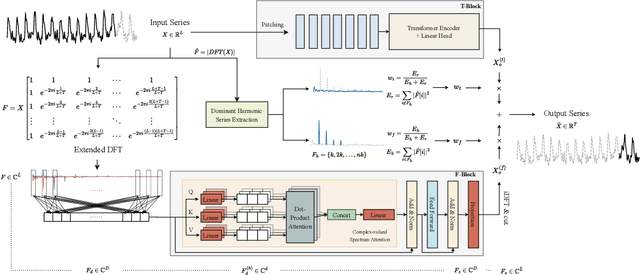
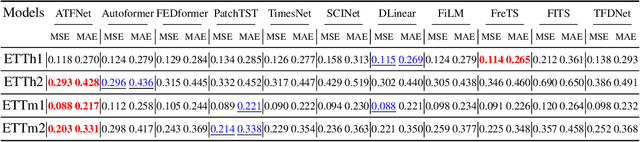
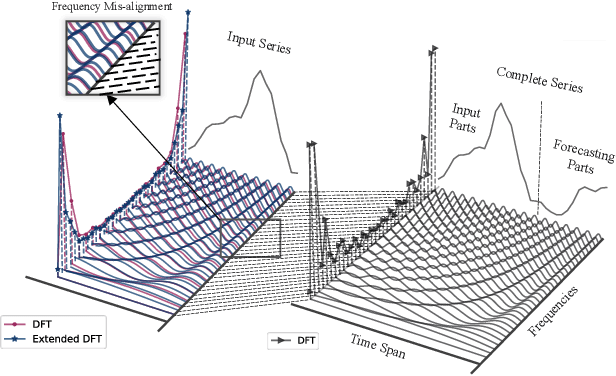
The intricate nature of time series data analysis benefits greatly from the distinct advantages offered by time and frequency domain representations. While the time domain is superior in representing local dependencies, particularly in non-periodic series, the frequency domain excels in capturing global dependencies, making it ideal for series with evident periodic patterns. To capitalize on both of these strengths, we propose ATFNet, an innovative framework that combines a time domain module and a frequency domain module to concurrently capture local and global dependencies in time series data. Specifically, we introduce Dominant Harmonic Series Energy Weighting, a novel mechanism for dynamically adjusting the weights between the two modules based on the periodicity of the input time series. In the frequency domain module, we enhance the traditional Discrete Fourier Transform (DFT) with our Extended DFT, designed to address the challenge of discrete frequency misalignment. Additionally, our Complex-valued Spectrum Attention mechanism offers a novel approach to discern the intricate relationships between different frequency combinations. Extensive experiments across multiple real-world datasets demonstrate that our ATFNet framework outperforms current state-of-the-art methods in long-term time series forecasting.
Towards Optimal Neural Networks: the Role of Sample Splitting in Hyperparameter Selection
Jul 15, 2023When artificial neural networks have demonstrated exceptional practical success in a variety of domains, investigations into their theoretical characteristics, such as their approximation power, statistical properties, and generalization performance, have made significant strides. In this paper, we construct a novel theory for understanding the effectiveness of neural networks by discovering the mystery underlying a common practice during neural network model construction: sample splitting. Our theory demonstrates that, the optimal hyperparameters derived from sample splitting can enable a neural network model that asymptotically minimizes the prediction risk. We conduct extensive experiments across different application scenarios and network architectures, and the results manifest our theory's effectiveness.