 Add to Chrome
 Add to Firefox
 Add to Edge
JuZhou 1.0 Technical Report: The First Edge-Native Text-to-Image Foundation Model Trained Entirely on China-Developed AI Accelerators
Jun 25, 2026
Text-to-image (T2I) diffusion models typically require substantial computational resources and cloud infrastructure, posing significant challenges for edge deployment in terms of latency, cost, and user privacy. We present JuZhou 1.0, an ultra-lightweight T2I foundation model designed for fully offline, on-device execution. JuZhou 1.0 achieves its efficiency through four key designs: (1) a compact image-generation backbone consisting of a 0.385B-parameter denoising U-Net and a 1.90M-parameter distilled decoder, totaling approximately 0.387B parameters; (2) Rectified Flow training combined with DMD2 distillation, reducing inference to 4 sampling steps; (3) Chinese semantic alignment trained on 9M curated image-text pairs, enabling direct Chinese prompting without external translation at inference time; and (4) a training and distillation pipeline completed on domestically developed Sugon K100 AI accelerators without relying on NVIDIA GPUs for training or distillation. Despite its compact scale, the 28-step base model of JuZhou 1.0 achieves an overall GenEval score of 0.69, outperforming published baselines including SDXL (2.6B, 0.55), SD3-Medium (2B, 0.62), and IF-XL (4.3B, 0.61). We further validate the full poetry-to-image pipeline on Android and the core CLIP-U-Net-VAE generation branch on iOS. On a smartphone powered by the Snapdragon 8 Elite Gen 5 Mobile Platform, the 4-step U-Net denoising branch runs in approximately 1.6 seconds, while the full Android poetry-to-image pipeline takes 4.5 seconds with on-device prompt refinement on Xiaomi 17 Pro Max. These results position JuZhou 1.0 as a practical approach to mobile text-to-image generation and provide a concrete reference for Chinese-native generation, domestic-compute training, and fully offline on-device deployment after one-time installation.

UserLM-R1: Modeling Human Reasoning in User Language Models with Multi-Reward Reinforcement Learning
Jan 14, 2026User simulators serve as the critical interactive environment for agent post-training, and an ideal user simulator generalizes across domains and proactively engages in negotiation by challenging or bargaining. However, current methods exhibit two issues. They rely on static and context-unaware profiles, necessitating extensive manual redesign for new scenarios, thus limiting generalizability. Moreover, they neglect human strategic thinking, leading to vulnerability to agent manipulation. To address these issues, we propose UserLM-R1, a novel user language model with reasoning capability. Specifically, we first construct comprehensive user profiles with both static roles and dynamic scenario-specific goals for adaptation to diverse scenarios. Then, we propose a goal-driven decision-making policy to generate high-quality rationales before producing responses, and further refine the reasoning and improve strategic capabilities with supervised fine-tuning and multi-reward reinforcement learning. Extensive experimental results demonstrate that UserLM-R1 outperforms competitive baselines, particularly on the more challenging adversarial set.
Simulated Mental Imagery for Robotic Task Planning
Nov 23, 2022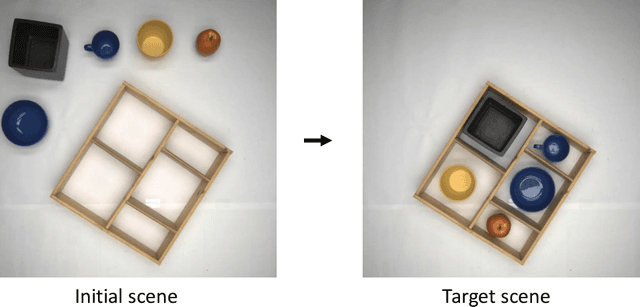
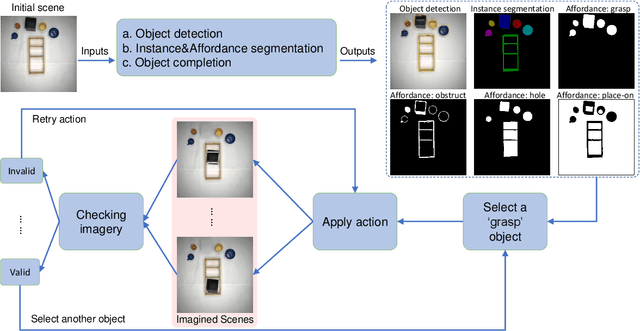
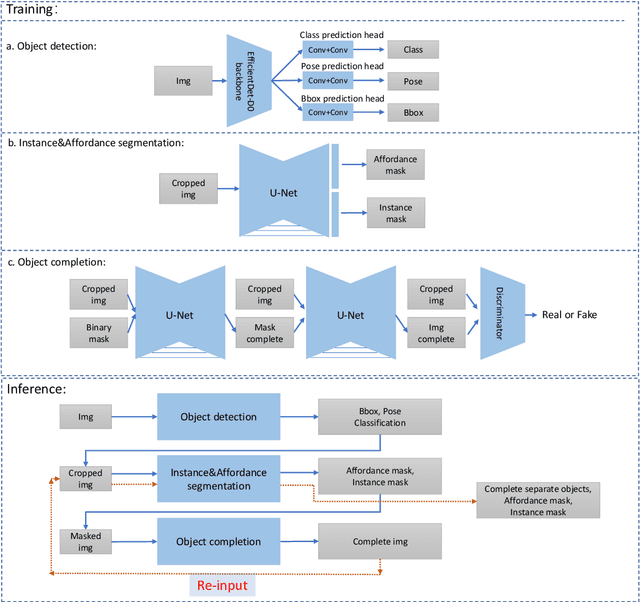
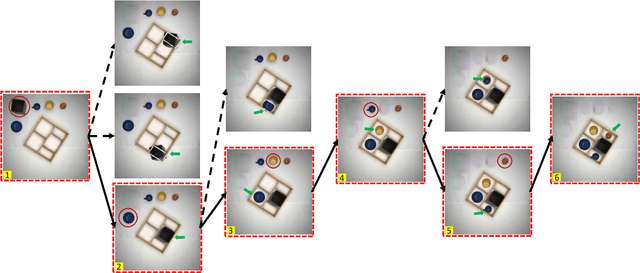
Traditional AI-planning methods for task planning in robotics require symbolically encoded domain description. While powerful in well-defined scenarios, setting this up requires substantial effort. Different from this, most everyday planning tasks are solved by humans intuitively, using mental imagery of the different planning steps. Here we suggest that the same approach can be used for robots, too, in cases which require only limited execution accuracy. In the current study, we propose a novel sub-symbolic method called Simulated Mental Imagery for Planning (SiMIP), which consists of several steps: perception, simulated action, success-checking and re-planning performed on 'imagined' images. We show that it is possible this way to implement mental imagery-based planning in an algorithmically sound way by combining regular convolutional neural networks and generative adversarial networks. With this method, the robot acquires the capability to use the initially existing scene to generate action plans without symbolic domain descriptions, hence, without the need to define an explicit representation of the environment. We create a dataset from real scenes for a packing problem of having to correctly place different objects into different target slots. This way efficiency and success rate of this algorithm could be quantified.