 Add to Chrome
 Add to Firefox
 Add to Edge
Dynamic Whole-Body Dancing with Humanoid Robots -- A Model-Based Control Approach
Apr 05, 2026
This paper presents an integrated model-based framework for generating and executing dynamic whole-body dance motions on humanoid robots. The framework operates in two stages: offline motion generation and online motion execution, both leveraging future state prediction to enable robust and dynamic dance motions in real-world environments. In the offline motion generation stage, human dance demonstrations are captured via a motion capture (MoCap) system, retargeted to the robot by solving a Quadratic Programming (QP) problem, and further refined using Trajectory Optimization (TO) to ensure dynamic feasibility. In the online motion execution stage, a centroidal dynamics-based Model Predictive Control (MPC) framework tracks the planned motions in real time and proactively adjusts swing foot placement to adapt to real world disturbances. We validate our framework on the full-size humanoid robot Kuavo 4Pro, demonstrating the dynamic dance motions both in simulation and in a four-minute live public performance with a team of four robots. Experimental results show that longer prediction horizons improve both motion expressiveness in planning and stability in execution.

ECO: Energy-Constrained Optimization with Reinforcement Learning for Humanoid Walking
Feb 06, 2026Achieving stable and energy-efficient locomotion is essential for humanoid robots to operate continuously in real-world applications. Existing MPC and RL approaches often rely on energy-related metrics embedded within a multi-objective optimization framework, which require extensive hyperparameter tuning and often result in suboptimal policies. To address these challenges, we propose ECO (Energy-Constrained Optimization), a constrained RL framework that separates energy-related metrics from rewards, reformulating them as explicit inequality constraints. This method provides a clear and interpretable physical representation of energy costs, enabling more efficient and intuitive hyperparameter tuning for improved energy efficiency. ECO introduces dedicated constraints for energy consumption and reference motion, enforced by the Lagrangian method, to achieve stable, symmetric, and energy-efficient walking for humanoid robots. We evaluated ECO against MPC, standard RL with reward shaping, and four state-of-the-art constrained RL methods. Experiments, including sim-to-sim and sim-to-real transfers on the kid-sized humanoid robot BRUCE, demonstrate that ECO significantly reduces energy consumption compared to baselines while maintaining robust walking performance. These results highlight a substantial advancement in energy-efficient humanoid locomotion. All experimental demonstrations can be found on the project website: https://sites.google.com/view/eco-humanoid.
CDM-MPC: An Integrated Dynamic Planning and Control Framework for Bipedal Robots Jumping
May 20, 2024

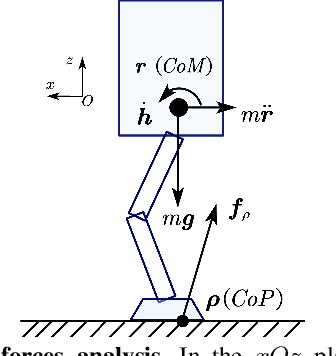

Performing acrobatic maneuvers like dynamic jumping in bipedal robots presents significant challenges in terms of actuation, motion planning, and control. Traditional approaches to these tasks often simplify dynamics to enhance computational efficiency, potentially overlooking critical factors such as the control of centroidal angular momentum (CAM) and the variability of centroidal composite rigid body inertia (CCRBI). This paper introduces a novel integrated dynamic planning and control framework, termed centroidal dynamics model-based model predictive control (CDM-MPC), designed for robust jumping control that fully considers centroidal momentum and non-constant CCRBI. The framework comprises an optimization-based kinodynamic motion planner and an MPC controller for real-time trajectory tracking and replanning. Additionally, a centroidal momentum-based inverse kinematics (IK) solver and a landing heuristic controller are developed to ensure stability during high-impact landings. The efficacy of the CDM-MPC framework is validated through extensive testing on the full-sized humanoid robot KUAVO in both simulations and experiments.