 Add to Chrome
 Add to Firefox
 Add to Edge
SmartRAG: Native Graph-Based RAG for Mobile Device
Jul 16, 2026
Deploying large language models (LLMs) as personal assistants on mobile devices demands privacy, low latency, and offline availability, yet the computational cost of giant models clashes with strict edge-hardware budgets. We argue that this tension cannot be resolved by model compression alone; it requires decomposing on-device intelligence into complementary functional roles. We present SmartRAG, a fully on-device framework that organizes an intelligent assistant around four coordinated modules -- Perception, Memory, Focus, and Thinking. At the core of SmartRAG is EvoNER, a continually learnable named-entity recognizer that incrementally expands its label inventory through teacher-distilled updates, enabling the system to absorb previously unseen entity types without retraining the backbone LLM. Extracted knowledge is stored in MRGraph, a three-layer provenance-preserving knowledge graph, and retrieved at query time through a hybrid pipeline combining graph traversal, lexical matching, and dense semantic search. The on-device LLM is invoked only for high-value semantic operations -- labeling, planning, and answer synthesis -- keeping inference costs bounded. Experiments on four QA benchmarks (TriviaQA, Natural Questions, HotpotQA, MultiHopQA) show that SmartRAG with a quantized 1.7B-parameter backbone achieves multi-hop reasoning performance competitive with models up to 18$\times$ larger, while running entirely on commodity smartphones within practical memory and latency envelopes.

Virtual Relational Knowledge Graphs for Recommendation
Apr 03, 2022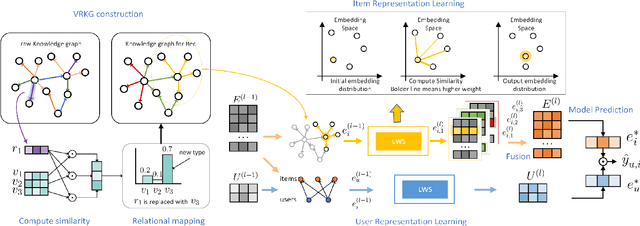
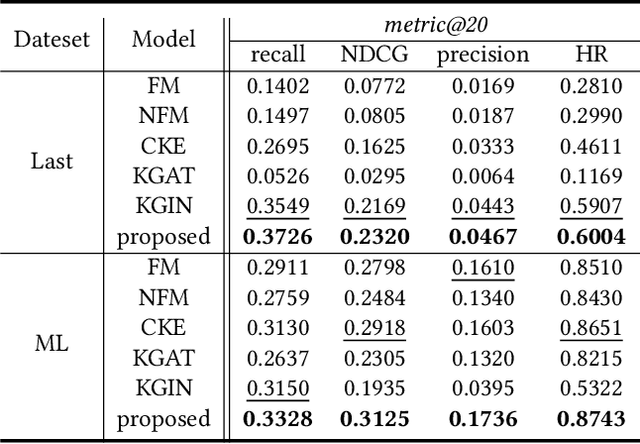
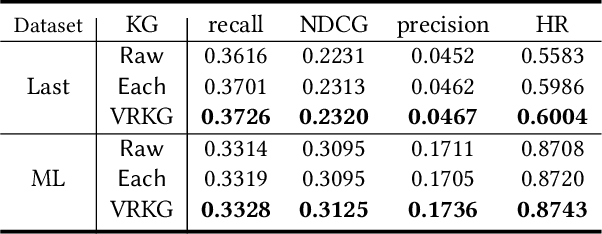
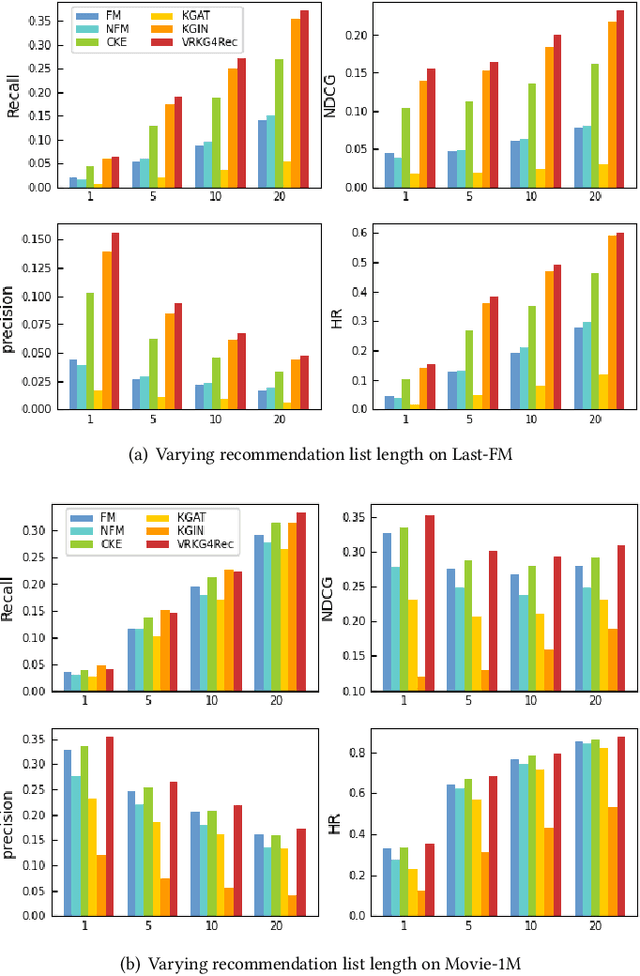
Incorporating knowledge graph as side information has become a new trend in recommendation systems. Recent studies regard items as entities of a knowledge graph and leverage graph neural networks to assist item encoding, yet by considering each relation type individually. However, relation types are often too many and sometimes one relation type involves too few entities. We argue that it is not efficient nor effective to use every relation type for item encoding. In this paper, we propose a VRKG4Rec model (Virtual Relational Knowledge Graphs for Recommendation), which explicitly distinguish the influence of different relations for item representation learning. We first construct virtual relational graphs (VRKGs) by an unsupervised learning scheme. We also design a local weighted smoothing (LWS) mechanism for encoding nodes, which iteratively updates a node embedding only depending on the embedding of its own and its neighbors, but involve no additional training parameters. We also employ the LWS mechanism on a user-item bipartite graph for user representation learning, which utilizes encodings of items with relational knowledge to help training representations of users. Experiment results on two public datasets validate that our VRKG4Rec model outperforms the state-of-the-art methods.