 Add to Chrome
 Add to Firefox
 Add to Edge
BenchCAD: A Comprehensive, Industry-Standard Benchmark for Programmatic CAD
May 11, 2026
Industrial Computer-Aided Design (CAD) code generation requires models to produce executable parametric programs from visual or textual inputs. Beyond recognizing the outer shape of a part, this task involves understanding its 3D structure, inferring engineering parameters, and choosing CAD operations that reflect how the part would be designed and manufactured. Despite the promise of Multimodal large language models (MLLMs) for this task, they are rarely evaluated on whether these capabilities jointly hold in realistic industrial CAD settings. We present BenchCAD, a unified benchmark for industrial CAD reasoning. BenchCAD contains 17,900 execution-verified CadQuery programs across 106 industrial part families, including bevel gears, compression springs, twist drills, and other reusable engineering designs. It evaluates models through visual question answering, code question answering, image-to-code generation, and instruction-guided code editing, enabling fine-grained analysis across perception, parametric abstraction, and executable program synthesis. Across 10+ frontier models, BenchCAD shows that current systems often recover coarse outer geometry but fail to produce faithful parametric CAD programs. Common failures include missing fine 3D structure, misinterpreting industrial design parameters, and replacing essential operations such as sweeps, lofts, and twist-extrudes with simpler sketch-and-extrude patterns. Fine-tuning and reinforcement learning improve in-distribution performance, but generalization to unseen part families remains limited. These results position BenchCAD as a benchmark for measuring and improving the industrial readiness of multimodal CAD automation.

Mastering Complex Control in MOBA Games with Deep Reinforcement Learning
Jan 03, 2020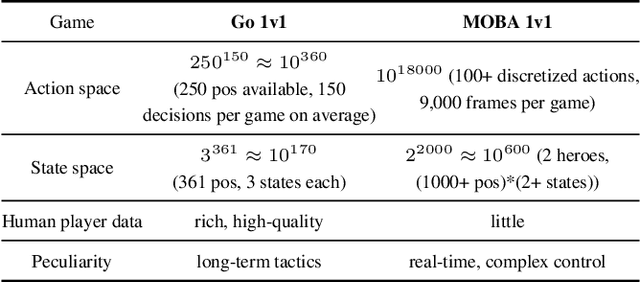
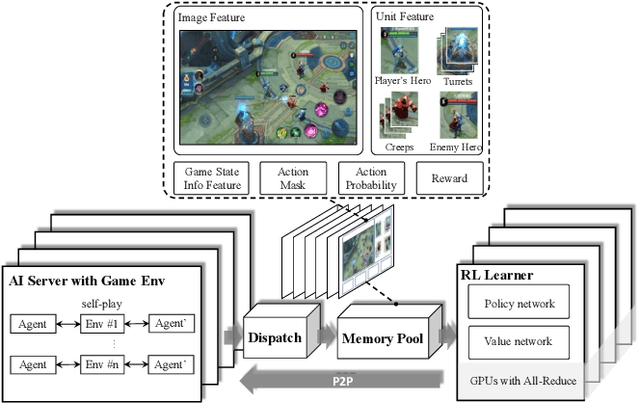
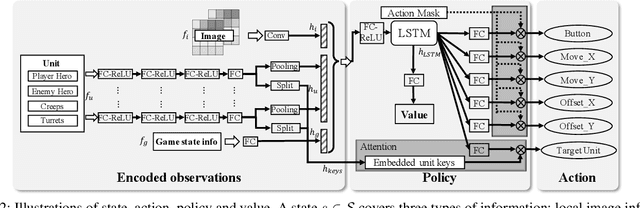
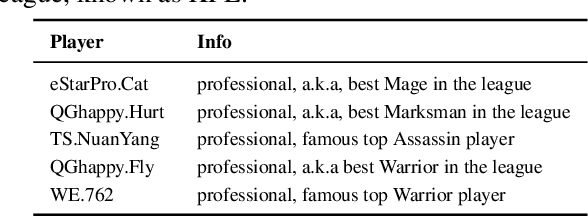
We study the reinforcement learning problem of complex action control in the Multi-player Online Battle Arena (MOBA) 1v1 games. This problem involves far more complicated state and action spaces than those of traditional 1v1 games, such as Go and Atari series, which makes it very difficult to search any policies with human-level performance. In this paper, we present a deep reinforcement learning framework to tackle this problem from the perspectives of both system and algorithm. Our system is of low coupling and high scalability, which enables efficient explorations at large scale. Our algorithm includes several novel strategies, including control dependency decoupling, action mask, target attention, and dual-clip PPO, with which our proposed actor-critic network can be effectively trained in our system. Tested on the MOBA game Honor of Kings, the trained AI agents can defeat top professional human players in full 1v1 games.