 Add to Chrome
 Add to Firefox
 Add to Edge
Entropy Polarity in Reinforcement Fine-Tuning: Direction, Asymmetry, and Control
May 14, 2026
Policy entropy has emerged as a fundamental measure for understanding and controlling exploration in reinforcement learning with verifiable rewards (RLVR) for LLMs. However, existing entropy-aware methods mainly regulate entropy through global objectives, while the token-level mechanism by which sampled policy updates reshape policy entropy remains underexplored. In this work, we develop a theoretical framework of entropy mechanics in RLVR. Our analysis yields a first-order approximation of the entropy change, giving rise to entropy polarity, a signed token-level quantity that predicts how much a sampled update expands or contracts entropy. This analysis further reveals a structural asymmetry: reinforcing frequent high-probability tokens triggers contraction tendencies, whereas expansive tendencies typically require lower-probability samples or stronger distributional correction. Empirically, we show that entropy polarity reliably predicts entropy changes, and that positive and negative polarity branches play complementary roles in preserving exploration while strengthening exploitation. Building on these insights, we propose Polarity-Aware Policy Optimization (PAPO), which preserves both polarity branches and implements entropy control through advantage reweighting. With the empirical entropy trajectory as an online phase signal, PAPO adaptively reallocates optimization pressure between entropy-expanding and entropy-contracting updates. Experiments on mathematical reasoning and agentic benchmarks show that PAPO consistently outperforms competitive baselines, while delivering superior training efficiency and substantial reward improvements.

Probing How Scalable Table Data Enhances General Long-Context Reasoning
Mar 23, 2026As real-world tasks grow increasingly complex, long-context reasoning has become a core capability for Large Language Models (LLMs). However, few studies explore which data types are effective for long-context reasoning and why. We find that structured table data with periodic structures shows strong potential for long-context reasoning. Motivated by this observation, we mathematically analyze tabular dependency structures using mutual information, revealing periodic non-vanishing dependencies in table data. Furthermore, we systematically analyze the capabilities of structured table data, conduct relevant scaling experiments, and validate its underlying mechanisms for enhancing long-context reasoning, yielding several meaningful insights. Leveraging these insights, we propose a simple yet scalable pipeline(TableLong) for synthesizing high-quality, diverse, and verifiable structured table data to boost long-context reasoning via RL. Extensive experimental results demonstrate that table data significantly enhances the long-context reasoning capability of LLMs across multiple long-context benchmarks (+8.24\% on average), and even improves performance on out-of-domain benchmarks (+8.06\% on average). We hope that our insights provide practical guidance for effective post-training data to enhance long-context reasoning in LLMs.
Step-GUI Technical Report
Dec 19, 2025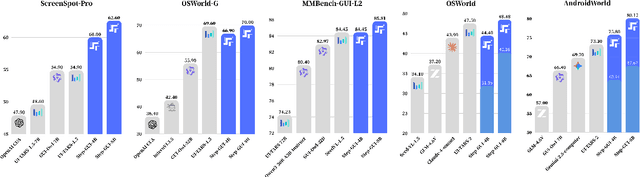
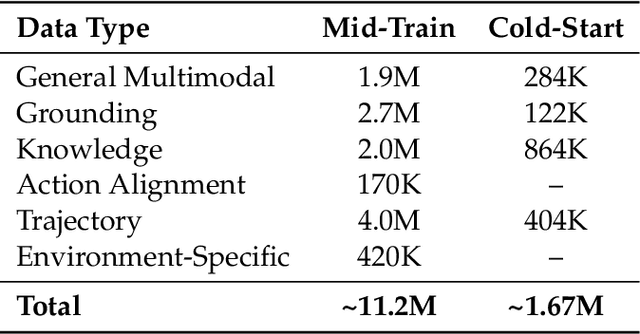
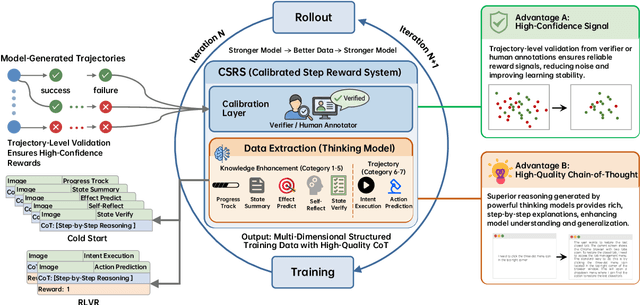
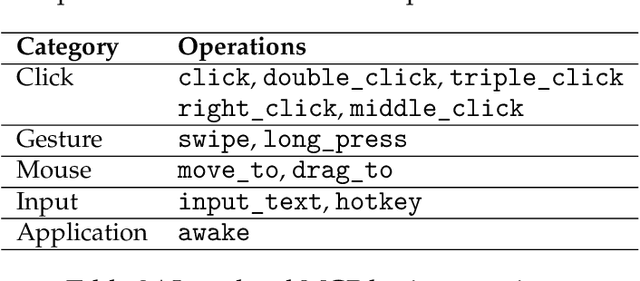
Recent advances in multimodal large language models unlock unprecedented opportunities for GUI automation. However, a fundamental challenge remains: how to efficiently acquire high-quality training data while maintaining annotation reliability? We introduce a self-evolving training pipeline powered by the Calibrated Step Reward System, which converts model-generated trajectories into reliable training signals through trajectory-level calibration, achieving >90% annotation accuracy with 10-100x lower cost. Leveraging this pipeline, we introduce Step-GUI, a family of models (4B/8B) that achieves state-of-the-art GUI performance (8B: 80.2% AndroidWorld, 48.5% OSWorld, 62.6% ScreenShot-Pro) while maintaining robust general capabilities. As GUI agent capabilities improve, practical deployment demands standardized interfaces across heterogeneous devices while protecting user privacy. To this end, we propose GUI-MCP, the first Model Context Protocol for GUI automation with hierarchical architecture that combines low-level atomic operations and high-level task delegation to local specialist models, enabling high-privacy execution where sensitive data stays on-device. Finally, to assess whether agents can handle authentic everyday usage, we introduce AndroidDaily, a benchmark grounded in real-world mobile usage patterns with 3146 static actions and 235 end-to-end tasks across high-frequency daily scenarios (8B: static 89.91%, end-to-end 52.50%). Our work advances the development of practical GUI agents and demonstrates strong potential for real-world deployment in everyday digital interactions.
HVOFusion: Incremental Mesh Reconstruction Using Hybrid Voxel Octree
Apr 27, 2024
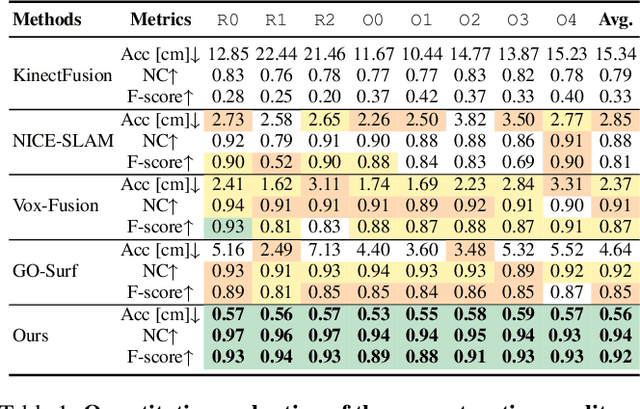
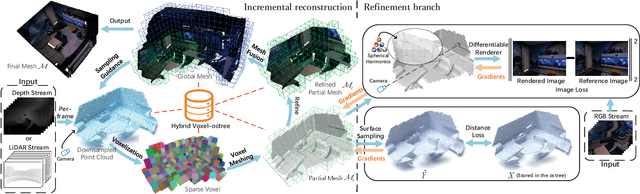
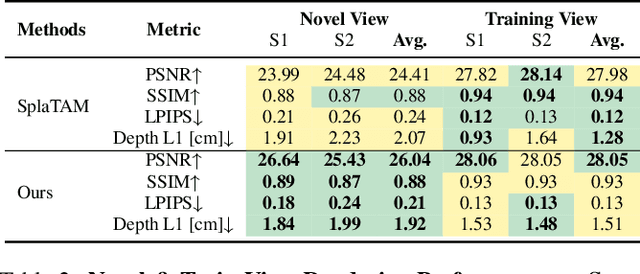
Incremental scene reconstruction is essential to the navigation in robotics. Most of the conventional methods typically make use of either TSDF (truncated signed distance functions) volume or neural networks to implicitly represent the surface. Due to the voxel representation or involving with time-consuming sampling, they have difficulty in balancing speed, memory storage, and surface quality. In this paper, we propose a novel hybrid voxel-octree approach to effectively fuse octree with voxel structures so that we can take advantage of both implicit surface and explicit triangular mesh representation. Such sparse structure preserves triangular faces in the leaf nodes and produces partial meshes sequentially for incremental reconstruction. This storage scheme allows us to naturally optimize the mesh in explicit 3D space to achieve higher surface quality. We iteratively deform the mesh towards the target and recovers vertex colors by optimizing a shading model. Experimental results on several datasets show that our proposed approach is capable of quickly and accurately reconstructing a scene with realistic colors.