 Add to Chrome
 Add to Firefox
 Add to Edge
Reinforcement Learning-Based Secure Near-field Directional Modulation Enhanced by Rotatable RIS
Mar 21, 2026
This paper investigates secure Directional Modulation (DM) design enhanced by a rotatable active Reconfigurable Intelligent Surface (RIS). In conventional RIS-assisted DM networks, the security performance gain is limited due to the multiplicative path loss introduced by the RIS reflection path. To address this challenge, a Secrecy Rate (SR) maximization problem is formulated, subject to constraints including the eavesdropper's Direction Of Arrival (DOA) estimation performance, transmit power, rotatable range, and maximum reflection amplitude of the RIS elements. To solve this non-convex optimization problem, three algorithms are proposed: a multi-stream null-space projection and leakage-based method, an enhanced leakage-based method, and an optimization scheme based on the Distributed Soft Actor-Critic with Three refinements (DSAC-T). Simulation results validate the effectiveness of the proposed algorithms. A performance trade-off is observed between eavesdropper's DOA estimation accuracy and the achievable SR. The security enhancement provided by the RIS is more significant in systems equipped with a small number of antennas. By optimizing the orientation of the RIS, a 52.6\% improvement in SR performance can be achieved.

Non-Registration Change Detection: A Novel Change Detection Task and Benchmark Dataset
May 15, 2025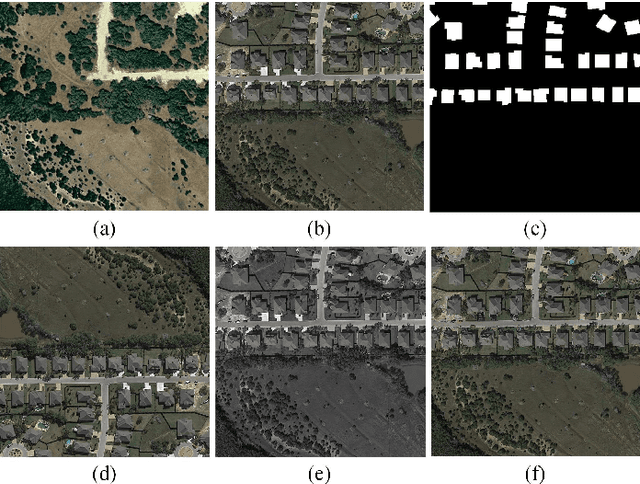
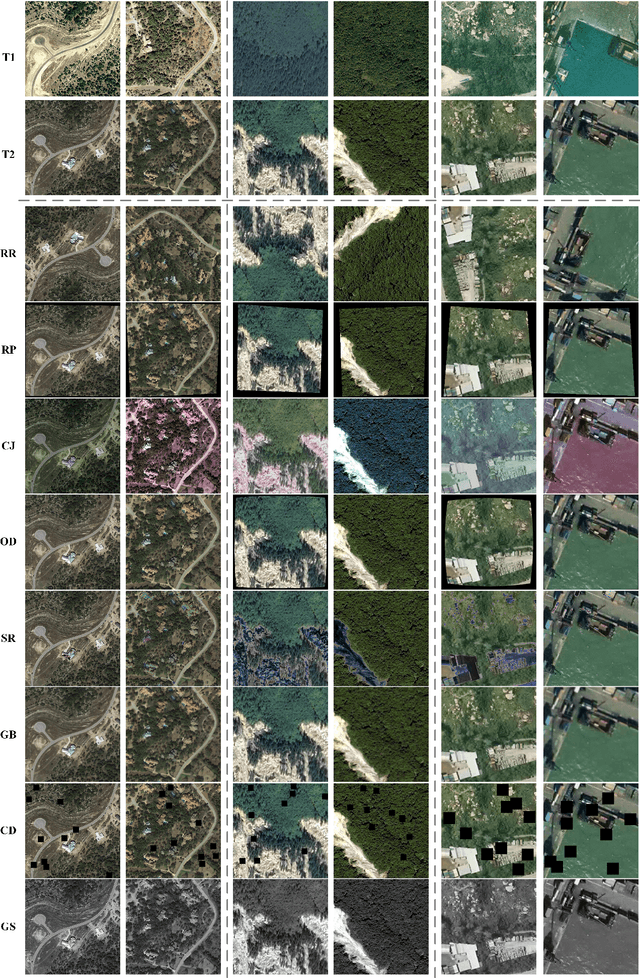

In this study, we propose a novel remote sensing change detection task, non-registration change detection, to address the increasing number of emergencies such as natural disasters, anthropogenic accidents, and military strikes. First, in light of the limited discourse on the issue of non-registration change detection, we systematically propose eight scenarios that could arise in the real world and potentially contribute to the occurrence of non-registration problems. Second, we develop distinct image transformation schemes tailored to various scenarios to convert the available registration change detection dataset into a non-registration version. Finally, we demonstrate that non-registration change detection can cause catastrophic damage to the state-of-the-art methods. Our code and dataset are available at https://github.com/ShanZard/NRCD.