 Add to Chrome
 Add to Firefox
 Add to Edge
DC-WAM: Dynamic-Centric Visual Supervision and Reasoning for World-Action Models
Jul 28, 2026
World-Action Models (WAMs) augment robot policies with future visual prediction, but it remains unclear what the visual modality should learn for control. While photorealistic future prediction provides dense supervision, it also incurs substantial computation and can allocate capacity to texture, illumination, and background variations that are only weakly related to action selection. Recent efficient WAM variants suggest that the main benefit of the video branch may not lie in the rendered future itself, but in the control-relevant visual representations induced during training. In this work, we revisit future video prediction from a dynamic-centric perspective and ask whether an existing RGB-based WAM can be redirected from appearance-dominated reconstruction toward interaction-induced visual dynamics without introducing additional modality-specific predictions or online inputs at deployment. We propose DC-WAM, a dynamic-centric WAM framework that redistributes supervision and computation in the RGB video branch. At the supervision level, DC-WAM combines temporal-difference flow matching with trajectory-guided weighting, emphasizing dense temporal changes and localized regions where the gripper, manipulated objects, and contact areas move. At the reasoning level, DynaRoute predicts token-wise dynamic relevance and converts it into an attention bias, guiding the model toward control-relevant future tokens. Experiments in simulation and on real-world manipulation tasks show that DC-WAM consistently improves policy performance, especially under out-of-distribution perturbations in lighting, object appearance, and background texture.

FGR: Frustum-Aware Geometric Reasoning for Weakly Supervised 3D Vehicle Detection
May 17, 2021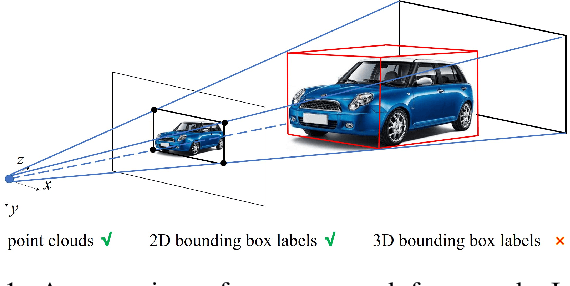
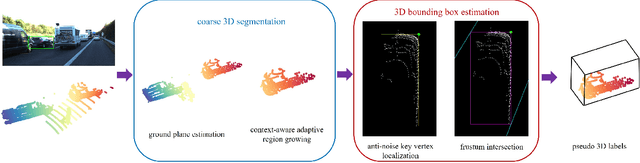
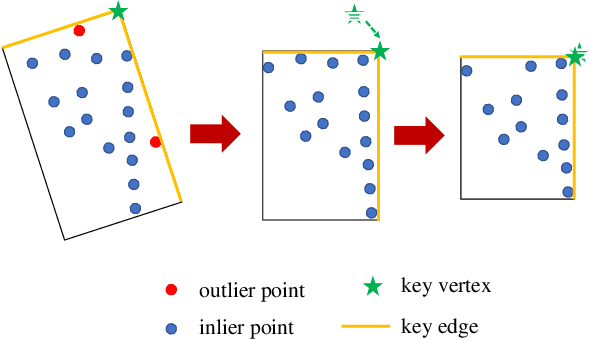
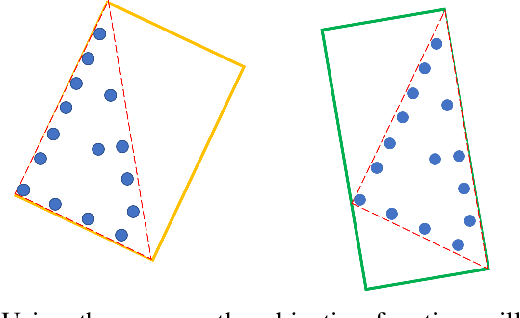
In this paper, we investigate the problem of weakly supervised 3D vehicle detection. Conventional methods for 3D object detection need vast amounts of manually labelled 3D data as supervision signals. However, annotating large datasets requires huge human efforts, especially for 3D area. To tackle this problem, we propose frustum-aware geometric reasoning (FGR) to detect vehicles in point clouds without any 3D annotations. Our method consists of two stages: coarse 3D segmentation and 3D bounding box estimation. For the first stage, a context-aware adaptive region growing algorithm is designed to segment objects based on 2D bounding boxes. Leveraging predicted segmentation masks, we develop an anti-noise approach to estimate 3D bounding boxes in the second stage. Finally 3D pseudo labels generated by our method are utilized to train a 3D detector. Independent of any 3D groundtruth, FGR reaches comparable performance with fully supervised methods on the KITTI dataset. The findings indicate that it is able to accurately detect objects in 3D space with only 2D bounding boxes and sparse point clouds.